To the Church in Thyatira (Revelation 2:18-29)
18 “And to the angel of the church in Thyatira write, ‘These things says the Son of God, who has eyes like a flame of fire, and His feet like fine brass: 19 “I know your works, love, service, faith, and your patience; and as for your works, the last are more than the first. 20 Nevertheless I have a few things against you, because you allow that woman Jezebel, who calls herself a prophetess, to teach and seduce My servants to commit sexual immorality and eat things sacrificed to idols. 21 And I gave her time to repent of her sexual immorality, and she did not repent. 22 Indeed I will cast her into a sickbed, and those who commit adultery with her into great tribulation, unless they repent of their deeds. 23 I will kill her children with death, and all the churches shall know that I am He who searches the minds and hearts. And I will give to each one of you according to your works. 24 “Now to you I say, and to the rest in Thyatira, as many as do not have this doctrine, who have not known the depths of Satan, as they say, I will put on you no other burden. 25 But hold fast what you have till I come. 26 And he who overcomes, and keeps My works until the end, to him I will give power over the nations—
27 ‘He shall rule them with a rod of iron;
They shall be dashed to pieces like the potter’s vessels’—
as I also have received from My Father; 28 and I will give him the morning star.
29 “He who has an ear, let him hear what the Spirit says to the churches.” ’
John’s Intentionally Inflammatory Remarks (Revelation 2:18)
In Revelation 2:18, Jesus addresses Thyatira using the title The Son of God. That title is very confrontational. Why? This prophecy has been sent in writing to a church planted in a Roman imperial setting. Domitian is Caesar at the time it was received. He ruled from 81-96 AD. Domitian regarded himself as God and directed people to refer to him as such1 (Domitian 13.2). The son of Domitian died as an infant in 83 AD. The emperor wanted his son to be regarded as the son of God. The coinage he created depicted his dead son as divine Caesar, enthroned over the world/globe and surrounded by seven stars. In Figure 1 the side of the coin depicting the dead son says Divus Caesar, Imperatoris Domitiani Filius. This, when translated, says The divine Caesar, son of Emperor Domitian.
John had already opened the book of Revelation with fighting words. How? In Revelation 1:16, the exiled apostle says that Jesus is the One who has the seven stars in His right hand. This directly contradicts the message that Domitian has sent through the denarius he had printed. And John, a dissident of the kingdom of Jesus rails against Domitian; indeed, he won’t let it rest. In Revelation 1:20, the seven stars are interpreted as the angels (messengers) of the seven churches. So John is not merely using pretty celestial imagery. He is saying , “The true Son of God is not Caesar’s dead son. The true Son of God and cosmic ruler is Jesus (cf Psalm 2:7). The seven stars belong to Him”(Revelation 1:16, 20; 2:1). Now, can you see why it is very confrontational?
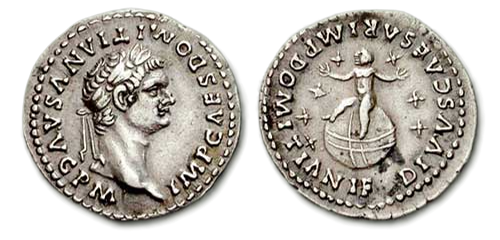
Figure 1: Silver Denarius (AD 82–83) of Domitian, featuring his deified infant son, who was born in AD 73 and died young, seated on a globe surrounded by seven stars.
Praise for a Persevering and Progressing Witness (Revelation 2:19)
When “love,” “faith,” and “endurance,” especially “endurance and faith,” are used in Revelation they usually indicate a witness that presses on or continues in the face of opposition – a persevering witness. This is clearly the case in light of the phrase “your last works are greater than the first.” The Lord and issuer of the prophecy hereby contrasts Thyatira with the church in Ephesus. While the first works of Ephesus were greater that the last (Revelation 2:5), the last works of Thyatira are greater than the first (Revelation 2:19). Their witness has waxed with time; they have made progress in presenting the truth about Christ to their surrounding community.
The Problem of Permitting a False Prophet (Revelation 2:20)
In Revelation 2:20, Jesus does not say, “Jezebel is teaching falsely.” He says: “You allow that woman Jezebel…” The sin before God is not only in the corrupting influence of the false prophetess. The sin is also and most egregiously in the leadership or congregation tolerating her influence. It looks a lot like the problem seen with Eli and his sons in the book of Samuel. Eli’s failure was not that he personally committed the same sins as his corrupt sons. His sin was that he failed to restrain evil that he had a responsibility to confront. The key passage is:
“For I have told him that I will judge his house forever for the iniquity which he knows, because his sons made themselves vile, and he did not restrain them.”
— 1 Samuel 3:13
The situation with Eli and his sons is similar to what is happening in Thyatira:
| Eli’s House | Thyatira |
|---|---|
| Eli knew about the evil | The church knew about Jezebel’s teaching |
| His sons abused spiritual position | Jezebel claimed prophetic authority |
| His sons led people into sexual immorality | Jezebel taught Christ’s servants to commit sexual immorality |
| Eli rebuked weakly but did not restrain | Thyatira “allowed” her |
| God judged not only the sinners, but the tolerated system | Jesus threatens judgment against Jezebel and those joined to her |
So then, how do we summarize this?
The issue in Thyatira was not only the presence of a Jezebel; it was the permission of a Jezebel. Jesus rebukes not only the false prophetess who corrupted the church, but the people in the church that allowed the corruption to continue. Thyatira had committed the sin of Eli: they knew the evil, saw the effect, and made no earnest attempt to stop it. That church did not have to teach Jezebel’s doctrine to become guilty of Jezebel’s deeds. The failure to restrain unrighteousness is passive facilitation and an active aiding and abetting in the actions of the false prophet.
The Grace of God for the Rebel (Revelation 2:21-22)
Jesus indicates that He has been patient. Although the particulars are not recorded in this message, He has already told that woman Jezebel to repent. The Son of God has also given her time to turn from sexual immorality and teaching idolatries. She did not use the time wisely. (In this light we see that the problem happening in Pergamum is fresh; there is no indicator that a period of time for repentance had passed.) Issues being addressed in Thyatira had already been confronted by Jesus and He had graciously given the leading sinner time to stop the particular sin of using tabernacles of meeting (1 Corinthians 6:19–20; John 14:16–17; Romans 8:9–11) for unholy activities. Time is up.
Unless they, that woman Jezebel and her children, repent of their deeds, she will be cast into a sickbed and her children (people that follow her teachings) will be killed. The rendering of the underlying Greek in 2:22 starts with Indeed. This is an unfortunate way of translating the underlying word. Upon reading this passage in the NKJV, I wondered whether the word underlying the Indeed of 2:22 was actually ἰδοὺ. Upon checking the Nestle-Aland United Bible Societies version, my suspicions were confirmed:
22ἰδοὺ βάλλω αὐτὴν εἰς κλίνην καὶ τοὺς μοιχεύοντας μετ̓ αὐτῆς εἰς θλῖψιν μεγάλην, ἐὰν μὴ μετανοήσωσιν ἐκ τῶν ἔργων αὐτῆς,
The rendering in the NKJV makes the statement of Jesus an interjection. As an interjection it does not direct the church in Thyatira to do anything. The indeed amounts to an introductory exclamation; words with emphasis and emotion. However, if it had been translated behold it is seen as an imperative and a summons to watch what He was going to do if the wrongdoers did not repent. (ESV, KJV, and NASB render the underlying word as behold, The NET Bible has Look!) It may seem like a small matter. However, without the imperative it is not a call to action or a command that alters the course of that church or the modern reader. Jesus calls them to behold what He will do if there are people in their fellowship that teach immorality and idolatry and will not repent. The Righteous Judge will protect the fellowship from their corrupting influence and make the evildoers and example.
Perception of Heart and Mind (Revelation 2:23)
The outcome of judgement will serve to prove to everyone that Jesus is a discerner of the intent of the heart and that He knows the hidden meditations of the mind. How will the sickbed, death, and tribulation prove this? Because, there will be a clear delineation between the devoted and disobedient, between the adherents of that woman Jezebel and her children and those that do not have this doctrine. In seeing the selective judgement and correlation with crimes against God, the churches shall know that Jesus is He who searches the minds and hearts.
This is the point of the attributes of Jesus that were highlighted in the introduction of the prophecy to Thyatira (Revelation 2:18): (1) the Son of God, (2) eyes like a flame of fire, (3) feet like fine brass. Earlier in John the readers are told that the Man in the vision (4) is clothed with a garment down to the feet and girded about the chest with a golden band (Revelation 1:13) and that He has a (5) voice as the sound of many waters. (See also Revelation 1:14). This man is the same as the one Daniel the prophet saw in his vision:
4 Now on the twenty-fourth day of the first month, as I was by the side of the great river, that is, the Tigris, 5 I lifted my eyes and looked, and behold, a certain man clothed in linen, whose waist was girded with gold of Uphaz! 6 His body was like beryl, his face like the appearance of lightning, his eyes like torches of fire, his arms and feet like burnished bronze in color, and the sound of his words like the voice of a multitude. 7 And I, Daniel, alone saw the vision, for the men who were with me did not see the vision; but a great terror fell upon them, so that they fled to hide themselves. (Daniel 10:4-7)
The reader that knows the Old Testament would not miss the similarity between the person that is being seen by John and the person of Daniel’s vision. The importance of the highlighted features now becomes apparent: the Son of God has eyes unusual eyes as an indicator of His ability to see what others cannot:
|
9 “The heart is deceitful above all things, |
7 But the LORD said to Samuel, “Do not look at his appearance or at his physical stature, because I have refused him. For the Lord does not see as man sees; for man looks at the outward appearance, but the Lord looks at the heart.” (1 Samuel 16:7) |
Jesus is now claiming to have the perception of the LORD (Yahweh). In fact, He is saying that He is the Lord. But what is the significance the title Son of God, the eyes, and the feet like fine brass for the church in Thyatira?
| Attribute | Meaning | Thyatira Application |
|---|---|---|
| Son of God | True divine authority | Caesar’s claims and Jezebel’s claims are false before Him. |
| Eyes like flame of fire | He sees inwardly and exposes hidden compromise. | He sees the heart, motives, tolerance, and secret sin. |
| Feet like fine brass | He stands in holy strength and executes judgment. | He will act against Jezebel, her followers, and tolerated corruption. |
The Righeteous in the Church, the Rest in Thyatira, and the Shared Reign (Revelation 2:24-27)
The Relevance for Others in Christ (Revelation 2:29)
Footnotes
1 Suetonius reports that Domitian issued a circular letter beginning, “Our Master and our God bids that this be done,” after which the custom arose of addressing him in that way (Domitian 13.2).
2 “Love,” “faith,” and “endurance” are associated elsewhere in the book with the notion of a persevering witness: cf. ἀγάπη (“love”) in 2:4; ὑπομονή and πίστις (“endurance, faith”) in 13:10; 14:12; πίστις (“faith”) in 2:13; ὑπομονή (“endurance”) in 1:19; 3:10 (although cf. the exception in 2:2–3); see likewise πίστος (“faith”) in 1:5; 2:10; 3:14; 17:14.
References
Beale, G. K. (1999). The book of Revelation: a commentary on the Greek text (p. 260). W.B. Eerdmans; Paternoster Press.
Suetonius. (1914). The lives of the Caesars (J. C. Rolfe, Trans.). Harvard University Press. Original work published ca. 121 CE. https://penelope.uchicago.edu/Thayer/E/Roman/Texts/Suetonius/12Caesars/Domitian*.html