Archives January 2026

The Masoretes

30 January 2026

This morning I was in my kitchen studying Hebrew. (Why was I studying Hebrew? It is my hope that one day proficiency in this language of the Bible will help in the handling of the text before God and His people.) In the course of my studies I came across a particularly academic ancient group of Jews – the Masoretes (Pratico & Van Pelt, 2019, p. 7). Here below I have shared my findings about the Masoretes and the relevance of their work to the modern study of the Bible.

Who were the Masoretes?
The Masoretes were Jewish scribes and scholars from the second half of the first millenium (roughly AD 600–1000). Their life’s work was to preserve, standardize, and transmit the Hebrew Bible with high precision. Because of them, the Hebrew text we read today is astonishingly consistent with manuscripts copied a thousand years ago.

What problem were the Masoretes solving?
Ancient Hebrew manuscripts were written only with consonants. As Jewish communities spread and Hebrew was spoken less fluently, the risk grew that:

  • pronunciation would drift,
  • meanings would blur,
  • and copying errors would multiply.

For the purpose of ensuring that the word of God could be read and studied for generations to come, the Masoretes stepped in. Their goal was to lock the text in place in both pronunciation and meaning.

What exactly did Masoretes do?


  1. Added Vowel Pointing – They created the system of dots and dashes (niqqud) that indicate vowels—so readers would know how to pronounce the text, not just what letters were there.
  2. Preserved Pronunciation and Chanting – They added cantillation marks (ṭeʿamim) to guide: (1) synagogue reading, (2) pauses, (3) emphasis, and (4) melodic chanting.
  3. Added Quality Control to the Scripture Copying Process – They developed the Masorah—detailed marginal notes that recorded: (1) how many times a word appears, (2) unusual spellings, (3) the middle letter of a book, (4) and warnings if a copyist made a deviation.

This was ancient quality control—before printing, before spell-check, before computers.

Where were the Masoretes located and what did they produce?

Three main centers of their activity emerged:

  • Tiberias (Galilee) — the most influential tradition
  • Babylonia
  • Jerusalem

The Tiberian tradition eventually became standard for Judaism and most modern Hebrew Bibles. That brings us to the matter of what the Masoretes produced. Here below are the two most famous Masoretic manuscripts:

  • Aleppo Codex (10th century) – long considered the most authoritative
  • Leningrad Codex (1008 AD) – the oldest complete Masoretic Bible and the base text for most modern editions

Why do the Masoretes Matter?

They matter for those of us that study the Bible. The Masoretic Text (MT) is the source text behind most Old Testament translations (including NKJV, ESV, NASB).

When the Dead Sea Scrolls were discovered (2nd century BC–1st century AD), scholars were stunned to find how closely they matched the Masoretic Text—confirming the Masoretes’ faithfulness.

In other words: they didn’t change Scripture—they guarded it.


The Masoretes were meticulous Jewish scholars who preserved the Hebrew Bible by fixing its spelling, pronunciation, and transmission with unmatched precision—so later generations would receive the text, not a guess.

References

Pratico, G. D., & Van Pelt, M. V. (2019). Basics of Biblical Hebrew grammar (3rd ed.). Zondervan Academic.


Give Attention to Reading

Paul tells the young pastor of the church in Ephesus to give attention to reading (1 Timothy 4:13). The apostle is clearly telling the pastor-teacher Timothy how to order the life of his church. From this letter we get that one element of a church that is operating well is regular reading of God’s word. The Greek verb translated give attention to (πρόσεχε) means to devote oneself to, to hold firmly toward, and to continually apply attention. (See Hebrews 7:13 where the word is used to describe the service of the priest at the altar.) “Timothy, lead the church into reading the word of God continually, with high intention, and focus. Do not be casual about this.” The Greek noun translated reading (ἀνάγνωσις) refers to public reading aloud in an assembled community. (See Acts 13:15, 2 Corinthians 3:14. Also see Nehemiah 8:8 and Jeremiah 36:6 of the Septuagint.). Paul is bringing a synagogue pattern into the church (cf. Luke 4:16).

Reading the word of God, when accompanied by prayer, is a powerful stimulant for spiritual growth (1 Peter 2:2). In some cases just reading the Scriptures, when the heart has been prepared by difficulty, has produced individual and national repentance and revival (2 Kings 22:8-13; 2 Kings 23:1-3; Nehemiah 8:1-12; Nehemiah 9:1-3; 2 Chronicles 17:7-9). Among the many things that you are trying to get done today, spend time prayerfully reading the word of God. If you are wanting to break away from patterns of sin, reinforce your resolve to stay the course in the face of opposition, or find the strength to step out into a new things that God is calling you to… prayerfully read His word as often as you can.

We have something to help you with reading the Bible – a plan. On this site there is a reading plan that you can you to help you develop the discipline of spending time with Jesus daily in the Scriptures.

In His grip by His grace,
Roderick L. Barnes, Sr.

Where Am I?

Possible path from Capernaum to Bethany.

Figure 1 – Possible route of Jesus from Capernaum

Luke 10:38–42 (NKJV)

38 Now it happened as they went that He entered a certain village; and a certain woman named Martha welcomed Him into her house. 39 And she had a sister called Mary, who also sat at Jesus’ feet and heard His word. 40 But Martha was distracted with much serving, and she approached Him and said, “Lord, do You not care that my sister has left me to serve alone? Therefore tell her to help me.” 41 And Jesus answered and said to her, “Martha, Martha, you are worried and troubled about many things. 42 But one thing is needed, and Mary has chosen that good part, which will not be taken away from her.”

The En Route Rabbi (Luke 10:38) – Jesus is on His way to Jerusalem; it is time for Him to be received up (Mark 16:19; Acts 1:2; Luke 9:51). The Son of Man is determined to be where the Father would have Him to be doing what the Father would have Him to do. In this case, the Father would have His only begotten Son to be in Jerusalem. Eventually He must be in the Holy City for the Passover as the Lamb (Matthew 10:28; Mark 10:45; John 1:29).

But there is some time between this record of Jesus’ travels with His disciples and the Passover. As they went to Jerusalem, Jesus entered a certain village  (Luke 10:38). Laying the gospels alongside one another, we can see that the village mentioned by Luke was Bethany (John 11:1). The figure at the right shows a possible route from where Jesus was in Capernaum to Bethany.

In this certain village there is a family that is dear to Jesus – two sisters and their brother (John 11:5). The oldest sibling in the Bethany household is most likely Martha. How did I get that? I base this supposition on her apparent role as head of the household. In first-century Jewish and Greco-Roman culture, hospitality was ordinarily administered by the household’s senior authority. The eldest unmarried woman or the person bearing primary domestic responsibility (Keener, 1993). The act of formally welcoming a guest — particularly a traveling rabbi — normally fell to the individual who managed or governed the household. Luke’s description of Martha as the one who welcomed Jesus into her house suggests that she is the household’s senior figure. She is also possibly the owner of the house.

An Israelite Indeed (Luke 10:39; Deuteronomy 18:15, 19) – The account from Luke introduces the sister of Martha after the welcome; her name is Mary. She is presented to the reader doing two things: (1) sat as Jesus’ feet and (2) heard his word (Luke 10:39). Luke wants us to see her alignment with the expectations of God. Luke says, “Look, at her reader, and see that Mary is enacting obedience by taking a subordinate and teachable posture.” Why do I think that is what Luke is saying? Consider the words of Moses in his blessing on the children of Israel before his death (Deuteronomy 33:3):

Yes, He loves the people;
All His saints are in Your hand;
They sit down at Your feet;
Everyone receives Your words.

Moses said there are two things that an Israelite can do to indicate submission to Yahweh. Mary is doing both. That is, Mary is doing both things that Moses described as expressions of covenant loyalty for an Israelite: (1) sitting down at the feet of God (Jesus) and (2) receiving His words. (And there are other places where being at the feet indicates discipleship, submission, and readiness to obey. See Judges 4:10; 2 Kings 4:27). Further, if we are going to truly appreciate Mary, we must give special attention to the fact that she is hearing Jesus words. Hearing, for the Jew means more than the passive activity of allowing oneself to hear spoken words. It combines intentional listening and willful obedience (Deuteronomy 6:4). At this point Luke 10:39 becomes an unavoidable and unmistakable declaration of Mary’s decision to receive Jesus as the promised Prophet. How did I get that? Moses told that people

15 “The Lord your God will raise up for you a Prophet like me from your midst, from your brethren. Him you shall hear,… 18 I  [Yahweh] will raise up for them a Prophet like you from among their brethren, and will put My words in His mouth, and He shall speak to them all that I command Him. (Deuteronomy 18:15, 18)

She is seated in surrender and listening intently to the words of the rabbi from Nazareth. Mary is telling Jesus and anyone who will look at her actions in the light of God’s covenant with His people, “I see the Prophet that Moses mentioned. And I am hearing him.” Mary is an Israelite indeed.

Sidelined by Service (Luke 10:40) – The activities of Martha, the woman who welcomed Jesus into her home, are brought back into focus. While Mary is sitting at Jesus’s feet hearing his word, the other sister is distracted with much serving. Distracted? That is the word that Luke uses to describe Martha. The underlying verb (περισπάω) indicates that her attention has been drawn, pulled, or dragged away from one thing to another thing. That is, Martha’s has been drawn, pulled, or dragged away from one thing (Jesus words) to another thing (serving Jesus).  It is worth noting that the word translated serving (διακονία) is normally translated ministry (Ephesians 4:12; Acts 6:4). Martha is drawn away by work for Jesus from the words of Jesus.

Picture the scene with me. Martha is going back and forth from the kitchen to the place where Jesus is teaching. She is bringing food items and drinks to the Master and His disciples. Meanwhile, Mary is absorbed in the teaching of Jesus. Every time Martha, in the midst of her ministry, passes by her sister with a tray of food she becomes more irritated. In quiet words she says as she goes back and forth, “Oh no, don’t get it up, Mary!” And later, “Excuse me, Mary! Didn’t mean to come between you and this message with my menial work of ministering alone to the Master and His disciples.” Finally, it becomes too much and she interrupts the Teacher’s teaching with her tirade:

Lord, do you not care that my sister has left me to serve alone? Therefore tell her to help me.

Martha reminds me of so many people caught up in their self-imposed ministry that find fault with everyone not doing what they are doing. The Holy Spirit can rest a little easier when these people are around; they will eagerly assist in convicting the world of the sin of not measuring up to their standard of righteousness and their requirements for service. (O reader, calm down. This is sarcasm and not heresy.)

Answered Prayer (Luke 10:41) – Jesus answers. And although it looks like just a response to her question and suggestion. It should be seen as an answer to prayer. After all, He is God (John 1:1-3; Hebrews 1:8-10). Saying her name twice is an indicator that there is great emotion associated with the address (Genesis 22:11; 1 Samuel 3:10; 2 Samuel 18:33; Luke 22:31; Matthew 7:21-23; Matthew 23:37; Acts 9:4). This way of speaking to someone is called the double vocative and it means that the speaker is talking with great concern, distress, urgency, or tenderness. Although she accuses him of not caring, Jesus answers her prayer out of His great concern.

Martha is worried and troubled about many things. In this case, her worry and troubles are ministry. Ministry matters. But it should not have been a worry to her. She is not doing it right.

Gentle Correction and Warning (Luke 10:42) – The one thing needed is to hear Him (Deuteronomy 18:15, 19). This is the commandment of God through His servant Moses and reiterated earlier in the transfiguration (Luke 9:33-35).

Moment Distraction Divine Correction
Luke 10:38-42 Martha’s service “Mary has chosen the good part”
Luke 9:33-35 Peter’s ministry plan “Hear Him!”

Jesus tells the woman absorbed in busyness that this is not the Father’s business. Mary has chosen the one thing that is needed – hearing His words. And Mary’s choice is being protected by the Lord Himself; it will not be taken away from her. Don’t try to come between me and Mary. Serving Jesus cannot come before being served by Jesus (John 15:1-5). We are not sent (Mark 3:14) until we have been with Him (Acts 1:8; Acts 4:13).

Action Items for Us

Take time to sit with Jesus today. How? There is a reading plan on this site; that is a good place to start. Prayerfully consider His words and what they mean for your life. Let ministry ideas and initiatives be shaped by time spent listening; hear Him (Luke 9:33-25; Deuteronomy 18:15).

Questions for Consideration

  1. Where am I? Would my position best be described as sitting at the feet of the Teacher receiving His word or busy around the Teacher with my many worries?
  2. What worry needs to wait until after I have spent time with Jesus? Properly seen those worries are weeds that would choke out the word, cares that cut me off from the best Christ has to offer, and second-rate pleasures that pull me away from the real joy of just being with Jesus (Matthew 13:22; Mark 4:18-19; Luke 8:14).

References

Keener, C. S. (1993). The IVP Bible background commentary: New Testament. InterVarsity Press.

Spiritual Disciplines – Fasting

Old Testament — Fasting Passages

Pentateuch

  • Exodus 34:28 – Moses fasts 40 days and nights on Sinai
  • Leviticus 16:29–31 – Day of Atonement: “afflict your souls” (understood as fasting)
  • Leviticus 23:27–32 – Day of Atonement reiterated
  • Numbers 9:6–13 – Indirect fasting context tied to mourning
  • Deuteronomy 9:9, 18 – Moses’ second 40-day fast

Historical Books

  • Judges 20:26 – Israel fasts during national crisis
  • 1 Samuel 1:7–8 – Hannah’s grief and fasting
  • 1 Samuel 7:6 – National repentance at Mizpah
  • 1 Samuel 14:24 – Saul’s ill-advised fast
  • 1 Samuel 31:13 – Mourning fast for Saul
  • 2 Samuel 1:12 – David fasts for Saul and Jonathan
  • 2 Samuel 3:35 – David’s mourning fast
  • 2 Samuel 12:16–23 – David fasts for his sick child
  • 1 Kings 21:9–12, 27 – Ahab’s (external) repentance through fasting
  • 2 Chronicles 20:3 – Jehoshaphat proclaims a fast
  • Ezra 8:21–23 – Ezra calls a fast for guidance and protection
  • Ezra 10:6 – Ezra fasts over Israel’s sin
  • Nehemiah 1:4 – Nehemiah fasts and prays
  • Nehemiah 9:1–3 – Corporate fasting and confession
  • Esther 4:3, 16 – National and personal fasting for deliverance
  • Esther 9:31 – Fasting remembered in Purim context

Poetic & Wisdom Books

  • Job 1:20–22 – Mourning actions (implicit fasting)
  • Psalm 35:13 – “I humbled my soul with fasting”
  • Psalm 69:10 – Fasting linked with reproach
  • Psalm 109:24 – Physical effects of fasting
  • Daniel 9:3 – Fasting with prayer and confession

Major Prophets

  • Isaiah 58:1–12 – True vs. false fasting (key theological text)
  • Jeremiah 14:10–12 – Fasting rejected without repentance
  • Daniel 1:8–16 – Partial fast (vegetables and water)
  • Daniel 10:2–3 – Daniel’s extended fast

Minor Prophets

  • Joel 1:14 – Call a sacred fast
  • Joel 2:12–15 – Fasting tied to repentance
  • Jonah 3:5–10 – Nineveh’s citywide fast
  • Zechariah 7:3–5 – Questioning the heart behind fasting
  • Zechariah 8:19 – Fasts transformed into joy

New Testament — Fasting Passages

Gospels

  • Matthew 4:1–2 – Jesus fasts 40 days
  • Matthew 6:16–18 – Instruction on how to fast
  • Matthew 9:14–15 – Fasting after the Bridegroom departs
  • Matthew 17:21 (textual variant) – Fasting and prayer
  • Mark 2:18–20 – Fasting in relation to Jesus’ presence
  • Mark 9:29 – Prayer (and fasting, textual variant)
  • Luke 2:37 – Anna fasts and prays
  • Luke 4:1–2 – Jesus’ wilderness fast
  • Luke 5:33–35 – When disciples will fast
  • Luke 18:12 – Pharisee’s boastful fasting

Acts

  • Acts 9:9 – Paul’s fast after conversion
  • Acts 10:30 – Cornelius fasting before divine guidance
  • Acts 13:2–3 – Church fasting before mission commissioning
  • Acts 14:23 – Fasting when appointing elders
  • Acts 27:9 – Day of Atonement (“the Fast”) referenced

Epistles

  • 1 Corinthians 7:5 – Temporary fasting for prayer
  • 2 Corinthians 6:5 – Fasting as ministry discipline
  • 2 Corinthians 11:27 – Frequent fastings

Theological Summary

Across Scripture, fasting is associated with:

  • Repentance (Joel 2; Jonah 3)
  • Guidance & decision-making (Ezra 8; Acts 13)
  • Mourning & humility (2 Sam 12; Ps 35)
  • Spiritual warfare (Matt 4; Acts 14)
  • Preparation for divine encounter (Exod 34; Dan 10)

Importantly, Isaiah 58 and Matthew 6 anchor fasting not as ritual performance but as heart-directed humility before God.

The Word of the King and Forgiveness

Passage: Matthew 9:1-8; Mark 2:1-12; Luke 5:17-26

Jesus Makes the Most of His Moments (Matthew 9:1; Mark 2:1-2) — Jesus has recently been asked to leave a place where He has delivered two men from demon-possession (Matthew 8:33-34). What does He do when asked to leave? He leaves. That is, Jesus departs from the country of the Gergesenes, gets into a boat, crosses the sea of Galilee, and came to His own city (καὶ ἦλθεν εἰς τὴν ἰδίαν πόλιν).
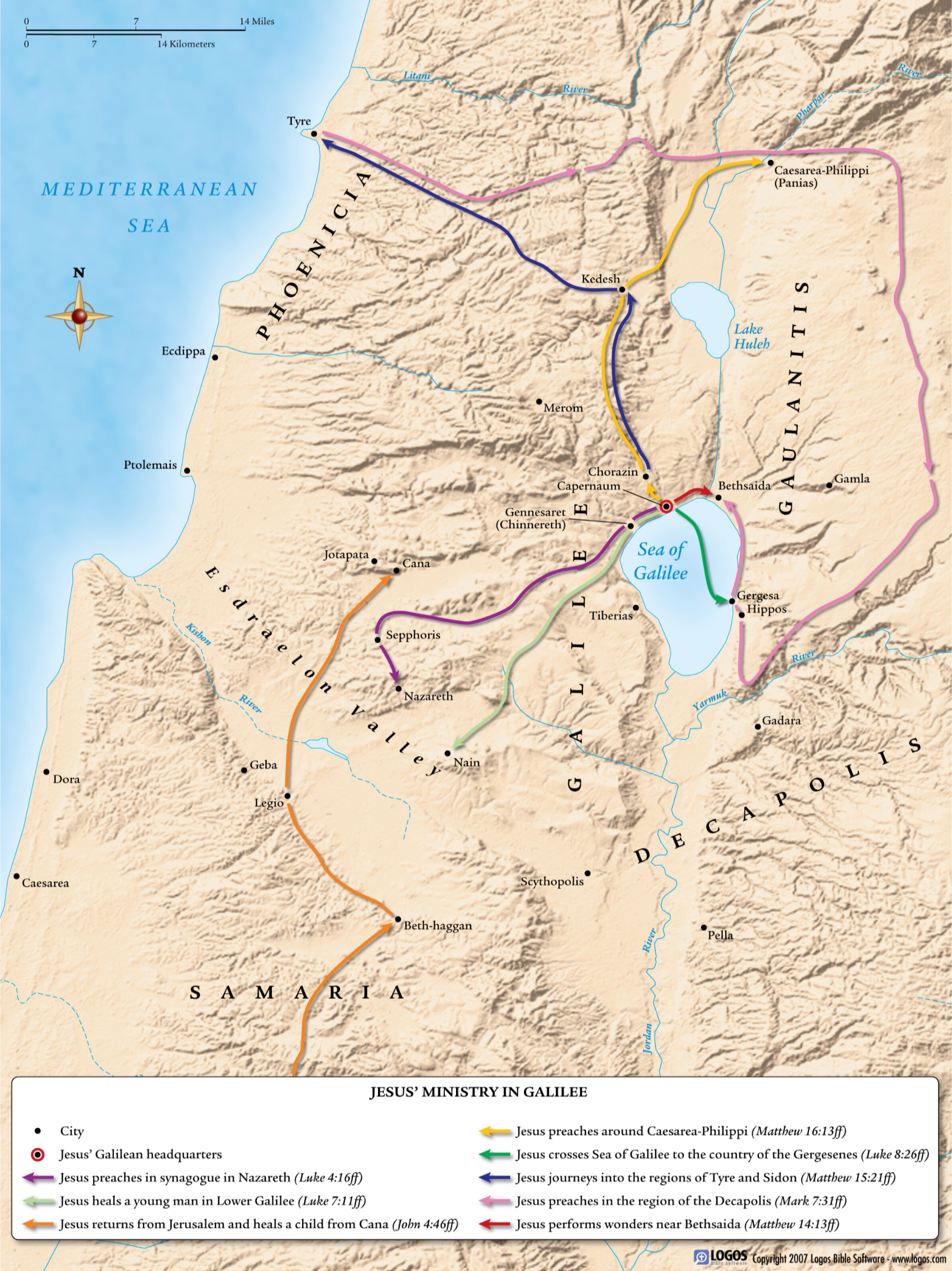
 

Figure 1 — Jesus crosses the Sea of Galilee to leave Gergesa and come home to Capernaum.


His own city is no longer Nazareth; Jesus has been ousted from there (Luke 4:16, 28-30) and now resides in Capernaum (Mark 2:1). Outside of Nazareth Jesus is regarded favorably and news of His presence draws a crowd. In the crowd are Pharisees and teachers of the law; they have come from the regions of Galilee, Judea, and the city of Jerusalem (Luke 5:17). And the moment is seized; He preached the word to them (Mark 2:2). His time is short and He does not want to waste a second of it. His agency is used to help people; His urgency leads him to use His moments for the long run and with a view toward eternity. Jesus is an opportunist; He uses the gathering to advance the understanding of the people that have come to Him in matters of the kingdom of God and living effectively.


Question: Am I Jesus to the people that come to me? That is, am I using my free will and my limited time to make the most of my moments with others? Do I share what I can about the kingdom of God and spiritual truths so that people can live effectively in the service of the Lord and others?


Bringing People to Jesus (Matthew 9:2) — Matthew says, “Look at this, reader! They brought to Jesus a paralytic lying on a bed.” The behold (ἰδού) calls the reader to look at what is being said with the intent of looking seriously and how it matters in two things: (1) the argument of the writer and (2) the application of what is being said to the reader’s life. In Matthew’s attempt to convince the reader that Jesus is the long-awaited Messiah-King, he draws attention to the fact that some people had already come to the conclusion that with Jesus there is hope for people otherwise considered hopeless. Four men have come to regard their paralyzed friend as having a chance of being whole. We learn from Mark that they are not daunted by the fact that they cannot get through the crowd. These uncouth men of faith will not be denied; they tear a whole in the tiling of the roof of the home and let their paralyzed man down through the hole (Mark 2:3-4; Luke 5:18-19).


Questions: Do I regard my friends as having real hope in Christ? What am I bringing them to? How determined am I to bring them to Jesus? Will I stop trying if it becomes inconvenient?


Jesus, seeing their faith, is moved to deal with the problems of the paralytic. Here is where things get interesting. The healing they are seeking is temporary. Where there is genuine faith Jesus is more concerned with the more serious matter of unforgiven sin. Paralysis as a problem pales compared to the lack of forgiveness. The wages of sin is death (Romans 3:23). Our value system is often most concerned with the inconvenience of ill health, the setback of sickness, or the pain caused by disease in our body or relationships. But in the economy of God my biggest problem is not failing health but my need for forgiveness and reconciliation to Himself. Failing health is an inevitable consequence of being human in this world; if it is fixed by Jesus… it is going to fail again. But forgiveness and favor with God benefits me now and for all eternity. Jesus deals with the biggest problem that man faces – sin (Matthew 1:21). Jesus says that the paralytic can be of good cheer or encouraged because his sins are forgiven him.


The Authority of Jesus (Matthew 9:3; Mark 2:7; Luke 5:21) — Matthew calls to the reader’s attention the inner dialogue of the scribes. And he does it again with behold (ἰδού). (It is unfortunate that the NKJV translates this as at once. ESV and KJV are consistent in this regard and render the underlying text as behold. The NET Bible and NLT do not translate it at all.) By using this word Matthew says that his argument about who Jesus is advanced; it is seen why this helps his argument when we put verse 3 with 4. I believe that the passage should read like this:


3 And behold some of the scribes said within themselves, “This Man blasphemes!”


What did they say to themselves? They said within themselves, “This Man blasphemes!” Matthew would have me to know that the statement of Jesus drew a very critical reaction from religious experts. Why?


Sin is first and foremost against God. Even when it immediately hurts others, it is a work against the God who made the others for Himself. David says as much when he summarily describes his sin against Uriah the Hittite, Bathsheba the wife of Uriah, and the people that he had conscripted to help with his trespass (2 Samuel 12:13).


4 Against You, You only, have I sinned,

And done this evil in Your sight—

That You may be found just when You speak,

And blameless when You judge. (Psalm 51:4)


It stands to reason that forgiveness of sin against God can only be granted by God. That is, it is not logical that someone other than God Himself could grant me forgiveness for the ways that I have wronged God Himself. With this in mind, Jesus’ statement is outrageous. If He is merely a man this is beyond arrogance. It is blasphemy — a bold disrespect and disregard for who God is and the difference between the domain of man and the domain of God!


6 And some of the scribes were sitting there and reasoning in their hearts, 7 “Why does this Man speak blasphemies like this? Who can forgive sins but God alone?” (Mark 2:6-7)


They are not wrong theologically? That is, their rhetorical question is the right one; it points up the fact that a mere man cannot pardon a person for sin against God. The problem is in their failure to realize who Jesus is. He is going to deal with that now.


The Powers of Perception of the King (Matthew 9:4; Psalm 139:2; 1 Samuel 16:7; John 2:23-25) — In their hearts they reacted immediately. In their hearts they reacted critically. In their hearts they started with the assumption that Jesus did not have the authority to forgive sin. This was an outworking of their prior unwillingness to accept the testimony and ministry of John (Matthew 21:23-25). Their failure to receive the full import of what had been said by John (John 1:15,29-34) was now manifest in a way-too-low view of Jesus.


But let us think for a moment on the statement itself. First, we are looking at a bold statement. Second, let us note that it is in the passive voice: your sins are forgiven you. Third, we should take into account that this statement was made by a Jew to other Jews; that means it was said in Hebrew. Putting these three things together


statement: your sins are forgiven you + passive voice + Hebrew


We have a statement that was familiar to the scribes. Fruchtenbaum helps us here:


The Hebrew form of the passive, your sins are forgiven you, is used only in one section of the entire Hebrew Bible: in Leviticus 4-6. The context of these chapters is atonement, as they detail the blood sacrifices necessary for the forgiveness of sins. The statement of forgiveness in a passive voice followed the sacrifice (e.g., Lev. 4:20, 26, 31, 35; 5:10, 13, 16, 18; 6:7). …[T]he Hebrew word for “forgiveness,” salach (סָלַח), is used of God. The passive means that God is doing the forgiving. Being Pharisees, these people knew both the Torah and Hebrew, and they caught the connection He was making. He was claiming the authority that God asserted for Himself in Leviticus 4-6: that by means of blood atonement, God had forgiven their sins. … Yeshua was, therefore, speaking as if He were God. (Fruchtenbaum, 2017, p. 186)


Jesus begins having conversation with His critics about the meditations of their hearts (John 2:23-25; Psalm 19:14).


14 Let the words of my mouth and the meditation of my heart

Be acceptable in Your sight,

O Lord, my strength and my Redeemer. (Psalm 19:14)


The Pharisees started with the assumption that Jesus was sinning. Their theology was correct. Their problem, though, was a small view of Messiah and failure to accept the testimony of John the Baptist (Matthew 21:23-25).


Question: Are there truths or testimonies that I have refused to receive that are making it hard for me to accept what God is showing me?


The Proof of the King (Matthew 9:5-6) — Jesus knows their thoughts and addresses their concern. He does this with an argument a fortiori. That is, he proves His claim that the sins are forgiven by demonstrating something that can be seen. We are apt to separate the say from the fulfillment; that was not the case with the people in this narrative (Ezekiel 12:28; Numbers 23:19). To them the saying and the fulfillment are one and the same. Thus, the easier thing to say, because it is does not require immediate validation, is “Your sins are forgiven you?” So then, Jesus takes on the harder thing as proof that the easier thing has been accomplished. It would have been to them immediate proof that the easier thing to say was true and that the man’s sins were forgiven.


All of this was done that they would “know that the Son of Man has power on earth to forgive sins.” By using the phrase Son of Man the Rabbi from Nazareth is claiming to be the figure of Daniel’s prophecy:


13 “I was watching in the night visions,

And behold, One like the Son of Man,

Coming with the clouds of heaven!

He came to the Ancient of Days,

And they brought Him near before Him.

14 Then to Him was given dominion and glory and a kingdom,

That all peoples, nations, and languages should serve Him.

His dominion is an everlasting dominion,

Which shall not pass away,

And His kingdom the one

Which shall not be destroyed.

Daniel 7:13-14, approximately 550 BC


This is not an emphasis of His humanity but His deity; the Son of Man in Daniel’s vision receives worship (Daniel 7:14). When Jesus refers to Himself using this phrase He is claiming to be the enigmatic character that Daniel saw receiving glory, a kingdom, and worship with the approval of the Ancient of Days. Jesus then gives the command to the man to “Arise, take up your bed, and go to your house?”


Who is Going to Fix This Roof (Matthew 9:7) — The man did just as Jesus directed him. He departed to his own house glorifying God (Luke 5:25). We can imagine the looks on the faces of the people as the man who came in through a whole in the roof with the aid of four men left through the door carrying his own bed. But let us not miss the meaning of the walking man. His walking was working to advance the more important point – his sins were forgiven.


When the Walk Wins People Over (Matthew 9:8) — Jesus had proven His claim. The paralytic was gone; in his place was a man that could carry his own bed. His walk was winning people over. Thus, they now know that the Son of Man has power on earth to forgive sins. This was the conclusion of the multitudes: God had given such power to men.


Question: Do I accept that Jesus has the authority to forgive me and free me from the power of indwelling sin (John 8:36)? Do I regard myself as forgiven of the sins of the past? Or am I still trying to work off my debt? Is my perspective that I am free from the power of sin, or am I living in a stalemate with behaviors and ways of thinking that are contrary to the will of God?


Our walk matters more than we are willing to accept. In our walk we become witnesses to the work of God in our lives. The change in us is a sign that says He saves. (In our walk is evidence that either confirms or denies my convictions about Christ.) A changed walk confirms that I am convinced that I am free from the power of indwelling sin and called to live for Him that died for me. A lack of change indicates either that I am not convinced or that I am not converted. After receiving Christ I will not be sinless; but I should begin sinning less as I learn to walk in my (1) healing, (2) freedom, and (3) what it means to follow Jesus.


Calling the Outcast (Matthew 9:9) — Jesus has just finished fixing a man both physically and spiritually. With a word the Son of Man (Matthew 9:6; Daniel 7:13-14) restored a paralytic to wholeness. So well was the man that he walked carrying his bed out of a room that he moments ago had to be lowered into. More importantly, Jesus set the man right with God (Matthew 9:2); that is why He came (Matthew 1:21). It was outlandish and outstanding at the same time. Outlandish that a Man would have the audacity to tell someone that his sins were forgiven. Outstanding that He could actually do it (Matthew 9:6,8). The rabble rousing Rabbi passed on from there (Matthew 9:9). As He does He passes the tax office or place of the toll (τὸ τελώνιον) and notices a man named Matthew sitting there.
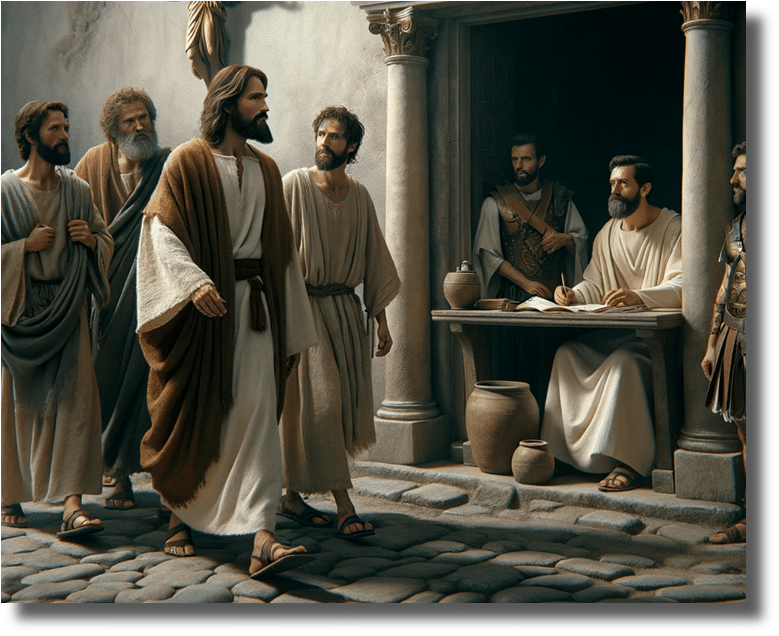
 

Figure 1 – Jesus passing the tax office and noticing Levi.


Matthew also goes by the name Levi (Mark 2:14; Luke 5:27). We commonly refer to him as a publican (from the Latin publicanus) or tax collector. However, there are two types of publicans. One collects taxes on income. The other collects taxes or tolls on people traveling through ports or official travel routs. Matthew is a tax collector of the sort that collects money on boats going across the lake outside of Hero’s territory or from people going from Damascus to the coast (Robertson, 1933).


Although Matthew is a Jew, he is hated by Jewish society because he is regarded as a sellout and collaborator with the nation’s oppressors — the Romans. Tax collectors had military support in the collection of taxes from the Jews; they had the help of soldiers in making a great living from their Jewish brethren. Everything that a tax collector could collect above what was due was his own.


Tax collectors earned a profit by demanding a higher tax from the people than they had prepaid to the Roman government. This system led to widespread greed and corruption. The tax-collecting profession was saturated with unscrupulous people who overtaxed others to maximize their personal gain. According to Adams, “The toll-collectors were in a profession that was open to dishonesty and oppression of their neighbor” (Adams, The Sinner in Luke). Since the Jews considered themselves victims of Roman oppression, Jewish tax collectors who overtaxed their fellow countrymen were especially despised. Jews viewed such favor for Rome as betrayal and equal to treason against God. Rabbinic sources consistently align Jewish tax collectors with robbers. (Miller, 2016)


The profession, although held in low regard by religious leadership, was not inherently wrong. When tax collectors came to John the Baptist for baptism, the voice in the wilderness did not direct them to abandon their work. They were told to do their work without the wickedness of getting more than what was right:


12 Then tax collectors also came to be baptized, and said to him, “Teacher, what shall we do?” 13 And he said to them, “Collect no more than what is appointed for you.” (Luke 3:12-13)


Notice that Jesus’ call on Matthew was not complicated (Matthew 4:19; 8:22; 19:21; John 1:43; 12:26; 21:22). There is no ceremony and no formalities. Lacking in the call of Jesus, when compared to modern methods of getting people into ministry today, was sophistication or contracts. We have often added too much. The call to follow Jesus was just that – a call to follow Jesus. Faith is all that was required. What kind of faith? The kind that believes that everything is going to be okay when leaving everything behind (Luke 5:28). That kind of faith, beloved.


Let us marvel at Matthew’s response; it is remarkable. Although he was regarded as a wretched human being, given the opportunity, he was ready to leave everything behind to be with Jesus (Luke 5:28).


The call was simple. It was not to a formal membership class, not to a denomination, or an ascetic lifestyle. It was a call by the Savior to Himself. Jesus summoned a sinner that everyone loved to hate into fellowship with Himself. The decision to follow Jesus is first, foremost, and forever a personal call to just Jesus.


𝕋𝕙𝕣𝕖𝕖 𝕋𝕙𝕚𝕟𝕘𝕤 ℕ𝕖𝕖𝕕𝕖𝕕 𝕥𝕠 𝔹𝕖𝕔𝕠𝕞𝕖 𝕄𝕠𝕣𝕖 𝔼𝕗𝕗𝕖𝕔𝕥𝕚𝕧𝕖 𝕚𝕟 𝔻𝕚𝕤𝕔𝕚𝕡𝕝𝕖𝕤𝕙𝕚𝕡

① Sanctification of the Caller (John 17:9) – The person calling has to be willing to let things go in order to become an effective mentor. In addition to a commitment to a consecrated life (holiness), there must be a willingness to eliminate people and things that distract us from discipleship. The person that is going to call others to Christ, to be maximally effective, must cut away everything that hinders in the work of helping others to walk with Jesus.

② Simplification of the Call (Matthew 4:19; 8:22; 19:21; John 1:43; 12:26; 21:19, 22; Luke 9:59) – The call cannot be complicated. It is not a call to circumcision, a certain style of worship, joining an organization, or accepting a title. Effective discipleship occurs when we focus on calling people to follow Jesus. That is all! When we add other qualifications, although well-meaning, we weigh people down with traditions and man-made religion.

③ Nurture and Nourish the Called (John 21:17; 1 Peter 2:2) – The person being called may have the faith to follow. But they will certainly lack almost everything else. Effective discipleship happens when we are longsuffering like Jesus in nurturing followers into maturity. It is painstaking work that involves discouraging setbacks, conflict, and the need to persevere through big problems. It is spiritual work. Feed them the word and help them see how it relates to the relationship with Jesus.


The Consequence of Calling the Outcast (Matthew 9:10) — In humility Matthew does not make mention of who owned the house. We have to look at parallel accounts to discover that the dwelling belongs to the tax collector (Mark 2:15; Luke 5:29) and that the feast, a party that included his friends, was thrown by Matthew for Jesus. In his recounting of the event for the reader Matthew calls to the readers attention the kind of people that came and sat down with [Jesus] and His disciples — many tax collectors and sinners (καὶ ἰδοὺ πολλοὶ τελῶναι καὶ ἁμαρτωλοὶ). Look at this, says Matthew. It was shocking to see someone considered to be righteous and a teacher sitting with people hated and not allowed into normal fellowship. They were not at the door but they were sitting down with Jesus and His disciples.


The consequence of calling Matthew matters to us as we attempt to make disciples today. In this particular event is a timeless principle and strategy for reaching those who need Christ most: those who would be good fishers of men must see that the well-loved outcast is a lure for lost men of the same kind.


This was the plan all along: use somebody to reach others.


https://www.youtube.com/watch?v=MRgFeZa_I48


The Reaction of the Religious (Matthew 9:11) — Notice the reaction of religious people. They are unable to understand Jesus. He is outside. Of what? Outside of their model of unhealthy ministry, their puritanical focus on rules, and their condescending attitude toward people who need help. They are looking at what Jesus is doing but cannot make sense of it. Why?


Pharisees don’t see. They don’t see the value of people that have lost their way. They don’t grieve over the great tragedy of a soul that rejects God’s right to reign. Pharisees, both then and now, are beset by a blindness that makes that unable to understand the undertaking of showing mercy and kindness in the mission of promoting reconciliation to God.

The Pharisee in you and me is all too ready to be rid of what we don’t like regardless of what God wants.

Answering the Critics (Matthew 9:12) — They put the question to the disciples. Jesus heard ( δὲ ἀκούσας) and put the answer to the critics themselves. He is not running from the question or using intermediaries to answer His critics; Jesus is not afraid of them. He is saying more than one thing with this statement. First, those who are well are the spiritually healthy. Those who are well are those who are walking with God and enjoying fellowship with Him and His people. Jesus did not come to merely high five the holy folk, recline with the righteous, and sing songs with the sanctified.

Jesus indicates His intentions by initiating fellowship with someone that everyone would say is not worth saving. I am here for him… and them!

The Teacher Gives Homework (Matthew 9:13) — What Jesus says next is a rebuke. It is an assignment to learn something about God that they should have already known. He says you are confused about my conduct because you don’t know my concerns, my character, and my call. You cannot make sense of me because you do not know my Father; I look just like Him (John 14:8-9).

  • Knowing Me is More Important than Religious Activity (Hosea 6:6)
  • Saving Them is the Heart of God (Ezekiel 33:11)

References

Fruchtenbaum, Arnold G. (2017). Yeshua: The Life of Messiah from a Messianic Jewish Perspective, Vol. 2. Ariel Ministries.

Miller, J. E. (2016). Tax Collector. In J. D. Barry, D. Bomar, D. R. Brown, R. Klippenstein, D. Mangum, C. Sinclair Wolcott, L. Wentz, E. Ritzema, & W. Widder (Eds.), The Lexham Bible Dictionary. Lexham Press.

Robertson, A. T. (1933). Word Pictures in the New Testament (Mt 9:9). Broadman Press.

Missional Living – To Boldly Go! Part 5 (Acts 13:4-12)

Missions Business Intelligence

U.S. Missionary Sending Overview

  • Missionary Count: U.S. churches support approximately 127,000 of the estimated 430,000 full-time missionaries serving worldwide. Union Baptist Association
  • Global Leadership: The United States remains the leading sender of missionaries globally, followed by Brazil, South Korea, the Philippines, and Nigeria. Christianity Today

Missionary Focus and Distribution

  • Reached vs. Unreached: About 97% of missionaries serve in regions where the gospel is already accessible, while only 3% focus on unreached people groups. Christianity Today
  • Unreached Engagement: Only 1 in every 41,707 Protestant Christians becomes a missionary to unreached populations. The Traveling Team

Financial Commitment to Missions

  • Giving Patterns: For every $100,000 earned by Christians, an average of $107 is donated to world missions. Of this, only about 1% supports efforts among the 3.1 billion people in unreached groups. missionaryportal.webflow.io

Missionary Tenure and Challenges

  • Service Duration: Nearly 50% of missionaries serve for 5 years or less. Common reasons for early departure include financial constraints, lack of support, and burnout. Nations Outreach+1The Salt Lake Tribune+1

Domestic Mission Field

  • Church Reproduction: In the U.S., less than 5% of churches are actively reproducing or planting new congregations. ABWE

Trends and Observations

  • Global Shift: The center of Christianity is moving towards the Global South, with countries like Brazil, South Korea, and Nigeria becoming significant missionary-sending nations. THE OTHER CHEEK+2Union Baptist Association+2Christianity Today+2
  • Missionary Allocation: Despite the vast number of unreached people groups, a disproportionate number of missionaries are sent to already evangelized regions.

Introduction
Barnabas and Saul have been called and sent out by the Holy Spirit (Acts 13:2,4) from the church in Antioch for missionary work. In their company is the young man John Mark. He is unprepared for the changes that will take place in their team and the challenges they face; but taking him along is a key part of keeping the command to make disciples (Matthew 28:18-20). The trio will boldly go where men have gone before; they are different from earlier people that went out because they go with a particular sending out of a local church by the Holy Spirit. Earlier in Luke’s account it was the scattering of Jewish believers after the persecution that arose over Stephen (Acts 8:1,4) that saw Jesus followers going to Cyprus preaching the word (Acts 11:19).

Figure 1: The First Missionary Journey of Paul and Barnabas

As they step out into this new work they have a curious practice of preaching the word of God in the synagogues before going to the Gentiles (Acts 13:5). Wait. Wasn’t Saul called to reach the Gentiles? (Acts 9:11-16) Isn’t this preaching to the choir? Not really. Although the Jews had been prepared for the coming of Messiah by the tutelage of the Law (Galatians 3:23-24), many do not realize that He has come in the person of Jesus Christ of Nazareth. By going to the Jews first Barnabas and Saul (Romans 1:16; 2:9; 2:10) are making the most of two opportunities: (i) a season of harvest and (ii) securing help.

The genuine or true prophet speaks on God’s behalf.

  • Deuteronomy 18:18-19
  • Jeremiah 1:9
  • Amos 3:7
  • 2 Peter 1:20-21

The false prophet claims to speak for God but does not.

  • Deuteronomy 18:20-22
  • Jeremiah 14:14; 23:16
  • Ezekiel 13:3
  • Matthew 7:15-16
  • 2 Peter 2:1-3; 2 Samuel 12:14
  • 1 John 4:1-3; Titus 1:16

The Lord Jesus Christ does not begin his ministry with large revivals. In relative obscurity he recruits a few Jewish men to just be with him (Mark 3:14). They were ready to be recruited because of the preparation by John the Baptist. (It had always been God’s desire to use the Jews to reach and change the world. See Genesis 12:1-3.) Going to the synagogues first, then, was in keeping with an ancient plan to get the help of a people specially prepared to promote the gospel.
Are you a missionary? Are you an evangelist? Do not miss the timeless principles presented in the examples of Barnabas and Saul.
Missions Assessment

  • First, always look for people that can become helps with the harvest (Matthew 9:37). That might mean visiting with local churches in the region you are reaching before trying enter a culture with the gospel. Key Question: Who has God been preparing to participate in this work?
  • Second, do not miss your Mark; there may be people willing to help you as you go. As they go with you there are lessons being caught through your conduct and conversation. Key Question: Who does God want with me as I work?
  • Third, work your way out. Before going to the ends of the earth trying going to the end of the block, the neighborhood, and the city that you are in. Key Question: Have we reached our own region before going remote?

The Spirit Works Through Saul Called Paul (Acts 13:9)
As a Roman citizen, Paul would have had three names —praenomen, nomen gentile, and cognomen. Paulos (Παῦλος) was his cognomen. The apostle’s praenomen and nomen gentile names have, unfortunately, not been preserved; the nomen gentile would have indicated the circumstances in which his family acquired Roman citizenship (Acts 22:25-29; 23:27). (Acts 13:8-10; John 16:7-11) The sorcerer thinks he is opposing a competing cult leader. Actually he is taking on the Holy Spirit; when Paul speaks to the opposition Luke says he was “filled with the Holy Spirit” (Acts 13:9).

  • The Spirit Uses Jesus Followers to Convict the World 7 Nevertheless I tell you the truth. It is to your advantage that I go away; for if I do not go away, the Helper will not come to you; but if I depart, I will send Him to you. 8 And when He has come, He will convict the world of sin, and of righteousness, and of judgment: 9 of sin, because they do not believe in Me; 10 of righteousness, because I go to My Father and you see Me no more; 11 of judgment, because the ruler of this world is judged. (John 16:7–11, NKJV)
  • The Spirit Uses Jesus Followers to Disclose Deception and Deal with the Devil 3 But Peter said, “Ananias, why has Satan filled your heart to lie to the Holy Spirit and keep back part of the price of the land for yourself? 4 While it remained, was it not your own? And after it was sold, was it not in your own control? Why have you conceived this thing in your heart? You have not lied to men but to God.” 5 Then Ananias, hearing these words, fell down and breathed his last. So great fear came upon all those who heard these things. (Acts 5:3–5, NKJV)
  • The Cause of Condemnation – Recognizing and Rejecting the Truth (Acts 13:11; John 3:19-20; 9:39) 19 And this is the condemnation, that the light has come into the world, and men loved darkness rather than light, because their deeds were evil. 20 For everyone practicing evil hates the light and does not come to the light, lest his deeds should be exposed. (John 3:19–20, NKJV)
  • How He Handles Haters 39 And Jesus said, “For judgment I have come into this world, that those who do not see may see, and that those who see may be made blind.” (John 9:39, NKJV)

Making the Most of a Moment (Acts 13:12)
Three things have come together for the conversion of the proconsul Sergius Paullus – (1) the problem of a false prophet, (2) the miraculous handling of the issue, and (3) the teaching of the Lord. This is a pattern in the narrative. Earlier the apostles Peter and John came across a lame beggar; the handicap of the beggar was the problem. Peter looked intently at the man and released the miracle of healing him (Acts 3:1-9); that was the miraculous handling of the issue. The miracle amazed the crowds (Acts 3:11). Back then the gathering of astounded people was a platform for preaching and teaching that led many to faith (Acts 4:4). It is happening again with Paul and Barnabas on the island of Cyprus. Do you see it? There are three parts in the pattern. Let us look at them.

The Problem of the False Prophet (Acts 13:8)
The proconsul had called for Barnabas and Paul seeking to hear the word of God (ἐπεζήτησεν ἀκοῦσαι τὸν λόγον τοῦ θεοῦ). In the act of answering the call the missionaries encountered opposition – a false prophet connected to the proconsul. Barnabas and Paul had been sent by the Spirit and called by the Roman official. However, Elymas the sorcerer withstood them.
The Miraculous Handling of the Issue (Acts 13:9-11)
And then there is the attention grabber. In the rebuke of the false prophet Paul gets the attention of the proconsul (Acts 13:9-11). The sorcerer and deceiver Elymas had opposed the work of the Spirit (Acts 13:8). Now the false prophet was being used by the Spirit to show that the faith being presented by Paul is

(i) Excellent – The God and power in Paul is greater than what was being presented by the false prophet.

(ii) Exclusive (1 Samuel 5:1-5) – There is no peace or fellowship with Christianity and the mystics of this world, and

(iii) Extended – that Paul should be heard while there is a chance.

Teaching Time (Acts 13:12)
That brings us to the next part in the pattern. It is the teaching time. Paul did not waste what he had been given – the undivided attention of the Roman official. What did Paul do? He taught the proconsul. The teaching of Paul amazed the student. It changed him. How much? That brings us to the final part in the pattern. There is conversion. (This does not always happen.) As it is presented in the text the belief happened as a result of (1) the attention grabber and (2) the teaching time. It was all used by the Spirit to bring about faith in Jesus.
Is there a timeless principle and probing question here? I see at least one of each. The Spirit of the Lord works through moments both good and bad to get the attention of people. The same Spirit then works through the missionary to explain the gospel and exhort people to make a decision. Finally, the Spirit of the Lord causes the listening person to believe in Jesus. Paul and Barnabas have been called away from the comfort of fellowship in Antioch to a mission of making Jesus known. Along the way amazing moments, good and bad, are being used to get the attention of the people they will meet. As effective missionaries they use such moments to make Christ known. The question is, on my missionary journey what am I doing with my moments?

Here is a small action plan for making the most of your moments:

  • Pray (Acts 13:3) – Ask God to show you how to make the most of your moments, to reveal the nature of your missionary journey, to lead your travels, and to help you deal with your own fears.
  • Prepare (Acts 10:38) – Moments good and bad come upon us. But some of them can be made. Consider making some good moments and then using them as a platform to present Christ. In this time also spend time with Jesus learning the gospel so that you can share it effectively.
  • Present (Acts 13:12) – When the moment comes turn the attention to Jesus. Present the gospel – the good news – to the person while you have their attention. Let the Lord do the rest.

Barnabas and Saul (Acts 13:1,7; 11:30; 12:25)
Paul and Barnabas (Acts 13:42, 46)
Paul and His Companions (Acts 13:13)
In His grip by His grace,
Roderick L. Barnes

References

Christianity Today. (2024, September). Lausanne Report: Most Missionaries Are Reaching the Reached. Retrieved from https://www.christianitytoday.com/2024/09/lausanne-missions-state-great-commission-christianity-polycentrism/

The Traveling Team. (n.d.). Missions Statistics. Retrieved April 23, 2025, from https://www.thetravelingteam.org/stats

Don’t Be That Guy – Receive Jesus!

Productivity Requirement – Perseverance (Acts 13:13-15)

Barnabas and Paul had been working together in the first mission of the church at Antioch on the Orontes. Because of God’s favor on their work they will have much success. But between the embarking and the successes there will be setbacks. For those of us who would be successful in the work that God has called us to there is much to learn from the mission trip of these two men.

Although they had met some resistance on the island of Cyprus, the word of God in Pamphylia was being received and people were making decisions to follow Christ (Acts 13:49-52). In the midst of this a young man, John Mark from Jerusalem (Acts 12:12, 25), is being mentored. Unfortunately the disciple has had enough of on-the-road discipleship. Mark makes for the door (Acts 13:13).

Scripture does not tell us what Paul said or did in the moment that Mark took leave of the mission. And Luke is silent as to why their protégé packed his stuff and went home. We know from the contention that developed between Paul and Barnabas that Paul was not happy about the young man’s departure; he regarded Mark’s return to Jerusalem as an unwillingness to endure the difficulties that come with the call to go to the nations with the gospel (Acts 15:37- 38).

Luke does not say why John Mark left Barnabas and Paul at Perga and returned home. He indicates at a later point in his narrative (15:38) that Paul regarded his departure as desertion. Perhaps he was unprepared for the increasing rigors which evangelization in Asia Minor would involve; perhaps he resented the way in which his cousin Barnabas was falling into second place. When the expedition sets out from Syria, Luke speaks of “Barnabas and Saul”; by the time they leave Cyprus, it is “Paul and his company.”

Bruce, F. F. (1988). The Book of the Acts (pp. 250–251). Grand Rapids, MI: Wm. B. Eerdmans Publishing Co.

J.B. Polhill puts it this way

At Perga, John Mark decided to leave them, and he returned home to Jerusalem. Just why he did so has long been a fruitful subject for speculation. Was he intimidated by the prospect of the arduous and dangerous task of crossing the Taurus mountains to reach Antioch? Was he angered that Paul was assuming more and more authority and forcing his cousin Barnabas to a lesser role? Did he contract malaria in the Pamphylian lowlands? Did he disagree with Paul’s concept of a law-free mission to the Gentiles? All of these have been suggested; none can be substantiated. Luke was simply silent on the reason. He did clarify that it was a serious matter for Paul, serious enough to create a falling out with Barnabas on a subsequent occasion (cf. 15:37f.)

Polhill, J. B. (1992). Acts (Vol. 26, pp. 296–297). Nashville: Broadman & Holman Publishers.

Paul prospered in ministry. The Holy Spirit called him out of great fellowship in Antioch to fields of unreached peoples. Why? He was called to the harvest-mission of making disciples unto Jesus among the Gentiles. And he succeeded. But those who set out hoping to see similar success must not overlook the role of a Spirit-enabled superpower that Paul used in his work – perseverance. Before there were conversions there were conflicts with crazy sorcerers (Acts 13:6-12), contentions with jealous Jewish brethren (Acts 13:44-45), and evil campaigns to have him cast out of town (Acts 13:49-52). Before there were disciples there were desertions and departures from within his own meager company of missionaries. Do we really want to prosper in ministry like Paul? Then let us, like Paul, recognize and utilize a primary Spirit-enabled superpower – perseverance. Let us continue by confidence in Christ in the mission of making disciples unto Jesus… especially when it gets bad.

Introduction (Acts 13:44)

In our prior time in the word we saw that almost a whole city of Gentiles came out together to hear the word of God (Acts 13:44). They were invited by their Gentile friends and family that had shared something about the message of the prior sabbath. We said last time that we were going to look at what was shared. This will take us back to Acts 13:13.

The Changes and the Departure (Acts 13:13-14; 15:38-39; 2 Timothy 4:11) “Barnabas and Saul” (Acts 12:25; 13:2, 7) has become “Paul and his party” in the narrative. The story then relates that John Mark, the cousin of Barnabas (Colossians 4:10), took leave of the group (Acts 13:13). Why? While no reason is given it is not unreasonable to think that the combination of changes and challenges were too much for John Mark.

  • The Changes – (i) Saul now goes by Paul (Acts 13:9), (ii) beyond just work among the Jews (Acts 13:5) the Gentiles are requesting and getting an audience with the evangelists (Acts 13:7), and (iii) Paul becomes primary in the undertaking (Acts 13:13).
    • Barnabas Before Saul (Acts 12:25) – Notice the order of these saints in this mention of their return from Jerusalem.
    • Barnabas and Saul are Bookends of Prophets and Teachers (Acts 13:1) – If the listing of roles and names provided in Acts 13:1 is an indicator of their positions, Barnabas is a leader as a prophet and Saul is a leader as a teacher.
    • Barnabas and Saul are Summoned (Acts 13:7) – Notice the order of their names in this mention of their being summoned. Barnabas is first.
    • Saul Becomes Paul (Acts 13:9) – As they interact with the Gentile leader Sergius Paulus (Σεργίῳ Παύλῳ) the last leverages his cultural understanding and Saul becomes Paul (Παῦλος). He is a Roman citizen and a Jew; he has a type of dual citizenship and uses it for the gospel (1 Corinthians 9:22).
    • Paul and His Party (Acts 13:13) – The traveling missionary fellowship is now regarded as being led by Paul. He is formally at the fore and will remain in the front until they return and recount their journeys to the church in Jerusalem; notice that in Acts 15:2 Paul is listed first but when they speak before the church, Barnabas is listed first (Acts 15:12).
  • The Challenges – (i) Jewish sorcerers are opposing the efforts to make Christ known (Acts 13:8-11) and (ii) there is a lot more unknown going forward.

Are we willing to examine ourselves in the light of this passage? It is asking us questions:

  • Are my reasons for involvement in the mission aligned with the goals of the group?
  • In the mission of my group what would it take to make me leave?
  • Are there disappointments, discomforts, or dangers that would precipitate my departure from the work?
  • What do I tend to do when things do not go my way or when I do not like the person in charge?


My resolve to stay with the mission is weak and beggarly if it requires comfort, if it demands that I get the leader that I prefer, or that I have the role that I want when I want it. A rugged resolve is based on calling, rooted in convictions, power by the Spirit, and guided by Scripture.


The Petition to Preach (Acts 13:15; Luke 4:16-27) The team, minus one John Mark, left Perga and came to Pisidian Antioch. According to their custom and philosophy of ministry (Acts 3:26; Romans 1:16) they start with the Jews of the region and, thus, went into the synagogue on the Sabbath day and sat down. After a customary reading from the Law and the Prophets the rulers of the synagogue inquired about whether their guests had for their gathering a word of exhortation: “Men and brethren, if you have any word of exhortation for the people, say on.”

I grew up in the church. In fact, a large part of my parenting came from my grandfather – an old Methodist preacher. When visiting churches it was not uncommon for a visiting minister of the gospel to be asked to sit with the other pastors and preachers. And it was altogether possible that the visiting preacher would be asked to deliver the message of the morning service — even if the congregation’s pastor had previously planned to do so. This was the custom of our Methodist churches in the South. This passage, then, seems oddly familiar to me at this point. My grandfather would says that the visiting preacher must always be ready to deliver the message on that morning. The passage is asking us questions again:

  • In our mission activities are we going to places where we can explain our mission and exhort others to take up the task of believing and being witnesses?
  • Are we ready to bring the word when we arrive in a new place?
    • The God of this people Israel chose our fathers.
      • Not Because of Israel’s Greatness (Deuteronomy 7:6-8)
      • Not Because of Israel’s Goodness (Deuteronomy 9:4-6)
    • Exalted the People when they dwelt as Strangers in Egypt (Exodus 14:8)
    • Put Up with the People 40 Years (Deuteronomy 1:31; Exodus 16:35; Numbers 14:34; Acts 7:36).
    • Destroyed Seven Nations in the Land of Canaan (Deuteronomy 7:1): Hittites, Girgashites, Amorites, Canaanites, Perizzites, Hivites, and Jebusites.
    • When the people were in a cycle of sin, God Raised up Judges to deliver and lead them (Acts 13:20; Judges 2:16; 1 Samuel 4:18; 7:15).
    • When the people longed to look like the nations around them, they asked for a king (Acts 13:21; 1 Samuel 8:5). Their rejection of judges was actually a rejection of a theocracy; they did not want to be led by the Lord.
    • God gave them Saul the Son of Kish for forty years (1 Samuel 10:20-24). Saul was not serious about glorifying God and keeping his commandments; he would not obey. In that period of 40 years God proved that the person chosen to lead could not be selected based on worldly criteria (1 Samuel 16:7).
    • God Removed Saul as King (Acts 13:22; 1 Sam. 15:23, 26, 28) and God Replaced Saul with David (1 Sam. 16:1, 12, 13). To be sure, there would be disobedience in both leaders. Some would even say that the sin of Saul was more serious that the disobedience of David. However, in the former sin was explained, rationalized, and excused. In the latter case it was owned without question and there was no blaming of others. The first became last and the last became first.
    • David Was Built Different (Acts 13:22; 1 Samuel 13:14) – The difference was in the most important part of the person – his heart; he was zealous for the will of God and to see Him glorified. God describes David as a man after his own heart. The aim, objective, and goal of the shepherd boy was to get and give glory to God.
    • God Promised that David’s Seed would be Savior (Acts 13:22; Psalm 89; 132:11; Isaiah 11:1).
    • God raised up the Savior in Jesus (Ezekiel 21:27; Matthew 1:21). Like His father David the final King would desire to do God’s will (Jeremiah 23:5; 33:16; Hebrews 1:8-10; Matthew 4:1-11).
    • John Came Preparing for the Coming of the King (Matthew 3:1; Luke 3:3) and Pointing to Him (John 1:20, 27). Notice that there was a closure of what John was called to do; and John knew it. He recognized that he was finishing his course (John 3:30).


In the story that Luke shares the visiting preacher named Paul was ready. What follows in the story is the message he was eager and prepared to preach.

Paul Preaches Christ Part 1

Addressing the Crowd (Acts 13:16) Although they have been asked if they have a word to share, not everyone in the synagogue realizes that Paul and his party are going to bring a word of exhortation. Paul uses his hands to indicate that he should be given their undivided attention. In his address the apostle to the Gentiles names two groups – (i) the Men of Israel and (ii) the you who fear God among them (Acts 13:16, 26); they are Jews and Gentiles respectively. Do not overlook the fact that Paul does not overlook the diversity of the gathering. In his address he notices and speaks to both his Jewish brethren and people that have become God-fearing or worshipers of the one true God.

Recognizing and respecting social and ethnic distinctions is an indicator of high social intelligence, a sign of spiritual sensitivity, and prominent predictor that a ministry will prosper when placed in diverse settings.

The Historical Review Part 1 – From Bondage to Being in Charge (Acts 13:17-19) From Bondage in Egypt to Destroying the Enemies in Canaan (Acts 13:17-19)

The Historical Review Part 2 – From Judges to Kings (Acts 13:20-22)

The Historical Review Part 3 – From King David to King Jesus (Acts 13:23-25)

  • The Condemnation and Crucifixion of the Christ (Acts 13:26-29)
    • Out of inexcusable and inveterate ignorance (Luke 23:34) the residents and rulers of Jerusalem condemned the Christ (Acts 13:27).
    • Without cause they hated the Christ and asked Pilate to put Jesus to death (Matthew 27:22-23; Acts 3:14; 2 Corinthians 5:21; Hebrews 4:15).
    • Having fulfilled the prophecies (Luke 18:31) they laid him in a tomb (Mark 15:42-47).
  • The Resurrection of the Christ is the Most Important Part of the Gospel (Acts 13:30-31)
    • God Raised Jesus from the dead (Matt. 12:39, 40; 28:6).
    • Many people for many days saw the resurrected Jesus (Acts 1:3, 11; 1 Cor. 15:5–8).
    • The Good News / Glad Tidings – This is Proof that the Promise made to the fathers has been kept and confirmed (Genesis 3:15; Deuteronomy 18:15).


The Resurrection in Paul’s Preaching (Acts 13:32-37)

First Mention (Acts 13:30) The ruling was reversed, the condemnation was condemned, and Jesus was crowned king.

Second Mention (Acts 13:33) This is how the promises have been fulfilled to His people.

Third Mention (Acts 13:34) The resurrection was better than the sign seen in Lazarus.

Fourth Mention (Acts 13:37) The words of David did not apply to David; they were about the Son of David – Jesus.

Fifth Mention (Acts 13:41) This is the work that, if it is rejected, those who will not believe will perish.

The resurrection is the melody, chorus, and refrain of the gospel. It is the means by which the gift of God is given meaning. We need to make more of the resurrection.


  • Christ Firstborn from the Dead unto God (Acts 13:32-37)
    • The raising from the dead was unto the newness of life and His role and Messiah and Deliverer unto God His Father (Psalm 2:7; Colossians 1:18; Revelation 1:5).
    • The Raising from the Dead was unto the Throne of David (Isaiah 55:3).

The Appeal to Accept the Offer (Acts 13:38-41; Romans 3:20; Galatians 2:16; Galatians 3:21) Having concluded the presentation of Christ as Messiah the apostle now makes his entreaty. He is calling them to forgiveness of sins all of them. Paul makes a point of mentioning the fact that the law cannot justify a person; some sins could only be handled by capital punishment.

He is also warning them against the wickedness of treating the truth with contempt (Habakkuk 1:5; Acts 13:40-41). The excuse of not knowing has been taken away. What is left is the opportunity for conversion or condemnation.

16 For God so loved the world that He gave His only begotten Son, that whoever believes in Him should not perish but have everlasting life. 17 For God did not send His Son into the world to condemn the world, but that the world through Him might be saved. 18 “He who believes in Him is not condemned; but he who does not believe is condemned already, because he has not believed in the name of the only begotten Son of God. 19 And this is the condemnation, that the light has come into the world, and men loved darkness rather than light, because their deeds were evil. (John 3:16–19, NKJV)


Simon Says, Simon Sees, and Peter Calls It

9 But there was a certain man called Simon, who previously practiced sorcery in the city and astonished the people of Samaria, claiming that he was someone great, 10 to whom they all gave heed, from the least to the greatest, saying, “This man is the great power of God.” 11 And they heeded him because he had astonished them with his sorceries for a long time. 12 But when they believed Philip as he preached the things concerning the kingdom of God and the name of Jesus Christ, both men and women were baptized. 13 Then Simon himself also believed; and when he was baptized he continued with Philip, and was amazed, seeing the miracles and signs which were done. 14 Now when the apostles who were at Jerusalem heard that Samaria had received the word of God, they sent Peter and John to them, 15 who, when they had come down, prayed for them that they might receive the Holy Spirit. 16 For as yet He had fallen upon none of them. They had only been baptized in the name of the Lord Jesus. 17 Then they laid hands on them, and they received the Holy Spirit. 18 And when Simon saw that through the laying on of the apostles’ hands the Holy Spirit was given, he offered them money, 19 saying, “Give me this power also, that anyone on whom I lay hands may receive the Holy Spirit.” 20 But Peter said to him, “Your money perish with you, because you thought that the gift of God could be purchased with money! 21 You have neither part nor portion in this matter, for your heart is not right in the sight of God. 22 Repent therefore of this your wickedness, and pray God if perhaps the thought of your heart may be forgiven you. 23 For I see that you are poisoned by bitterness and bound by iniquity.” 24 Then Simon answered and said, “Pray to the Lord for me, that none of the things which you have spoken may come upon me.” 25 So when they had testified and preached the word of the Lord, they returned to Jerusalem, preaching the gospel in many villages of the Samaritans.

Simon Says (Acts 8:9-12) — The conjunction of 8:9 has is usually translated but (δέ – ESV, KJV, NKJV, ESV); that word is used to introduce this part of the Samaria story as contrast with what was previously said. (In the wider scope this part of the story is still about Peter and the Lord’s work through him. The segue to the importance of Peter’s role in ministry to the Samaritans is through the account of what happened with Philip when he left Jerusalem.) Immediately prior Luke says that there was great joy in that city (Acts 8:8). Now Luke says there were some bad things happening as well; or “but concerning a certain man called Simon what is about to be related is not part of that great joy.” The Simon of this part of the narrative, is described thus:

  • practiced sorcery in the city — Simon Magus was a sorcerer. He used unauthorized means or witchcraft to interact with the spiritual realm for his own purposes. God had forbidden this among the people of Israel (Exodus 22:18; Leviticus 19:26, 31; Leviticus 20:6,7) and cited witchcraft as a reason why he was deposing rulers (2 Kings 21:6) and removing nations (Deuteronomy 18:9-14).

Ungodly spiritual leaders operate in illegitimate spiritual activity. They do not work 𝑤𝑖𝑡ℎ witchcraft their work 𝑖𝑠 witchcraft — an ungodly means of using the spiritual to obtain and keep control of things and people.

  • astonished the people of Samaria — Through witchcraft Simon did things that were astonishing. How? First, the evil spirits he was working with could give him insights about other people and things that no human could know. (He was receiving information from evil spirits that was mixed with lies in order to become credible. These spirit that provide him information are demons that want to deceive people and want worship and sacrifices that belong only to God [John 10:10]. See Leviticus 17:7; Deuteronomy 32:17; Psalm 106:37; Isaiah 13:21; 1 Samuel 16:14-16. The teachings that are inspired by these spirits are doctrines of demons; See 1 Timothy 4:1.) Second, the evil spirits he worked with could interact with our world in ways that would have made Simon look more powerful than any human could be. Through cooperation with unseen evil spirits Simon could be made to look like he had influence over the spiritual and material world. But the cost was high. His collaboration had facilitated the demon possession of many Samaritans (Acts 8:7). Today sorcery is still taking place. In what ways?
    1. Divination: This is seeking knowledge of the future or the unknown by supernatural means (e.g., tarot cards, crystal balls, astrology, and Ouija boards). Even in Christian circles there a people who constantly seek a word about what lies ahead without clearly indicating that they are seeking it from God. Something, then, dropped in their spirit. References: Deuteronomy 18:10, Ezekiel 21:21
    2. Sorcery and Magic: Practitioners of witchcraft perform rituals and cast spells (runes and incantations) believed to invoke supernatural forces. References: Galatians 5:19-21, Revelation 21:8; Isaiah 47:9, 47:12
    3. Necromancy, Consulting Mediums or Spiritists: Communicating with the dead or attempting to summon spirits of the dead. Seeking guidance or knowledge from those who claim to have contact with spirits or the dead. References: Deuteronomy 18:11, 1 Samuel 28 (The Witch of Endor) References: Leviticus 19:31, Isaiah 8:19
    4. Witchcraft or Casting Spells: Performing rituals or spells to influence people or situations through supernatural means. References: Exodus 22:18, Deuteronomy 18:10
    5. Astrology: Believing that the stars and planets have an influence on human affairs and natural phenomena, often used for guidance. References: Isaiah 47:13-14
    6. Fortune-Telling: Predicting or foreseeing future events, often through palm reading, crystal balls, or other occult practices. References: Acts 16:16
    7. Potion-Making and Use of Charms: Creating and using potions, amulets, or charms believed to have magical properties for healing, harm, or protection. References: Ezekiel 13:18-20
    8. Idolatry and Sacrifices to False Gods: Worshiping idols or making sacrifices to gods other than the God of the Bible, often involving occult rituals. References: 1 Corinthians 10:20-21, Leviticus 20:2-6
  • self proclaimed greatness — As with all false leaders, Simon claimed to be someone great. People taken with his lies believed that he was someone important with God. The belief was broad; the least in the city and people of great influence or importance were all deceived into believing that Simon was from God.
  • they heeded him (obeyed him) saying “This man is the great power of God” — Simon presented himself as an emanation from God; that emanation was called The Great Power of God. This is a gnostic idea. (He is often said to be the father of Gnosticism. Justin Martyr, a church father from Samaria, says that this same Simon was the source of gnostic heresies.) The astonishing things done by Simon were aimed at controlling others. The goal was always to be in power and to have people under his control. Evil spiritual leaders enslave people. Godly spiritual leaders set them free.

Sorcerers bear an uncanny resemblance to their father the devil. In what way? They cannot resist the temptation to self promote (Isaiah 14:12-14; Ezekiel 28:12-17; 2 Thessalonians 2:3-4; Revelation 12:7-9; Matthew 4:8-10); they are unable to stop using the spiritual realm to (1) draw attention to themselves, (2) promote their own agenda, and (3) lead people into bondage. Their messages, although mixed with truth, are poison. The antidote for the venom of these asps is the work of God in the hearts of the deceived. That work accompanies preaching powered by the Holy Spirit.

Simon Sees Part 1: Figuring Out Philip (Acts 8:13) — The believing of Simon would seem to be a good thing. Not so fast. We are hasty and naive when we jump to the conclusion that the mention of faith means salvation. No New Testament writer hits harder than James when he says this:

You believe that there is one God. You do well. Even the demons believe—and tremble! (James 2:19)

But you will answer, “When [Simon] was baptized he continued with Philip.” With the mention of his faith and baptism was the participle: seeing the miracles and signs which were done. Luke is trying to say something about this magic man’s faith and conversion. A similar thing was said in John’s gospel (John 2:23-3:4).

Judas was with Jesus. And Simon Magus is with Philip. Don’t get too excited by attendance or early participation. People will be present in your ministry for motives outside the mission. And they will ride with you for reasons that are not right.

With the introduction of the gospel, Simon has lost his influence and the means to his affluence. From Simon’s perspective, Philip is a more powerful magician. Simon’s goal is simple: figure out Philip.

Apostolic Approval and Learning (Acts 8:14-17; Luke 9:51-54) — Why was the Spirit not given when the people of Samaria believed and were baptized (Acts 8:12)? Was the preaching of Philip somehow deficient in its description of what is required for salvation (Acts 8:4)? No. Deacon Philip has been trained by the apostles for three years, selected for leadership by the congregation in Jerusalem, and given apostolic approval for ministry. There is no mention made of the need to correct the message that had been delivered by Philip. Peter and John had been sent from Jerusalem when it was heard that the Samaritans had receive the word of God (Acts 8:14); there is no indication that they went with doubts about the quality of teaching. The apostles were sent by the church to provide what was lacking — approval.

Figure 1: The population of the world broken into the categories of Short and Tall.


Figure 2: The population of the world broken into the categories

of Jew, Part Jew, and Non-Jew or Jew, Samaritan, and Gentile.

The numbers shown here are examples and not to be regarded as

representative of the world in 36 AD.


Ministry Validation

The ministry, prior to this point, has been to the Jews. By taking the gospel to the Samaritans the almoner Philip has started a new type of ministry. (It was prefigured by Jesus Himself in the gospel of John. See John 4:1-42. However, it had not been revisited since then.) Philip’s work cannot be given Heaven’s endorsement until the appointed authorities have indicated their approval. In particular, Peter must sanction the work. This was indicated earlier in the ministry of Jesus:

  • Peter Looses (Matthew 16:17-19) – The you (δώσω σοι τὰς κλεῖδας τῆς βασιλείας τῶν οὐρανῶν) of verse 19 is singular; Jesus was not talking to all of the disciples. In context, it is plain that the Lord was talking to Simon (Matthew 16:17-18). The big fisherman was given a new name and then declared to be a large part of the foundation of the church (Ephesians 2:19-20; Revelation 21:14). (Jesus, though, is the chief cornerstone.) Peter, in particular, had a role of spiritual binding and releasing. He did not take this to himself and was not able to confer the ability on anyone else. If Peter has been able to pass the position or authority to approve new ministries to others, the laying on of hands for the seven deacons would have made requesting the Holy Spirit for the Samaritans unnecessary; Philip would have done it. The ministry, with regard to the receiving of the Holy Spirit, is still locked. Simon Peter has the keys (Matthew 16:19). (Some will use these comments to say that I am with a particular denomination or promoting the papacy. I am doing no such thing; these are merely my meager efforts to explain the text to my brothers and sisters.)
  • Peter Leads (Luke 22:31-32; John 21:15-17) – His fall is foretold by Jesus (Luke 22:33-34); so is his restoration (Luke 22:32). Peter is called upon to lead the leaders. When they have all been weakened by the trials of Jesus execution and the betrayal by Judas, Peter will strengthen them (Acts 1:15-26). He feeds his fellow disciples the word of God (Acts 1:16, 20).

In summary, the sending of the apostles was manifold in what it accomplished. The apostles are now seen as being over the Samaritan church as well as the church in Jerusalem. In this way the church is protected from division that was so prominent in the relationship between the Jews and the Samaritans (John 4:9; Luke 9:51-53). Another good outcome of sending the apostles to Samaria to verify the claims was that John’s perspective on Samaritans is further adjusted. Fruchtenbaum says it succinctly:


First, so that Samaritan salvation could be authenticated by apostolic authority; and second, because Peter had the keys of the kingdom. John was sent so that the matter could be established by the mouth of two witnesses. Furthermore, this was to be a personal lesson for him, because he and his brother James had wanted the Samaritans destroyed (Lk. 9: 54). (Fruchtenbaum, 2020, Kindle Locations 3454-3456)


Upon arriving they found that the new believers had yet to receive the Holy Spirit (Acts 8:15). Why? That is, again, why was the Spirit not given when the people of Samaria received the word of God. The Lord wanted everyone to know that this ministry to Samaritans cannot be deemed valid until His man Peter had used his keys to unlock the door or loose the spiritual blessing of the Holy Spirit to them. The apostles do that by praying for the Samaritans to receive the Holy Spirit. And when their hands were laid on these new believers they received the Holy Spirit (Acts 8:16).


Simon Sees Part 2: Getting Control (Acts 8:18-19) — It is the “aha” moment that the magician was waiting for. Philip had received the Spirit by faith. But with the laying on of hands of the apostles he was granted special authority for signs. Now, although the people had already believed in Jesus, with the apostles approval they receive the Holy Spirit. Simon wants power. That is what he says: Give me this power also. He is not interested in people or the kingdom of God; he wants to be someone great again. This power is the means.

Getting to God is not the goal for everyone going to church.


Peter Puts it in Perspective (Acts 8:20-23) — Simon’s heart is exposed in his offer to buy power. It is explained in Peter’s comments. Listen as Peter puts Simon’s issues in perspective:


  • Simon’s Path – he is on the path to destruction. Peter says that the money can perish with him.
  • Simon Perversion – he has turned the Holy Spirit, grace, and the gift of God into a thing things to be controlled for money. In the mind of the magician the gospel is merely means for manipulating people.
  • Simon’s Problem – he is not a member of the church (part) and has no inheritance in Christ (portion/lot). Why? The reason is given: a heart condition (Jeremiah 17:9).
  • Simon’s motives reveal him to be bitter (Hebrews 12:15) and bound (John 8:36) by iniqity.


Simon Says Part 2: You Do It (Acts 8:24) — Notice that Simon does not obey. His response seems like humility. “I do not have a right standing with God and therefore cannot pray. Pray for me.” Rather, it reveals that (1) he was not submitted to leadership, (2) he did not respect God’s right to reign in his life, and (3) was not wanting to be in God’s will. Consider what he wanted Peter to pray for: that none of the things which you have spoken may come upon me. What about forgiveness? He was not after forgiveness. Why? Forgiveness is of no value when there is no desire for fellowship. Simon’s primary concern was avoiding the penalty of sin.

The Grace of God

Even after being exposed as having evil intent the opportunity to get right was offered to Simon. That is grace and mercy. Have you fallen? Are you having a hard time believing that there is hope for you. Call on the Lord who is rich in grace and mercy. Admit wrong motives and confess any attempts to use spiritual things for selfish purposes. If you will draw near to God he will draw near to you.

References

Arnold G. Fruchtenbaum. (2020). Commentary Series: The Book of Acts. Ariel Ministries. Kindle Edition.

End Notes

They had not yet been baptized by the Holy Spirit. He had come upon the Jews, but not yet upon the Samaritans. The reason was that the Messiah had given the keys of the kingdom to Peter, and it was up to Peter to allow any new group into the body. As previously mentioned, in New Testament times, the three main people groups were the Jews, the Samaritans, and the Gentiles. (Fruchtenbaum, 2020, Kindle Locations 3465-3467)


The purpose was authentication. For the Jerusalem apostles, it authenticated Samaritan salvation, proving that Samaritans were savable. For the Samaritans, it authenticated apostolic authority, because they received Spirit baptism by the laying on of hands by Jewish apostles from Jerusalem. That meant they were not to set up a separate, rival Samaritan church, as they had set up a separate, rival Samaritan temple. (Fruchtenbaum, 2020, Kindle Locations 3510-3513)

Using Setbacks to Spring Forward

1 Now Saul was consenting to his death. At that time a great persecution arose against the church which was at Jerusalem; and they were all scattered throughout the regions of Judea and Samaria, except the apostles. 2 And devout men carried Stephen to his burial, and made great lamentation over him. 3 As for Saul, he made havoc of the church, entering every house, and dragging off men and women, committing them to prison. 4 Therefore those who were scattered went everywhere preaching the word. 5 Then Philip went down to the city of Samaria and preached Christ to them. 6 And the multitudes with one accord heeded the things spoken by Philip, hearing and seeing the miracles which he did. 7 For unclean spirits, crying with a loud voice, came out of many who were possessed; and many who were paralyzed and lame were healed. 8 And there was great joy in that city.

Introduction

What are you going to do when the consequences of keeping company with Christ come home? We cannot be so naive as to think that periods of peace will last always. Indeed, it is not wise to ignore the advisories and admonitions of Scripture regarding persecution:

  • Positive Perspectives on Persecution (Matthew 5:11-12 – part of the profile of a prize winner) 11 “Blessed are you when they revile and persecute you, and say all kinds of evil against you falsely for My sake. 12 Rejoice and be exceedingly glad, for great is your reward in heaven, for so they persecuted the prophets who were before you.

persecution is an indicator of imminent great reward

  • Promises of Persecution (2 Timothy 3:12 – more than a high probability) Yes, and all who desire to live godly in Christ Jesus will suffer persecution.

persecution is an indispensable part of godly living

  • Purposes of Persecution (1 Peter 4:14-16 – promotion of God’s glory; Romans 5:1-5; James 1:1-2 – purifying of character) 14 If you are reproached for the name of Christ, blessed are you, for the Spirit of glory and of God rests upon you. On their part He is blasphemed, but on your part He is glorified. 15 But let none of you suffer as a murderer, a thief, an evildoer, or as a busybody in other people’s matters. 16 Yet if anyone suffers as a Christian, let him not be ashamed, but let him glorify God in this matter.

persecution is an instigation of glory for God

All of these words from Scripture are helpful insofar as they keep me from falling into despair. But what are we to do when it is our day to pay for following Jesus? If you think this question is little more than the rhetoric required for opening this message consider the following:

Do not be deceived into thinking that modern persecution of Jesus followers is fiction, or that it is random, or that it is seldom, or that it is remote. The opposition to following Christ is real, it is frequent, it is progressing, and it is local. What should we do? Thank God for the Bible! His word is telling us the perspective to have and the plan to execute when adversity arrives; the precedents and guidance are found in the history of our faith as recorded in Acts. Specifically, we need to study the writings of Luke in Acts; there are principles for us in this book. Concerning the situation in Jerusalem, J. B. Polhill writes

The opposition to the Christians had been gaining momentum throughout chaps. 4–6. It came first from the Jewish officials in the arrest of the apostles and the two hearings before the Sanhedrin. The first resulted in a warning (4:21); the second, in a flogging (5:40). With the Hellenist Stephen came a third Sanhedrin trial, and this one resulted in death for the Christian witness (7:58–60). The new factor was that this time the officials had the backing of the people (6:12). (Polhill, 1992, p.211)

In Acts 8 we are reading about the intolerance that was heaped on the early Hellenists (Greek-speaking Jews) because of their grand view of God and their promotion of Jesus. They insist that God is global in His concerns and that the true temple of God is not a location on earth (Isaiah 66:1-2) but the moving body of Christ. They have the audacity to say that the purpose of the law in preparing for the coming of the Christ has been fulfilled (Galatians 3:24) in Jesus of Nazareth and that now the relationship between Jew (or Gentile) and God will not be based on the law of Moses. The former things had become items of pride for many Jews; the idea that the law and temple were no longer needed was threatening to the egos, empires, and economies of people who had learned to use the law and the temple for self-promotion.

The Hellenist vision of an “unbounded God” was intolerable, particularly for the “Zionists” of the Diaspora-Jewish synagogues; and they unleashed their fury on these Greek-speaking Christian “radicals” in their midst. (Polhill, 1992, p. 211)

These new perspectives coming out of the Jesus community were threatening to people who used the religion to ruthlessly control others, stay in power, feed their appetites for vain glory, and line their pockets. They saw no choice but to rid their communities of the new sect of Jesus followers.

Questions for Consideration

  1. How have you experienced persecution for your devotion to Christ, for being godly, or being truthful? Are you willing to accept that it is part of the promises of God (2 Timothy 3:12) and consequence of keeping company with Christ (1 Peter 4:14-16)?
  2. The command and approved response to being mistreated for serving Jesus is worship (Matthew 5:11-12; 1 Peter 4:16) and giving thanks (1 Thessalonians 5:18). What are you doing with this command from Christ?
  3. You have been counted worthy! Of what? Read all of these verses and then answer the question (Matthew 5:11-12; Acts 5:40-41).

Your persecution is your participation in the suffering that was once directed at the head. Now the body of Christ is suffering. To be included in that suffering is confirmation that you are His and that He is yours. Rejoice that you have been counted worthy to suffer shameful treatment for His name.
Acts 8:1 Saul (Σαῦλος) was consenting to the death of Stephen (Acts 7:60). The word translated consenting comes from the verb συνευδοκέω; it can mean either approval and support (Luke 11:48; Romans 1:32) or merely a willingness to accept (1 Corinthians 7:12, 13). When Saul, years later, recounts this event to his Jewish brethren he sheds additional light on what his consenting meant:

19 So I said, ‘Lord, they know that in every synagogue I imprisoned and beat those who believe on You. 20 And when the blood of Your martyr Stephen was shed, I also was standing by consenting to his death, and guarding the clothes of those who were killing him.’ (Acts 22:19-20, NKJV)

In his own words Saul says that consenting was more than a passive acceptance of what was being done to Stephen. His approving attitude toward the martyrdom of Stephen was accompanied by the action of assisting Stephen’s executioners. In order to be unhindered in stoning Stephen, the high priests and the well-dressed of the sanhedrin disrobed. Some of the expensive items they were wearing would have been stolen if not for the role that Saul played. In this way, working as a guard over the clothes, the young Saul aided in the murder of the Lord’s servant Stephen (7:58). While the Sanhedrin unjustly executed a godly man, Saul made sure that they were able to do so without fear of someone stealing the clothing that they had taken off; elaborate robes and costly religious garb were guarded for the stone-throwing mob by the young Pharisee.
The martyrdom of Stephen was the beginning of an outbreak: At that time a great persecution arose against the church which was at Jerusalem. Literally the text reads, “There, also, arose in that day a great persecution came upon the church” (Ἐγένετο δὲ ἐν ἐκείνῃ τῇ ἡμέρᾳ διωγμὸς μέγας ἐπὶ τὴν ἐκκλησίαν). The conjunction after the verb (δὲ) shows either contrast or continuation. In this case it is continuation; what began with Stephen expands into an all out assault on the church in Jerusalem. Hell broke loose!
Am I being crass by saying “Hell broke loose?” No. The church, empowered by Jesus and led by an ignorant and untrained fisherman, has been assaulting the gates of hell… and winning.

18 And I also say to you that you are Peter, and on this rock I will build My church, and the gates of Hades shall not prevail against it. (Matthew 16:18, NKJV)

Indeed, it is more appropriate to say that the Savior has been using surrendered souls as soldiers in a siege on dead religion, hypocrisy, and in His mission to set captives free. Crucifixion did not stop Jesus; but He was just One. Threatening Peter and John did not stop Jesus; they were two. Arresting and beating the apostles did not stop Jesus; they were twelve. This persecution could have been predicted as the anxious response to a growing number of Jesus followers; there are thousands of them.
On account of this great persecution on the church the believers were all scattered throughout the regions of Judea and Samaria. Yes! This is a good thing. Why? Once again the enemy is exploited to execute the plan. Let me say that again. The enemy of God is being exploited in the plan of God. Look back to the beginning of Acts.

8 But you shall receive power when the Holy Spirit has come upon you; and you shall be witnesses to Me in Jerusalem, and in all Judea and Samaria, and to the end of the earth.” (Acts 1:8, NKJV)

Where were the people scattered? They were scattered to the places that the Lord wanted to Go! The persecution was being used to push the people of God into the places that Jesus had already said they would go.
Persecution is used by God to further His own plan. The attempts of the enemy to hurt saints and hinder the church will actually help with what God is doing to sanctify His people and advance His own agenda. The setbacks intended by the enemy are setups for springing forward.

Are there people persecuting you because your light interferes with their evil plan? God is going to use the persecution to further his plan and your faith (Genesis 50:20) and reveal that you are in His will. Abide in Him and do not believe for a moment that this is not going to be used for the Lord’s glory, the Lord’s goals, and your good (Romans 8:28).

Questions for Consideration

  1. Is persecution pushing you in a certain direction or to a different place? Is it possible that the persecution is being used by God to promote a plan that He has already revealed and to move a saint into another place needing your light?
  2. When was the last time you sat with the Lord to review what He has revealed as His plan for you? Are you afraid that persecution will stop His plan from coming true? Talk with Him about your fear and make sure that you are not trying to make His plan happen. He will.

2 And devout men carried Stephen to his burial, and made great lamentation over him. 3 As for Saul, he made havoc of the church, entering every house, and dragging off men and women, committing them to prison.
The vile and violent victory of the liars and haters that killed Stephen was the start of an uprising against Greek-speaking Jesus followers in Jerusalem. But in the midst of all the growing animosity toward the first Christians, some people took time to feel. Although it was inconvenient and more than a little dangerous, devout men took time to say “I love you, Stephen” and saw to the burial of his broken body. And they wept greatly for their fallen brother.
The decision to mourn our martyrs matters. In the time intentionally set aside to be sorrowful we recognize the loss, reflect on their light, and thereby also become reinforced in our resolve to live more like them (Ecclesiastes 7:2-4).
Taking time to mourn our fallen heroes, good friends, and light-bearing leaders is part of (1) respecting them, (2) thanking God for their contribution to our lives, and (3) beginning the process of good changes in the heart, and (4) picking up where they left off. As we embrace the loss and think on their legacy, we can be led into deeper commitments, repentance, and revival. For those of us who want to move in the direction of being better persons, good grieving is key. Consider the words of Solomon on the matter:

2 Better to go to the house of mourning

Than to go to the house of feasting,

For that is the end of all men;

And the living will take it to heart.

3 Sorrow is better than laughter,

For by a sad countenance the heart is made better.

4 The heart of the wise is in the house of mourning,

But the heart of fools is in the house of mirth.

The house of mourning, in the passage above, is the place and time dedicated to grieving the loss of someone. We go to that house when we choose to mourn our dead. This is better than trying to cope with their loss through escapes into pleasure or the decision to go to places dedicated to feeding the flesh (house of feasting). Why? Solomon goes on to explain that the dead we mourn have gone where we too are going: “For that is the end of all men,” he says. While we are still alive, we can be fundamentally changed for the better if we will intentionally go look upon the fact that our time is short and that we cannot escape death. When the living look intentionally at the loss of life it affects them profoundly… they taken to heart (Ecclesiastes 7:2).
The decision to mourn the loss of Stephen was a decision to become better men through grief. Their faces and voices visibly expressed the excruciating pain of parting ways with a beloved brother. The text says they made great lamentation over him (Acts 8:2). But notices what Solomon says about this:

3 Sorrow is better than laughter,

For by a sad countenance the heart is made better.

In this moment the mourners are being made better. They are facing facts and their hearts, the place from which spring our words, work (Matthew 12:34; Luke 6:45), and the issues of life (Proverbs 4:23), are being refined.

Questions for Consideration

  1. Are you taking time to mourn the losses of loved one and important relationships? Why would you intentionally enter the sadness of thinking over someone’s life and the loss? (Ecclesiastes 7:2-4; 1 Corinthians 11:23-26)
  2. Can you think of someone that you have loss that had a trait that you admired or work that you appreciated? What would it look like for you to embrace the pain of their departure, think soberly about your eventually end on earth, and then prayerfully consider how you might continue their work?

It was an act of real courage to take time to mourn the loss of Stephen. Jewish law forbade funeral observances for condemned criminals; Stephen had been the victim of mob violence and those who stoned him viewed him as a blasphemer and law breaker. They will look for his friends, associates, and family. The courage of these devout men is a reminder of the similar valor shown by Joseph of Arimathea and Nicodemus in the burial of Jesus (Matthew 27:57-60; Mark 15:42-46; Luke 23:50-54; John 19:38).

The Leading Persecutor of the Church (Acts 8:3; 26:9-11; Galatians 1:13)

Saul, is at work fanning this flame into a blaze. He leads the charge against the Jesus followers by going methodically from home to home, and from synagogue to synagogue to persecute them. The description of his activities is called havoc in Acts 8:3. It carries the meaning of the damage caused by a wild animal. He reflects on his violence toward the church later in life:
And I punished them often in every synagogue and compelled them to blaspheme; and being exceedingly enraged against them, I persecuted them even to foreign cities. (Acts 26:11, NKJV)
Leading the work of hurting the church was the young man who had stood with the clothes of those who stoned Stephen. He was not content to support Stephen’s death; he obtained permission to pursue people that tried to run away while continuing to promote faith in Jesus:

The prime agent in the repressive campaign was Saul of Tarsus, who now carried into more effective action the attitude to the new movement which he had displayed at the stoning of Stephen. Armed with the necessary authority from the chief-priestly leaders of the Sanhedrin, he harried the church, arresting its members in their own homes and sending them off to prison. A zealot for the ancestral traditions of his nation, he saw that the new faith menaced those traditions. Drastic action was called for: these people, he thought, were not merely misguided enthusiasts whose sincere embracing of error called for patient enlightenment; they were deliberate impostors, proclaiming that God had raised from the tomb to be Lord and Messiah a man whose manner of death was sufficient to show that the divine curse rested on him. (Bruce, 1988, p. 163)

From his perspective the Jesus followers had to be stopped. And he was going to do it.

Moving On with the Message (Acts 8:4)

4 Therefore those who were scattered went everywhere preaching the word.
The consequence of the persecution is a scattering of the believers (Acts 8:2, 4). With their scattering the word of God is also scattered. The gospel of Jesus Christ is now being preached everywhere. In particular it is now being proclaimed in those places (Judea and Samaria) that Jesus wanted to reach (Acts 1:8).
They were scattered like one scatters seed. But scattered seeds grow, Christian. See the irony! The persecution and scattering of the Christians only led to the growing of the movement. With the dispersal of the Hellenist Christians, the fulfillment of the second phase of Jesus’ commission began—the witness to all Judea and Samaria (8:1b; cf. 1:8).
Learn to look at life through the lens of the Lord’s program. In that view nothing is wasted and the things that seem like setbacks are actually used to spring forward in doing His will (Romans 5:1-5; 8:28).

The Principle of Persisting (Acts 8:4)

The nation of Israel had been dispersed among the Gentiles (James 1:1). Through that scattering of God’s people other nations came to know about God’s plan to bring them salvation through the King of the Jews (Matthew 2:1-2; John 4:19, 25). Now the new people of God are being dispersed among the nations. But what will they do among the nations? Be witnesses, of course!
The church had grown extensively; it was to grow more than ever, but now by being spread abroad. Luke’s figures and further notes about the growth make the estimate of 25,000 believers in and near Jerusalem at the time of Stephen’s martyrdom seem conservative. The persecution aimed to destroy the infant church; in the providence of God it did the very opposite. It started a great number of new congregations especially in all of Palestine, each becoming a living center from which the gospel radiated into new territory even as Jesus had traced its course by adding after Jerusalem “all Judea and Samaria” (1:8). (Lenski, 1961, p. 311)
Over the nearly two years since Pentecost (33 AD) thousands of Jesus followers have been trained by the apostles to pursue holiness, present the gospel, and mentor others in following Jesus. They have been empowered, equipped, and educated in evangelism and discipleship. It is time for the highly trained church to be deployed. Luke says that the response of the church was logical; Therefore (οὖν) those who were scattered went everywhere preaching the word (Acts 8:4). What else could they do? Witnessing, for the Christian, is not activity; it is an essential identity (Acts 1:8; Deuteronomy 6:4; Isaiah 43:12; 44:8). When they could not be accepted for who they are, they go elsewhere in their new identity.
How would you respond? Before you answer, consider what Jesus means by giving the Holy Spirit. It was not to simply facilitate activity; he baptized the new believers of Jerusalem into Himself to give them a new essential identity:

  • Therefore, if anyone is in Christ, he is a new creation; old things have passed away; behold, all things have become new. (2 Corinthians 5:17, NKJV)
  • For in Christ Jesus neither circumcision nor uncircumcision avails anything, but a new creation. (Galatians 6:15, NKJV)

That identity is not a function of location. They are new creations wherever they go. And so the new creation of God has just been scattered abroad. This is what Jesus wanted (Matthew 10:23). The setback of persecution was a setup to spring forward in the mission of taking the gospel to the world.

Questions for Consideration

  • Am I regularly taking time to think about what Christ did for me?
  • Can I see God’s hand in moving me from one place to another?
  • How can I bring the message to the places He has moved me?

References

Bruce, F. F. (1988). The Book of the Acts. Grand Rapids, MI: Wm. B. Eerdmans Publishing Co.

Lenski, R. C. H. (1961). The Interpretation of the Acts of the Apostles. Minneapolis, MN: Augsburg Publishing House.
Polhill, J. B. (1992). Acts (Vol. 26, p. 211). Nashville: Broadman & Holman Publishers.

Spiritual Disciplines – Prayer

32 At evening, when the sun had set, they brought to Him all who were sick and those who were demon-possessed. 33 And the whole city was gathered together at the door. 34 Then He healed many who were sick with various diseases, and cast out many demons; and He did not allow the demons to speak, because they knew Him. 35 Now in the morning, having risen a long while before daylight, He went out and departed to a solitary place; and there He prayed. 36 And Simon and those who were with Him searched for Him. 37 When they found Him, they said to Him, “Everyone is looking for You.” (Mark 1:32-37)

Although the day is done, the demands have not diminished. When the sun had set the people are still bringing their diseased and demon-possessed loved ones to Jesus. Why? For healing and the delivering effect of the power that was in Him (Mark 1:32; Acts 10:38). Diseases and demons are no match for Him… and the people now know it; accordingly they are going to Him for help even when the hour is late (Luke 4:40-41). Notice this, fellow Jesus follower:

There is an occupational hazard to becoming effective in the enabling of God. It is an unending pressure to relieve pain, release prisoners, and remain in place (Luke 4:42).

There are no off hours. Jesus has no time to call His own. Look at our Lord in this scene and get insight for what lies ahead for those who would become Spirit-filled servant leaders (John 12:26).

The best part, though, is the response of Jesus to the pressures. (See also Luke 5:12-16.) In His handling of the situation I am made to see at least two things. First, I can what pleases the Father. (This is always true when watching Jesus. See John 8:29.) Second, I can see the main thing for my own ministry (Mark 9:28-29; Luke 6:12-13; Matthew 9:37-38; John 15:5-7; Luke 11:1-13; Mark 1:35-38). For the sake of time, let us focus on the former – what pleases the Father as it is revealed here in this part of Mark’s narrative.

More important than getting enough rest is the practice of pulling myself away from the crowed to be before God requesting His help for myself and His people. I must be willing to lay aside lying down, set aside slumber, and become at times intentionally inconvenient to reach (Matthew 6:6; Luke 5:15-16; Luke 6:12; Matthew 14:22-23). Why? So that I can, at last, be undistracted in hearing God (Acts 6:4) and unhindered being helped by God for His ministry. It was pleasing to the Father that His beloved Son prioritized the humbling act of prayer before rest, before planning, and the unending pressures of the crowd.

Jesus’ Model of Ministry versus Hyper-Connectivity

In our text Jesus has retreated to pray. Both his core and the crowd are looking for Him (Mark 1:36; Luke 4:42). They have to look, beloved, because Jesus made Himself less available on purpose. You have to see that the Son of Man removed Himself from easy access so that he could be uninterrupted in prayer.

Momentarily detaching from the social scene was intentional. Jesus wants unbroken time asking and listening; He is not going to be disturbed by casual conversation in the room or the person just passing by where He was praying.

God’s grace for personal growth and effective living has been made available to us for the asking (Matthew  7:7-8). In the spiritual discipline of prayer we position ourselves to receive that grace. But there is a modern theological and practical model of ministry irreconcilably at odds with the way of Jesus in prayer and ministry. The inveterate antagonist of Jesus’ model is hyper-connectivity. Let us compare these models:

Jesus’ Model Hyper-Connectivity
Accessibility Go into your room and shut the door (Matthew 6:6). Keep the channel of communication constantly open.
Effectiveness The inevitable outcome of an unseen commitment to being in the presence of God praying. [Moses (Sinai), Elijah (Horeb), Jesus (wilderness), Peter (housetop)] The inevitable outcome of increasing our reach through uninterrupted and increased visibility.
Prayer Quality Extended, unbroken, immersive Shallow presence with God due to a readiness to respond to every request.
Dependency and Validation Jesus’ model says that our dependency is on the Father (Deuteronomy 8:3; Matthew 4:4). We must have feedback based on likes, views, and praise in comments.

Making It Practical (Psalm 63:1; Acts 6:4)

  • PRIORITIZE YOUR PRAYING (Psalm 63:1; Mark 1:35) → Psalm 63:1 presents prayer as the first movement of the soul: “Early will I seek You.” David’s prayer is oriented toward God before circumstances are addressed. Mark 1:35 shows Jesus rising “a long while before daylight” to pray. He is going after time with the Father after a successful ministry day and before the next demands arrive.

Practical Implication – Give God the first fruits of the day, not the tired remainder. It must be regarded as non-negotiable.

Figure 1: Pirates do not politely ask for valuables.
We should not be too nice about getting time with
God. It is a non-negotiable.

  • PROTECT and PLAN YOUR PRAYING (Acts 6:4; Luke 5:16) → Acts 6:4 records a deliberate apostolic decision: “But we will give ourselves continually to prayer and to the ministry of the word.” The phrase “give ourselves” implies intentional allocation and protection. Luke 5:16 says of Jesus: “So He Himself often withdrew into the wilderness and prayed.” “Often” indicates a pattern, not an exception. Prayer does not survive on good intentions. In Scripture, it survives because it is: (1) Protected from intrusion, (2) planned into life rhythms, and (3) pursued when other things are pressing in.

Practical Implication – Schedule prayer (time with God) as deliberately as meetings with supervisors, coworkers, congregants, and friends. Create physical and temporal boundaries. Be okay with the fact that some good things are going to be sacrificed for the best.

  • PERSIST in YOUR PRAYING (Daniel 6:1-10) → Daniel 6:10 records Daniel’s response to a legal threat against prayer: “He knelt down on his knees three times that day, and prayed and gave thanks before his God, as was his custom since early days.” Prayer here is three things: (1) Custom (“as was his custom”), (2) Costly (it risks death), and (3) Continuous even when the conditions were contrary. Daniel does not increase prayer for show, nor does he reduce it for safety. He simply continues.

Practical Implication – Persisting in prayer means praying when answers delay (Daniel 10:2-3; Daniel 10:12-13), when obedience becomes costly, and when pressure increases rather than receding.

Figure 2: Daniel did not compromise his commitment to prayer.
W
hen it became inconvenient or could cost him his life. This
custom
has been part of forming his excellent spirit (Daniel 6:3).


In His grip by His grace,
Roderick L. Barnes, Sr.