Category Missional Living

Don’t Be That Guy – Receive Jesus!

Productivity Requirement – Perseverance (Acts 13:13-15)

Barnabas and Paul had been working together in the first mission of the church at Antioch on the Orontes. Because of God’s favor on their work they will have much success. But between the embarking and the successes there will be setbacks. For those of us who would be successful in the work that God has called us to there is much to learn from the mission trip of these two men.

Although they had met some resistance on the island of Cyprus, the word of God in Pamphylia was being received and people were making decisions to follow Christ (Acts 13:49-52). In the midst of this a young man, John Mark from Jerusalem (Acts 12:12, 25), is being mentored. Unfortunately the disciple has had enough of on-the-road discipleship. Mark makes for the door (Acts 13:13).

Scripture does not tell us what Paul said or did in the moment that Mark took leave of the mission. And Luke is silent as to why their protégé packed his stuff and went home. We know from the contention that developed between Paul and Barnabas that Paul was not happy about the young man’s departure; he regarded Mark’s return to Jerusalem as an unwillingness to endure the difficulties that come with the call to go to the nations with the gospel (Acts 15:37- 38).

Luke does not say why John Mark left Barnabas and Paul at Perga and returned home. He indicates at a later point in his narrative (15:38) that Paul regarded his departure as desertion. Perhaps he was unprepared for the increasing rigors which evangelization in Asia Minor would involve; perhaps he resented the way in which his cousin Barnabas was falling into second place. When the expedition sets out from Syria, Luke speaks of “Barnabas and Saul”; by the time they leave Cyprus, it is “Paul and his company.”

Bruce, F. F. (1988). The Book of the Acts (pp. 250–251). Grand Rapids, MI: Wm. B. Eerdmans Publishing Co.

J.B. Polhill puts it this way

At Perga, John Mark decided to leave them, and he returned home to Jerusalem. Just why he did so has long been a fruitful subject for speculation. Was he intimidated by the prospect of the arduous and dangerous task of crossing the Taurus mountains to reach Antioch? Was he angered that Paul was assuming more and more authority and forcing his cousin Barnabas to a lesser role? Did he contract malaria in the Pamphylian lowlands? Did he disagree with Paul’s concept of a law-free mission to the Gentiles? All of these have been suggested; none can be substantiated. Luke was simply silent on the reason. He did clarify that it was a serious matter for Paul, serious enough to create a falling out with Barnabas on a subsequent occasion (cf. 15:37f.)

Polhill, J. B. (1992). Acts (Vol. 26, pp. 296–297). Nashville: Broadman & Holman Publishers.

Paul prospered in ministry. The Holy Spirit called him out of great fellowship in Antioch to fields of unreached peoples. Why? He was called to the harvest-mission of making disciples unto Jesus among the Gentiles. And he succeeded. But those who set out hoping to see similar success must not overlook the role of a Spirit-enabled superpower that Paul used in his work – perseverance. Before there were conversions there were conflicts with crazy sorcerers (Acts 13:6-12), contentions with jealous Jewish brethren (Acts 13:44-45), and evil campaigns to have him cast out of town (Acts 13:49-52). Before there were disciples there were desertions and departures from within his own meager company of missionaries. Do we really want to prosper in ministry like Paul? Then let us, like Paul, recognize and utilize a primary Spirit-enabled superpower – perseverance. Let us continue by confidence in Christ in the mission of making disciples unto Jesus… especially when it gets bad.

Introduction (Acts 13:44)

In our prior time in the word we saw that almost a whole city of Gentiles came out together to hear the word of God (Acts 13:44). They were invited by their Gentile friends and family that had shared something about the message of the prior sabbath. We said last time that we were going to look at what was shared. This will take us back to Acts 13:13.

The Changes and the Departure (Acts 13:13-14; 15:38-39; 2 Timothy 4:11) “Barnabas and Saul” (Acts 12:25; 13:2, 7) has become “Paul and his party” in the narrative. The story then relates that John Mark, the cousin of Barnabas (Colossians 4:10), took leave of the group (Acts 13:13). Why? While no reason is given it is not unreasonable to think that the combination of changes and challenges were too much for John Mark.

  • The Changes – (i) Saul now goes by Paul (Acts 13:9), (ii) beyond just work among the Jews (Acts 13:5) the Gentiles are requesting and getting an audience with the evangelists (Acts 13:7), and (iii) Paul becomes primary in the undertaking (Acts 13:13).
    • Barnabas Before Saul (Acts 12:25) – Notice the order of these saints in this mention of their return from Jerusalem.
    • Barnabas and Saul are Bookends of Prophets and Teachers (Acts 13:1) – If the listing of roles and names provided in Acts 13:1 is an indicator of their positions, Barnabas is a leader as a prophet and Saul is a leader as a teacher.
    • Barnabas and Saul are Summoned (Acts 13:7) – Notice the order of their names in this mention of their being summoned. Barnabas is first.
    • Saul Becomes Paul (Acts 13:9) – As they interact with the Gentile leader Sergius Paulus (Σεργίῳ Παύλῳ) the last leverages his cultural understanding and Saul becomes Paul (Παῦλος). He is a Roman citizen and a Jew; he has a type of dual citizenship and uses it for the gospel (1 Corinthians 9:22).
    • Paul and His Party (Acts 13:13) – The traveling missionary fellowship is now regarded as being led by Paul. He is formally at the fore and will remain in the front until they return and recount their journeys to the church in Jerusalem; notice that in Acts 15:2 Paul is listed first but when they speak before the church, Barnabas is listed first (Acts 15:12).
  • The Challenges – (i) Jewish sorcerers are opposing the efforts to make Christ known (Acts 13:8-11) and (ii) there is a lot more unknown going forward.

Are we willing to examine ourselves in the light of this passage? It is asking us questions:

  • Are my reasons for involvement in the mission aligned with the goals of the group?
  • In the mission of my group what would it take to make me leave?
  • Are there disappointments, discomforts, or dangers that would precipitate my departure from the work?
  • What do I tend to do when things do not go my way or when I do not like the person in charge?


My resolve to stay with the mission is weak and beggarly if it requires comfort, if it demands that I get the leader that I prefer, or that I have the role that I want when I want it. A rugged resolve is based on calling, rooted in convictions, power by the Spirit, and guided by Scripture.


The Petition to Preach (Acts 13:15; Luke 4:16-27) The team, minus one John Mark, left Perga and came to Pisidian Antioch. According to their custom and philosophy of ministry (Acts 3:26; Romans 1:16) they start with the Jews of the region and, thus, went into the synagogue on the Sabbath day and sat down. After a customary reading from the Law and the Prophets the rulers of the synagogue inquired about whether their guests had for their gathering a word of exhortation: “Men and brethren, if you have any word of exhortation for the people, say on.”

I grew up in the church. In fact, a large part of my parenting came from my grandfather – an old Methodist preacher. When visiting churches it was not uncommon for a visiting minister of the gospel to be asked to sit with the other pastors and preachers. And it was altogether possible that the visiting preacher would be asked to deliver the message of the morning service — even if the congregation’s pastor had previously planned to do so. This was the custom of our Methodist churches in the South. This passage, then, seems oddly familiar to me at this point. My grandfather would says that the visiting preacher must always be ready to deliver the message on that morning. The passage is asking us questions again:

  • In our mission activities are we going to places where we can explain our mission and exhort others to take up the task of believing and being witnesses?
  • Are we ready to bring the word when we arrive in a new place?
    • The God of this people Israel chose our fathers.
      • Not Because of Israel’s Greatness (Deuteronomy 7:6-8)
      • Not Because of Israel’s Goodness (Deuteronomy 9:4-6)
    • Exalted the People when they dwelt as Strangers in Egypt (Exodus 14:8)
    • Put Up with the People 40 Years (Deuteronomy 1:31; Exodus 16:35; Numbers 14:34; Acts 7:36).
    • Destroyed Seven Nations in the Land of Canaan (Deuteronomy 7:1): Hittites, Girgashites, Amorites, Canaanites, Perizzites, Hivites, and Jebusites.
    • When the people were in a cycle of sin, God Raised up Judges to deliver and lead them (Acts 13:20; Judges 2:16; 1 Samuel 4:18; 7:15).
    • When the people longed to look like the nations around them, they asked for a king (Acts 13:21; 1 Samuel 8:5). Their rejection of judges was actually a rejection of a theocracy; they did not want to be led by the Lord.
    • God gave them Saul the Son of Kish for forty years (1 Samuel 10:20-24). Saul was not serious about glorifying God and keeping his commandments; he would not obey. In that period of 40 years God proved that the person chosen to lead could not be selected based on worldly criteria (1 Samuel 16:7).
    • God Removed Saul as King (Acts 13:22; 1 Sam. 15:23, 26, 28) and God Replaced Saul with David (1 Sam. 16:1, 12, 13). To be sure, there would be disobedience in both leaders. Some would even say that the sin of Saul was more serious that the disobedience of David. However, in the former sin was explained, rationalized, and excused. In the latter case it was owned without question and there was no blaming of others. The first became last and the last became first.
    • David Was Built Different (Acts 13:22; 1 Samuel 13:14) – The difference was in the most important part of the person – his heart; he was zealous for the will of God and to see Him glorified. God describes David as a man after his own heart. The aim, objective, and goal of the shepherd boy was to get and give glory to God.
    • God Promised that David’s Seed would be Savior (Acts 13:22; Psalm 89; 132:11; Isaiah 11:1).
    • God raised up the Savior in Jesus (Ezekiel 21:27; Matthew 1:21). Like His father David the final King would desire to do God’s will (Jeremiah 23:5; 33:16; Hebrews 1:8-10; Matthew 4:1-11).
    • John Came Preparing for the Coming of the King (Matthew 3:1; Luke 3:3) and Pointing to Him (John 1:20, 27). Notice that there was a closure of what John was called to do; and John knew it. He recognized that he was finishing his course (John 3:30).


In the story that Luke shares the visiting preacher named Paul was ready. What follows in the story is the message he was eager and prepared to preach.

Paul Preaches Christ Part 1

Addressing the Crowd (Acts 13:16) Although they have been asked if they have a word to share, not everyone in the synagogue realizes that Paul and his party are going to bring a word of exhortation. Paul uses his hands to indicate that he should be given their undivided attention. In his address the apostle to the Gentiles names two groups – (i) the Men of Israel and (ii) the you who fear God among them (Acts 13:16, 26); they are Jews and Gentiles respectively. Do not overlook the fact that Paul does not overlook the diversity of the gathering. In his address he notices and speaks to both his Jewish brethren and people that have become God-fearing or worshipers of the one true God.

Recognizing and respecting social and ethnic distinctions is an indicator of high social intelligence, a sign of spiritual sensitivity, and prominent predictor that a ministry will prosper when placed in diverse settings.

The Historical Review Part 1 – From Bondage to Being in Charge (Acts 13:17-19) From Bondage in Egypt to Destroying the Enemies in Canaan (Acts 13:17-19)

The Historical Review Part 2 – From Judges to Kings (Acts 13:20-22)

The Historical Review Part 3 – From King David to King Jesus (Acts 13:23-25)

  • The Condemnation and Crucifixion of the Christ (Acts 13:26-29)
    • Out of inexcusable and inveterate ignorance (Luke 23:34) the residents and rulers of Jerusalem condemned the Christ (Acts 13:27).
    • Without cause they hated the Christ and asked Pilate to put Jesus to death (Matthew 27:22-23; Acts 3:14; 2 Corinthians 5:21; Hebrews 4:15).
    • Having fulfilled the prophecies (Luke 18:31) they laid him in a tomb (Mark 15:42-47).
  • The Resurrection of the Christ is the Most Important Part of the Gospel (Acts 13:30-31)
    • God Raised Jesus from the dead (Matt. 12:39, 40; 28:6).
    • Many people for many days saw the resurrected Jesus (Acts 1:3, 11; 1 Cor. 15:5–8).
    • The Good News / Glad Tidings – This is Proof that the Promise made to the fathers has been kept and confirmed (Genesis 3:15; Deuteronomy 18:15).


The Resurrection in Paul’s Preaching (Acts 13:32-37)

First Mention (Acts 13:30) The ruling was reversed, the condemnation was condemned, and Jesus was crowned king.

Second Mention (Acts 13:33) This is how the promises have been fulfilled to His people.

Third Mention (Acts 13:34) The resurrection was better than the sign seen in Lazarus.

Fourth Mention (Acts 13:37) The words of David did not apply to David; they were about the Son of David – Jesus.

Fifth Mention (Acts 13:41) This is the work that, if it is rejected, those who will not believe will perish.

The resurrection is the melody, chorus, and refrain of the gospel. It is the means by which the gift of God is given meaning. We need to make more of the resurrection.


  • Christ Firstborn from the Dead unto God (Acts 13:32-37)
    • The raising from the dead was unto the newness of life and His role and Messiah and Deliverer unto God His Father (Psalm 2:7; Colossians 1:18; Revelation 1:5).
    • The Raising from the Dead was unto the Throne of David (Isaiah 55:3).

The Appeal to Accept the Offer (Acts 13:38-41; Romans 3:20; Galatians 2:16; Galatians 3:21) Having concluded the presentation of Christ as Messiah the apostle now makes his entreaty. He is calling them to forgiveness of sins all of them. Paul makes a point of mentioning the fact that the law cannot justify a person; some sins could only be handled by capital punishment.

He is also warning them against the wickedness of treating the truth with contempt (Habakkuk 1:5; Acts 13:40-41). The excuse of not knowing has been taken away. What is left is the opportunity for conversion or condemnation.

16 For God so loved the world that He gave His only begotten Son, that whoever believes in Him should not perish but have everlasting life. 17 For God did not send His Son into the world to condemn the world, but that the world through Him might be saved. 18 “He who believes in Him is not condemned; but he who does not believe is condemned already, because he has not believed in the name of the only begotten Son of God. 19 And this is the condemnation, that the light has come into the world, and men loved darkness rather than light, because their deeds were evil. (John 3:16–19, NKJV)


Using Setbacks to Spring Forward

1 Now Saul was consenting to his death. At that time a great persecution arose against the church which was at Jerusalem; and they were all scattered throughout the regions of Judea and Samaria, except the apostles. 2 And devout men carried Stephen to his burial, and made great lamentation over him. 3 As for Saul, he made havoc of the church, entering every house, and dragging off men and women, committing them to prison. 4 Therefore those who were scattered went everywhere preaching the word. 5 Then Philip went down to the city of Samaria and preached Christ to them. 6 And the multitudes with one accord heeded the things spoken by Philip, hearing and seeing the miracles which he did. 7 For unclean spirits, crying with a loud voice, came out of many who were possessed; and many who were paralyzed and lame were healed. 8 And there was great joy in that city.

Introduction

What are you going to do when the consequences of keeping company with Christ come home? We cannot be so naive as to think that periods of peace will last always. Indeed, it is not wise to ignore the advisories and admonitions of Scripture regarding persecution:

  • Positive Perspectives on Persecution (Matthew 5:11-12 – part of the profile of a prize winner) 11 “Blessed are you when they revile and persecute you, and say all kinds of evil against you falsely for My sake. 12 Rejoice and be exceedingly glad, for great is your reward in heaven, for so they persecuted the prophets who were before you.

persecution is an indicator of imminent great reward

  • Promises of Persecution (2 Timothy 3:12 – more than a high probability) Yes, and all who desire to live godly in Christ Jesus will suffer persecution.

persecution is an indispensable part of godly living

  • Purposes of Persecution (1 Peter 4:14-16 – promotion of God’s glory; Romans 5:1-5; James 1:1-2 – purifying of character) 14 If you are reproached for the name of Christ, blessed are you, for the Spirit of glory and of God rests upon you. On their part He is blasphemed, but on your part He is glorified. 15 But let none of you suffer as a murderer, a thief, an evildoer, or as a busybody in other people’s matters. 16 Yet if anyone suffers as a Christian, let him not be ashamed, but let him glorify God in this matter.

persecution is an instigation of glory for God

All of these words from Scripture are helpful insofar as they keep me from falling into despair. But what are we to do when it is our day to pay for following Jesus? If you think this question is little more than the rhetoric required for opening this message consider the following:

Do not be deceived into thinking that modern persecution of Jesus followers is fiction, or that it is random, or that it is seldom, or that it is remote. The opposition to following Christ is real, it is frequent, it is progressing, and it is local. What should we do? Thank God for the Bible! His word is telling us the perspective to have and the plan to execute when adversity arrives; the precedents and guidance are found in the history of our faith as recorded in Acts. Specifically, we need to study the writings of Luke in Acts; there are principles for us in this book. Concerning the situation in Jerusalem, J. B. Polhill writes

The opposition to the Christians had been gaining momentum throughout chaps. 4–6. It came first from the Jewish officials in the arrest of the apostles and the two hearings before the Sanhedrin. The first resulted in a warning (4:21); the second, in a flogging (5:40). With the Hellenist Stephen came a third Sanhedrin trial, and this one resulted in death for the Christian witness (7:58–60). The new factor was that this time the officials had the backing of the people (6:12). (Polhill, 1992, p.211)

In Acts 8 we are reading about the intolerance that was heaped on the early Hellenists (Greek-speaking Jews) because of their grand view of God and their promotion of Jesus. They insist that God is global in His concerns and that the true temple of God is not a location on earth (Isaiah 66:1-2) but the moving body of Christ. They have the audacity to say that the purpose of the law in preparing for the coming of the Christ has been fulfilled (Galatians 3:24) in Jesus of Nazareth and that now the relationship between Jew (or Gentile) and God will not be based on the law of Moses. The former things had become items of pride for many Jews; the idea that the law and temple were no longer needed was threatening to the egos, empires, and economies of people who had learned to use the law and the temple for self-promotion.

The Hellenist vision of an “unbounded God” was intolerable, particularly for the “Zionists” of the Diaspora-Jewish synagogues; and they unleashed their fury on these Greek-speaking Christian “radicals” in their midst. (Polhill, 1992, p. 211)

These new perspectives coming out of the Jesus community were threatening to people who used the religion to ruthlessly control others, stay in power, feed their appetites for vain glory, and line their pockets. They saw no choice but to rid their communities of the new sect of Jesus followers.

Questions for Consideration

  1. How have you experienced persecution for your devotion to Christ, for being godly, or being truthful? Are you willing to accept that it is part of the promises of God (2 Timothy 3:12) and consequence of keeping company with Christ (1 Peter 4:14-16)?
  2. The command and approved response to being mistreated for serving Jesus is worship (Matthew 5:11-12; 1 Peter 4:16) and giving thanks (1 Thessalonians 5:18). What are you doing with this command from Christ?
  3. You have been counted worthy! Of what? Read all of these verses and then answer the question (Matthew 5:11-12; Acts 5:40-41).

Your persecution is your participation in the suffering that was once directed at the head. Now the body of Christ is suffering. To be included in that suffering is confirmation that you are His and that He is yours. Rejoice that you have been counted worthy to suffer shameful treatment for His name.
Acts 8:1 Saul (Σαῦλος) was consenting to the death of Stephen (Acts 7:60). The word translated consenting comes from the verb συνευδοκέω; it can mean either approval and support (Luke 11:48; Romans 1:32) or merely a willingness to accept (1 Corinthians 7:12, 13). When Saul, years later, recounts this event to his Jewish brethren he sheds additional light on what his consenting meant:

19 So I said, ‘Lord, they know that in every synagogue I imprisoned and beat those who believe on You. 20 And when the blood of Your martyr Stephen was shed, I also was standing by consenting to his death, and guarding the clothes of those who were killing him.’ (Acts 22:19-20, NKJV)

In his own words Saul says that consenting was more than a passive acceptance of what was being done to Stephen. His approving attitude toward the martyrdom of Stephen was accompanied by the action of assisting Stephen’s executioners. In order to be unhindered in stoning Stephen, the high priests and the well-dressed of the sanhedrin disrobed. Some of the expensive items they were wearing would have been stolen if not for the role that Saul played. In this way, working as a guard over the clothes, the young Saul aided in the murder of the Lord’s servant Stephen (7:58). While the Sanhedrin unjustly executed a godly man, Saul made sure that they were able to do so without fear of someone stealing the clothing that they had taken off; elaborate robes and costly religious garb were guarded for the stone-throwing mob by the young Pharisee.
The martyrdom of Stephen was the beginning of an outbreak: At that time a great persecution arose against the church which was at Jerusalem. Literally the text reads, “There, also, arose in that day a great persecution came upon the church” (Ἐγένετο δὲ ἐν ἐκείνῃ τῇ ἡμέρᾳ διωγμὸς μέγας ἐπὶ τὴν ἐκκλησίαν). The conjunction after the verb (δὲ) shows either contrast or continuation. In this case it is continuation; what began with Stephen expands into an all out assault on the church in Jerusalem. Hell broke loose!
Am I being crass by saying “Hell broke loose?” No. The church, empowered by Jesus and led by an ignorant and untrained fisherman, has been assaulting the gates of hell… and winning.

18 And I also say to you that you are Peter, and on this rock I will build My church, and the gates of Hades shall not prevail against it. (Matthew 16:18, NKJV)

Indeed, it is more appropriate to say that the Savior has been using surrendered souls as soldiers in a siege on dead religion, hypocrisy, and in His mission to set captives free. Crucifixion did not stop Jesus; but He was just One. Threatening Peter and John did not stop Jesus; they were two. Arresting and beating the apostles did not stop Jesus; they were twelve. This persecution could have been predicted as the anxious response to a growing number of Jesus followers; there are thousands of them.
On account of this great persecution on the church the believers were all scattered throughout the regions of Judea and Samaria. Yes! This is a good thing. Why? Once again the enemy is exploited to execute the plan. Let me say that again. The enemy of God is being exploited in the plan of God. Look back to the beginning of Acts.

8 But you shall receive power when the Holy Spirit has come upon you; and you shall be witnesses to Me in Jerusalem, and in all Judea and Samaria, and to the end of the earth.” (Acts 1:8, NKJV)

Where were the people scattered? They were scattered to the places that the Lord wanted to Go! The persecution was being used to push the people of God into the places that Jesus had already said they would go.
Persecution is used by God to further His own plan. The attempts of the enemy to hurt saints and hinder the church will actually help with what God is doing to sanctify His people and advance His own agenda. The setbacks intended by the enemy are setups for springing forward.

Are there people persecuting you because your light interferes with their evil plan? God is going to use the persecution to further his plan and your faith (Genesis 50:20) and reveal that you are in His will. Abide in Him and do not believe for a moment that this is not going to be used for the Lord’s glory, the Lord’s goals, and your good (Romans 8:28).

Questions for Consideration

  1. Is persecution pushing you in a certain direction or to a different place? Is it possible that the persecution is being used by God to promote a plan that He has already revealed and to move a saint into another place needing your light?
  2. When was the last time you sat with the Lord to review what He has revealed as His plan for you? Are you afraid that persecution will stop His plan from coming true? Talk with Him about your fear and make sure that you are not trying to make His plan happen. He will.

2 And devout men carried Stephen to his burial, and made great lamentation over him. 3 As for Saul, he made havoc of the church, entering every house, and dragging off men and women, committing them to prison.
The vile and violent victory of the liars and haters that killed Stephen was the start of an uprising against Greek-speaking Jesus followers in Jerusalem. But in the midst of all the growing animosity toward the first Christians, some people took time to feel. Although it was inconvenient and more than a little dangerous, devout men took time to say “I love you, Stephen” and saw to the burial of his broken body. And they wept greatly for their fallen brother.
The decision to mourn our martyrs matters. In the time intentionally set aside to be sorrowful we recognize the loss, reflect on their light, and thereby also become reinforced in our resolve to live more like them (Ecclesiastes 7:2-4).
Taking time to mourn our fallen heroes, good friends, and light-bearing leaders is part of (1) respecting them, (2) thanking God for their contribution to our lives, and (3) beginning the process of good changes in the heart, and (4) picking up where they left off. As we embrace the loss and think on their legacy, we can be led into deeper commitments, repentance, and revival. For those of us who want to move in the direction of being better persons, good grieving is key. Consider the words of Solomon on the matter:

2 Better to go to the house of mourning

Than to go to the house of feasting,

For that is the end of all men;

And the living will take it to heart.

3 Sorrow is better than laughter,

For by a sad countenance the heart is made better.

4 The heart of the wise is in the house of mourning,

But the heart of fools is in the house of mirth.

The house of mourning, in the passage above, is the place and time dedicated to grieving the loss of someone. We go to that house when we choose to mourn our dead. This is better than trying to cope with their loss through escapes into pleasure or the decision to go to places dedicated to feeding the flesh (house of feasting). Why? Solomon goes on to explain that the dead we mourn have gone where we too are going: “For that is the end of all men,” he says. While we are still alive, we can be fundamentally changed for the better if we will intentionally go look upon the fact that our time is short and that we cannot escape death. When the living look intentionally at the loss of life it affects them profoundly… they taken to heart (Ecclesiastes 7:2).
The decision to mourn the loss of Stephen was a decision to become better men through grief. Their faces and voices visibly expressed the excruciating pain of parting ways with a beloved brother. The text says they made great lamentation over him (Acts 8:2). But notices what Solomon says about this:

3 Sorrow is better than laughter,

For by a sad countenance the heart is made better.

In this moment the mourners are being made better. They are facing facts and their hearts, the place from which spring our words, work (Matthew 12:34; Luke 6:45), and the issues of life (Proverbs 4:23), are being refined.

Questions for Consideration

  1. Are you taking time to mourn the losses of loved one and important relationships? Why would you intentionally enter the sadness of thinking over someone’s life and the loss? (Ecclesiastes 7:2-4; 1 Corinthians 11:23-26)
  2. Can you think of someone that you have loss that had a trait that you admired or work that you appreciated? What would it look like for you to embrace the pain of their departure, think soberly about your eventually end on earth, and then prayerfully consider how you might continue their work?

It was an act of real courage to take time to mourn the loss of Stephen. Jewish law forbade funeral observances for condemned criminals; Stephen had been the victim of mob violence and those who stoned him viewed him as a blasphemer and law breaker. They will look for his friends, associates, and family. The courage of these devout men is a reminder of the similar valor shown by Joseph of Arimathea and Nicodemus in the burial of Jesus (Matthew 27:57-60; Mark 15:42-46; Luke 23:50-54; John 19:38).

The Leading Persecutor of the Church (Acts 8:3; 26:9-11; Galatians 1:13)

Saul, is at work fanning this flame into a blaze. He leads the charge against the Jesus followers by going methodically from home to home, and from synagogue to synagogue to persecute them. The description of his activities is called havoc in Acts 8:3. It carries the meaning of the damage caused by a wild animal. He reflects on his violence toward the church later in life:
And I punished them often in every synagogue and compelled them to blaspheme; and being exceedingly enraged against them, I persecuted them even to foreign cities. (Acts 26:11, NKJV)
Leading the work of hurting the church was the young man who had stood with the clothes of those who stoned Stephen. He was not content to support Stephen’s death; he obtained permission to pursue people that tried to run away while continuing to promote faith in Jesus:

The prime agent in the repressive campaign was Saul of Tarsus, who now carried into more effective action the attitude to the new movement which he had displayed at the stoning of Stephen. Armed with the necessary authority from the chief-priestly leaders of the Sanhedrin, he harried the church, arresting its members in their own homes and sending them off to prison. A zealot for the ancestral traditions of his nation, he saw that the new faith menaced those traditions. Drastic action was called for: these people, he thought, were not merely misguided enthusiasts whose sincere embracing of error called for patient enlightenment; they were deliberate impostors, proclaiming that God had raised from the tomb to be Lord and Messiah a man whose manner of death was sufficient to show that the divine curse rested on him. (Bruce, 1988, p. 163)

From his perspective the Jesus followers had to be stopped. And he was going to do it.

Moving On with the Message (Acts 8:4)

4 Therefore those who were scattered went everywhere preaching the word.
The consequence of the persecution is a scattering of the believers (Acts 8:2, 4). With their scattering the word of God is also scattered. The gospel of Jesus Christ is now being preached everywhere. In particular it is now being proclaimed in those places (Judea and Samaria) that Jesus wanted to reach (Acts 1:8).
They were scattered like one scatters seed. But scattered seeds grow, Christian. See the irony! The persecution and scattering of the Christians only led to the growing of the movement. With the dispersal of the Hellenist Christians, the fulfillment of the second phase of Jesus’ commission began—the witness to all Judea and Samaria (8:1b; cf. 1:8).
Learn to look at life through the lens of the Lord’s program. In that view nothing is wasted and the things that seem like setbacks are actually used to spring forward in doing His will (Romans 5:1-5; 8:28).

The Principle of Persisting (Acts 8:4)

The nation of Israel had been dispersed among the Gentiles (James 1:1). Through that scattering of God’s people other nations came to know about God’s plan to bring them salvation through the King of the Jews (Matthew 2:1-2; John 4:19, 25). Now the new people of God are being dispersed among the nations. But what will they do among the nations? Be witnesses, of course!
The church had grown extensively; it was to grow more than ever, but now by being spread abroad. Luke’s figures and further notes about the growth make the estimate of 25,000 believers in and near Jerusalem at the time of Stephen’s martyrdom seem conservative. The persecution aimed to destroy the infant church; in the providence of God it did the very opposite. It started a great number of new congregations especially in all of Palestine, each becoming a living center from which the gospel radiated into new territory even as Jesus had traced its course by adding after Jerusalem “all Judea and Samaria” (1:8). (Lenski, 1961, p. 311)
Over the nearly two years since Pentecost (33 AD) thousands of Jesus followers have been trained by the apostles to pursue holiness, present the gospel, and mentor others in following Jesus. They have been empowered, equipped, and educated in evangelism and discipleship. It is time for the highly trained church to be deployed. Luke says that the response of the church was logical; Therefore (οὖν) those who were scattered went everywhere preaching the word (Acts 8:4). What else could they do? Witnessing, for the Christian, is not activity; it is an essential identity (Acts 1:8; Deuteronomy 6:4; Isaiah 43:12; 44:8). When they could not be accepted for who they are, they go elsewhere in their new identity.
How would you respond? Before you answer, consider what Jesus means by giving the Holy Spirit. It was not to simply facilitate activity; he baptized the new believers of Jerusalem into Himself to give them a new essential identity:

  • Therefore, if anyone is in Christ, he is a new creation; old things have passed away; behold, all things have become new. (2 Corinthians 5:17, NKJV)
  • For in Christ Jesus neither circumcision nor uncircumcision avails anything, but a new creation. (Galatians 6:15, NKJV)

That identity is not a function of location. They are new creations wherever they go. And so the new creation of God has just been scattered abroad. This is what Jesus wanted (Matthew 10:23). The setback of persecution was a setup to spring forward in the mission of taking the gospel to the world.

Questions for Consideration

  • Am I regularly taking time to think about what Christ did for me?
  • Can I see God’s hand in moving me from one place to another?
  • How can I bring the message to the places He has moved me?

References

Bruce, F. F. (1988). The Book of the Acts. Grand Rapids, MI: Wm. B. Eerdmans Publishing Co.

Lenski, R. C. H. (1961). The Interpretation of the Acts of the Apostles. Minneapolis, MN: Augsburg Publishing House.
Polhill, J. B. (1992). Acts (Vol. 26, p. 211). Nashville: Broadman & Holman Publishers.

Spiritual Disciplines – Prayer

32 At evening, when the sun had set, they brought to Him all who were sick and those who were demon-possessed. 33 And the whole city was gathered together at the door. 34 Then He healed many who were sick with various diseases, and cast out many demons; and He did not allow the demons to speak, because they knew Him. 35 Now in the morning, having risen a long while before daylight, He went out and departed to a solitary place; and there He prayed. 36 And Simon and those who were with Him searched for Him. 37 When they found Him, they said to Him, “Everyone is looking for You.” (Mark 1:32-37)

Although the day is done, the demands have not diminished. When the sun had set the people are still bringing their diseased and demon-possessed loved ones to Jesus. Why? For healing and the delivering effect of the power that was in Him (Mark 1:32; Acts 10:38). Diseases and demons are no match for Him… and the people now know it; accordingly they are going to Him for help even when the hour is late (Luke 4:40-41). Notice this, fellow Jesus follower:

There is an occupational hazard to becoming effective in the enabling of God. It is an unending pressure to relieve pain, release prisoners, and remain in place (Luke 4:42).

There are no off hours. Jesus has no time to call His own. Look at our Lord in this scene and get insight for what lies ahead for those who would become Spirit-filled servant leaders (John 12:26).

The best part, though, is the response of Jesus to the pressures. (See also Luke 5:12-16.) In His handling of the situation I am made to see at least two things. First, I can what pleases the Father. (This is always true when watching Jesus. See John 8:29.) Second, I can see the main thing for my own ministry (Mark 9:28-29; Luke 6:12-13; Matthew 9:37-38; John 15:5-7; Luke 11:1-13; Mark 1:35-38). For the sake of time, let us focus on the former – what pleases the Father as it is revealed here in this part of Mark’s narrative.

More important than getting enough rest is the practice of pulling myself away from the crowed to be before God requesting His help for myself and His people. I must be willing to lay aside lying down, set aside slumber, and become at times intentionally inconvenient to reach (Matthew 6:6; Luke 5:15-16; Luke 6:12; Matthew 14:22-23). Why? So that I can, at last, be undistracted in hearing God (Acts 6:4) and unhindered being helped by God for His ministry. It was pleasing to the Father that His beloved Son prioritized the humbling act of prayer before rest, before planning, and the unending pressures of the crowd.

Jesus’ Model of Ministry versus Hyper-Connectivity

In our text Jesus has retreated to pray. Both his core and the crowd are looking for Him (Mark 1:36; Luke 4:42). They have to look, beloved, because Jesus made Himself less available on purpose. You have to see that the Son of Man removed Himself from easy access so that he could be uninterrupted in prayer.

Momentarily detaching from the social scene was intentional. Jesus wants unbroken time asking and listening; He is not going to be disturbed by casual conversation in the room or the person just passing by where He was praying.

God’s grace for personal growth and effective living has been made available to us for the asking (Matthew  7:7-8). In the spiritual discipline of prayer we position ourselves to receive that grace. But there is a modern theological and practical model of ministry irreconcilably at odds with the way of Jesus in prayer and ministry. The inveterate antagonist of Jesus’ model is hyper-connectivity. Let us compare these models:

Jesus’ Model Hyper-Connectivity
Accessibility Go into your room and shut the door (Matthew 6:6). Keep the channel of communication constantly open.
Effectiveness The inevitable outcome of an unseen commitment to being in the presence of God praying. [Moses (Sinai), Elijah (Horeb), Jesus (wilderness), Peter (housetop)] The inevitable outcome of increasing our reach through uninterrupted and increased visibility.
Prayer Quality Extended, unbroken, immersive Shallow presence with God due to a readiness to respond to every request.
Dependency and Validation Jesus’ model says that our dependency is on the Father (Deuteronomy 8:3; Matthew 4:4). We must have feedback based on likes, views, and praise in comments.

Making It Practical (Psalm 63:1; Acts 6:4)

  • PRIORITIZE YOUR PRAYING (Psalm 63:1; Mark 1:35) → Psalm 63:1 presents prayer as the first movement of the soul: “Early will I seek You.” David’s prayer is oriented toward God before circumstances are addressed. Mark 1:35 shows Jesus rising “a long while before daylight” to pray. He is going after time with the Father after a successful ministry day and before the next demands arrive.

Practical Implication – Give God the first fruits of the day, not the tired remainder. It must be regarded as non-negotiable.

Figure 1: Pirates do not politely ask for valuables.
We should not be too nice about getting time with
God. It is a non-negotiable.

  • PROTECT and PLAN YOUR PRAYING (Acts 6:4; Luke 5:16) → Acts 6:4 records a deliberate apostolic decision: “But we will give ourselves continually to prayer and to the ministry of the word.” The phrase “give ourselves” implies intentional allocation and protection. Luke 5:16 says of Jesus: “So He Himself often withdrew into the wilderness and prayed.” “Often” indicates a pattern, not an exception. Prayer does not survive on good intentions. In Scripture, it survives because it is: (1) Protected from intrusion, (2) planned into life rhythms, and (3) pursued when other things are pressing in.

Practical Implication – Schedule prayer (time with God) as deliberately as meetings with supervisors, coworkers, congregants, and friends. Create physical and temporal boundaries. Be okay with the fact that some good things are going to be sacrificed for the best.

  • PERSIST in YOUR PRAYING (Daniel 6:1-10) → Daniel 6:10 records Daniel’s response to a legal threat against prayer: “He knelt down on his knees three times that day, and prayed and gave thanks before his God, as was his custom since early days.” Prayer here is three things: (1) Custom (“as was his custom”), (2) Costly (it risks death), and (3) Continuous even when the conditions were contrary. Daniel does not increase prayer for show, nor does he reduce it for safety. He simply continues.

Practical Implication – Persisting in prayer means praying when answers delay (Daniel 10:2-3; Daniel 10:12-13), when obedience becomes costly, and when pressure increases rather than receding.

Figure 2: Daniel did not compromise his commitment to prayer.
W
hen it became inconvenient or could cost him his life. This
custom
has been part of forming his excellent spirit (Daniel 6:3).


In His grip by His grace,
Roderick L. Barnes, Sr.


He Met Them Where They Were

Before we excuse ourselves from serving God because of our many flaws, we should remember the people that God used mightily were also flawed. And they were used while still full of faults. (God did not endorse their sin. But He also did not refuse to summon them until they had purified their own lives.) The Lord met them where they were. Consider with me just a few examples:

1) Rahab – This woman is introduced not as a moral example. She is presented to the reader as Canaanite prostitute living in a condemned city (Joshua 2). She is triple marginalized: by occupation, by ethnicity, and by gender. What is striking is that God does not reform Rahab before using her to help others. He first reveals Himself to her. Rahab’s journey begins not with covenant knowledge, but with fear-informed faith. Listen to her:

For the LORD your God,
He is God in heaven above
and on earth beneath.
Joshua 2:11

She does not yet possess Israel’s law, worship, or moral framework. What she possesses is a growing conviction about who God is — and the courage to act on it at great personal risk.

2) Gideon – Although many commentators find fault with this man for his repeated requests for proof, God does not reprimand him. Gideon was raised in a household of idolatry and needed time and mentoring to come out of Canaanized thinking. God met Gideon where he was – fearful, secretly threshing wheat in a wine press, and ignorant of what God could do.

3) Samson – Although he had been given great gifts for helping others, this man would not move to help anyone. He was only motivated by self interests. And so God used Samson’s narcissism to nettle the man into the work that was needed by the people. How? When it seemed like all was in ruins, this egotistical womanizer called out to God. And God met him where he was and gave him the strength to die doing what he was supposed to be doing all along. You will reply, “But, he died!” And I will answer, “On purpose! That is, although he had been distracted and nearly destroyed by his own desires, Samson was now focused on striking a blow against the enemies of God and his own people. Yes, he died. But he died in the purpose that God had given him as God met him where he was.”

4) Peter – After his tragic failures, Peter could not bring himself to say that he had agape (ἀγάπη) love for Jesus. So Jesus met the big fisherman where he was and said that if philia (φιλίαbrotherly love) was all that Peter could muster, then let it be demonstrated by feeding Jesus’ sheep.

I could go on. But these are enough to show the truth: God is not waiting for you to get it together so that you can live in a way that pleases Him. He is meeting you where you are. How? Through Jesus Christ. The Father has sent the Son into the world to save us (John 3:16). Christ came here to meet us where we are in the human condition (John 1:14). He went beyond becoming a human being to paying the price of our rebellion against God (1 John 4:10). A life of purpose and living effectively, like Rahab or Gideon or Samson or Peter, begins with acknowledging and accepting who God is and what He has done for us.

Rahab did not know a lot about God. But she accepted that He is sovereign and had a right to reign in her life (Joshua 2:11). Next is admitting our great need (Romans 3:23); it is best if we look to the example of children (Matthew 18:3-4; Matthew 19:14). They know they need help. They are ever mindful of their need for help and the possibility of getting help through a parent or guardian. Acknowledge your need and then receive the Son by faith (John 1:11-12) and begin letting Him teach and care for you (Matthew 11:28-30; John 5:24). Under His teachings you will become a blessing to others… like Rahab, and Gideon, and Peter.

In His grip by His grace,
Roderick L. Barnes, Sr.

I’ve Got the Power (Acts 2:5-13)

Galileans Speaking Other Languages (Acts 2:5-6)

5 And there were dwelling in Jerusalem Jews, devout men, from every nation under heaven. 6 And when this sound occurred, the multitude came together, and were confused, because everyone heard them speak in his own language.

The sound of Jesus’ disciples declaring the wonderful works of God cannot be ignored (Acts 2:5-6,11). When His followers had been baptized with the Holy Spirit they began, as led and enabled by the Spirit, to speak in other tongues – and not too quietly. When the devout Jewish men from every nation under heaven hear their excited voices they respond by going to investigate. As the curious multitude begins arriving on the scene where the sound is coming from it is a bit much to take in. A crowd that has come looking for answers gets something else: confusion. Why? This scene does not make sense. Imagine it. Regardless of where you are from you hear people in this group exalting God in your native tongue. And this is all the more remarkable because the people doing this have a hard time speaking their own language.

The Power of God in a yielded person

works to make them worship and to

make those who watch… wonder why.

How Is This Happening ?(Acts 2:7-11)

7 Then they were all amazed and marveled, saying to one another, “Look, are not all these who speak Galileans? 8 And how is it that we hear, each in our own language in which we were born? 9 Parthians and Medes and Elamites, those dwelling in Mesopotamia, Judea and Cappadocia, Pontus and Asia, 10 Phrygia and Pamphylia, Egypt and the parts of Libya adjoining Cyrene, visitors from Rome, both Jews and proselytes, 11 Cretans and Arabs—we hear them speaking in our own tongues the wonderful works of God.”

It does not take long for the arriving observers to take stock of the people making the noise: Look,… all these who speak are Galileans. How did the crowd know that the people speaking were Galileans? There were a few things that may have marked the Spirit-filled group as being from the region of Galilee. Of those things accent ranks foremost. Remember, the multitude was drawn by the sound of their speech. It would be natural as they neared the group to be able to hear them with increasing clarity. Arriving at the place where the apostles and other disciples were speaking in tongues it would have been obvious to people of that time and region; the Galilean accent could not be hidden.

The pronunciation, the dialect, ἡλαλία of the Galilæans was defective in the utterance of the gutturals, so that no distinction was perceptible between ה ,ע ,א. Besides, the Galilæns also pronounced the שׁ like ח.” De Wette. The pronunciation of the people of Galilee was uncouth and indistinct; hence they were not allowed to read aloud in the Jewish synagogues. The Talmudists relate a number of amusing anecdotes about the curious misunderstandings occasioned by the indistinctness of pronunciation in Galilee. See Friedlieb, p. 84.

Lange, J. P., & Schaff, P. (2008). A commentary on the Holy Scriptures: Matthew (p. 498). Bellingham, WA: Logos Bible Software.

Galilaean speech was easily recognized because of its loss of laryngeals and aspirates; cf. A. Neubauer, “The Dialects of Palestine in the Time of Christ,” in Studia Biblica, I (Oxford, 1885), p. 51; G. Dalman, Grammatik des jüdisch-palästinischen Aramäisch (Leipzig, 1894), pp. 33–40, 42–51; F. Rosenthal, Die aramäistische Forschung (Leiden, 1939), p. 108 n.; E. Y. Kutscher, Studies in Galilaean Aramaic (Bar-Ilan University Press, Israel, 1976)

Only weeks prior to all of this Peter, in a moment of terrible weakness, attempts to deny association with on-trial Jesus. But try as he might his accent gives the big fisherman away:

And a little later those who stood by came up and said to Peter, “Surely you also are one of them, for your speech betrays you.” (Matthew 26:73, NKJV)

The onlookers are all amazed and marveling. These devout Jews cannot

  • The Numerous Languages – There are fifteen countries mentioned in this list. The people from each country came with their own dialect of common languages (Aramaic) or an entirely different tongue (Assyrian).
  • The Notorious Limitations – Without question it is striking that the Galileans are speaking with these other tongues. Although they are considered weak in their language skills they are displaying the power of God for being a witness.

What looked like a horrible handicap was actually God’s plan for ensuring that the disciples understand this simple truth:

The Holy Spirit is Himself the sufficiency

of the weak for the work of being a witness.

9 And He said to me, “My grace is sufficient for you, for My strength is made perfect in weakness.” Therefore most gladly I will rather boast in my infirmities, that the power of Christ may rest upon me. 10 Therefore I take pleasure in infirmities, in reproaches, in needs, in persecutions, in distresses, for Christ’s sake. For when I am weak, then I am strong.

Let us not miss what it seems that the crowed did or could not observe: There is no mention made of the multitude marveling about the sound of the wind or the divided tongues of fire that sat upon each of the recently baptized disciples (Acts 2:3). While the sound of wind and flames were apparent to the people who were baptized it seems that those who had not received the Holy Spirit either (1) arrived too late to view the tongues of fire or (2) were not able to see the tongues of fire. In either case this sign was not mentioned by the people that entered the company of Jesus’ disciples; it seems that they were only given the words of Jesus witnesses – in their own tongues. These signs are sent to simply to say, “I am with you!” They come to create confidence that Christ is in me. They have indeed been baptized with the Holy Spirit and fire (Matthew 3:11; Luke 3:16; cf. Mark 1:8 with emphasis on the Spirit).

Counsel on Being Confronted and Criticized (Acts 11:1-18)

1 Now the apostles and brethren who were in Judea heard that the Gentiles had also received the word of God. 2 And when Peter came up to Jerusalem, those of the circumcision contended with him, 3 saying, “You went in to uncircumcised men and ate with them!”

Regarding religious folk and ministry progress, the first act of the circumcision was not to ascribe to God glory for His amazing grace (Acts 11:1). Rather, it was to confront His servant for the audacity to live outside the lines (Acts 11:2-3). Are you following Jesus? Are you being led by the Spirit? Be warned! Some people are going to (1) find and focus on your faults, (2) point out and become preoccupied with perceived problems, and (3) come against you or contend with you for breaking with convention. What should you do?

  1. Be Approachable – Some leaders are above reproach and approach. They cannot be confronted and do not make themselves available for anything but applause and words full of warm sentiments. Oh leader, make yourself available for feedback and accessible to those who will give you constructive criticism. Do not be passive in this regard; be proactive about getting evaluations on your work.
  2. Be Accountable – Peter was able to present the facts supporting his decisions. He also had people who could testify to the veracity of his account. Jesus had mentored him into not going it alone. During the earthly ministry of Jesus the disciples were sent by twos (Mark 6:7; Luke 10:1; Ecclesiastes 4:9, 10). When Peter went out to do something that was not the norm he took people with him. He made his movements and ministry accountable to others for the sake of the gospel. By doing things in the open and with witnesses Peter is able to easily get two or three witnesses so that every word could be established (Deuteronomy 19:15).
  3. Be Patient – Some will need time to see why you are doing things differently. Don’t get riled up over a detractor. Take time to understand what they perceive to be a problem and then patiently help them to understand the vision God has given you and the results that have come out of the work.

Being led by the Spirit of Jesus is going to lead to conflict with the world and more than a few people in the church. Expect it. But also make sure that you are approachable, accountable, and patient.

In His grip by His grace,
Roderick L. Barnes, Sr.

Principles for Effective Ministry with Miracles – Part 2 of 2 (Acts 9:36-43)

Introduction

In Acts 9:32-35 Luke recounts how the message of the gospel was given a greater audience through the miraculous healing of a paralytic named Aeneas in Lydda (Acts 9:32-34). In that small passage we took time to look at two principles that must be honored if miracles are to be used effectively in ministry.

  • The Principle of Right Going – all going must be by people empowered to present the gospel. There must be an anointing that enables the wonder and most importantly the witness for Jesus.
  • The Principle of Right Giving – all glory goes to God. Miracles must be used to make Him known. They are not permanent fixtures of discipleship community but seasonal signs pointing to the Savior.

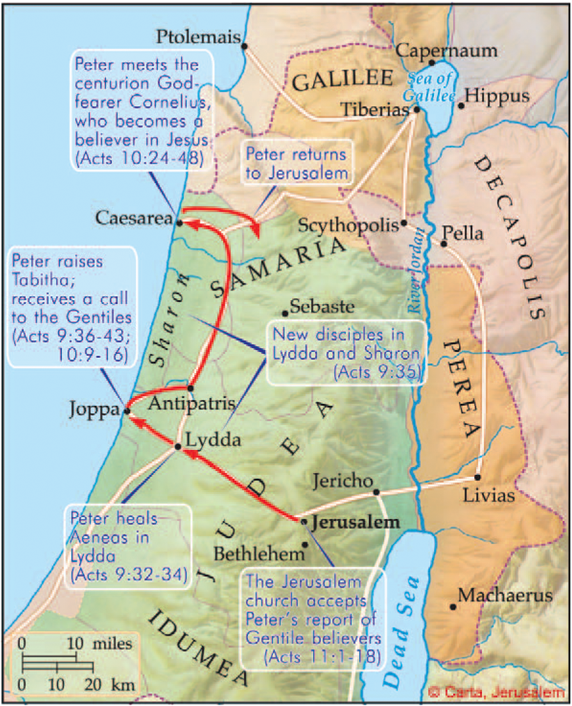
The miracle was so marvelous that all who dwelt at Lydda and Sharon saw [the healed man] and turned to the Lord (Acts 9:35).  Sharon is not a city but a coastal plain of some 30 miles stretching from Joppa to Caesarea. See Figure 1 below.

Figure 1 — The regions reached by Peter when Aeneas and Tabitha are healed. Sharon is not a city but a coastal plain of about 30 miles.

Luke makes mention of  Sharon as a segue into a new story using the same main character — Peter the apostle. As we consider this next passage we will also encounter a third principle that must be honored if a ministry is going to use miracles effectively: The Principle of Right Getting.

After Aeneas (Acts 9:36-39)

36 At Joppa there was a certain disciple named Tabithaa, which is translated Dorcasb. This woman was full of good works and charitable deedsc which she did. 37 But it happened in those days that she became sick and died.d When they had washed here, they laid her in an upper room. 38 And since Lydda was near Joppa, and the disciples had heard that Peter was there, they sent two men to him, imploring him not to delay in coming to them. 39 Then Peter arose and went with them. When he had come, they brought him to the upper room. And all the widows stood by him weeping, showing the tunics and garments which Dorcas had made while she was with them.

The contrast is stark. Luke takes his reader away from the scene of repentance, revival, and rejuvenated life in Lydda to a scene of tragedy and mourning about 12 miles away in Joppa. (See Figure 1 above.) Where Aeneas has made his bed and is walking in the gracious gift of restored health, Dorcas is dead. Her lifeless form lies on a table or bed surrounded by weeping widows (Acts 9:39).

While we are wanting to get to the principle of effective use of miracles in ministry we must not be so hurried that we miss other truths that, when prayerfully considered, will do much to help us live effectively in the Lord’s service. First, do not overlook the fact that the person upon whom this illness came was a Jesus follower – a disciple. Disease and even Death itself had visited a woman full of good works and charitable deeds. Think on the facts: (1) Dorcas was a disciple. (2) Dorcas was full of good deeds; her hands were neither idle nor involved in evil. (3) Dorcas got sick. (4) Dorcas died. We do well to consider these facts when we suggest that a person’s sickness today is (a) not God’s will because the person is a Christian or (b) that the sickness will be eliminated by casting it out in Jesus’ name.

Let us not corrupt the gospel by promising people a life free from sickness when they receive Jesus. There is no pass on pain for those who have given their lives to Christ. The promise of the gospel is forgiveness for all our failings, eternal and abundant life with purpose, the Lord’s abiding presence, and the privilege of partaking in His sufferings (1 Peter 4:13).

Dorcas had used so much of her time and talent and treasure to help the poor that her passing was the cause of exceedingly great sorrow among the disciples… especially the people she had helped. The second thing we must not miss is that Dorcas is missed so much that the disciples decide to ask for something that has not happened in the recorded history of the church at this point: raising the dead. Do not miss the questions that you should ask yourself:

  • Could it be proven that I have, in serving the Lord, provided help for the poor and made a difference that will be missed?
  • Could anyone gather enough evidence of my good deeds to show that my life was a blessing and not a blight on the community?
  • Would the sum total of my good works warrant a crazy plan to get a busy man to come and raise me from the dead?

Having heard about the healing of Aeneas the disciples sent two men to ask Peter to come immediately. He goes with them and, when he has arrived at the home in Joppa, is taken to the upper room. At this point the widows begin working on Peter. They aim to convince him that Tabitha’s life was worthy of a special work of God through him.

Unprecedented Power Displayed Through Peter (Acts 9:40-42; Mark 5:21-43)

40 But Peter put them all out, and knelt down and prayed. And turning to the body he said, “Tabitha, arise.” And she opened her eyes, and when she saw Peter she sat up. 41 Then he gave her his hand and lifted her up; and when he had called the saints and widows, he presented her alive. 42 And it became known throughout all Joppa, and many believed on the Lord.

Peter has seen a situation like this before. During His master’s ministry there was a little girl that had just died. Her father was a ruler in the community (Matthew 9:23) and their position made his daughter’s death highly visible. Jesus assesses the situation and then puts out the people (Matthew 9:24).

Peter sent them and the other mourners out of the room, as he had seen his Master do before he raised Jairus’s daughter from her deathbed; then he uttered a short sentence in Aramaic, differing only in one letter from Jesus’ words to Jairus’s daughter. Whereas Jesus had said Talitha qum (i) (Mark 5:41), Peter now said Tabitha qum (i))—“Tabitha, get up.”

Bruce, F. F. (1988). The Book of the Acts (p. 199). Grand Rapids, MI: Wm. B. Eerdmans Publishing Co.

The ministry of Peter to Dorcas and the community was not occasioned by his presence or his preaching. He became effective in helping them only in his willingness to be humbled. Every knee must bow. His words toward the body were imbued with power only after his pleading. Before he could give the command he needed to get the power. Peter follows Jesus’ lead and gives us the following principle for ministry with miracles:

The Principle of Right Getting (Get Down, Get Help)

What the Church needs to-day is not more machinery or better, not new organizations or more and novel methods, but men whom the Holy Ghost can use — men of prayer, men mighty in prayer. The Holy Ghost does not flow through methods, but through men. He does not come on machinery, but on men. He does not anoint plans, but men — men of prayer. (Bounds, Kindle Locations 46-48)

Figure 2 — Time in prayer with Chancellor Barnes on 2024-11-11 at the home of Austin and Aubrey lane during a Compass Young Adults meeting.

The language of the quote above is old. It speaks of prayer in ways that seem to make it the province and power of men. I will not charge E. M. Bounds with being chauvinistic; he spoke in a manner customary of his times. An updated version of the quote would change the word men to people; people of prayer are an indispensable part of a ministry that will be able to use the miraculous for the glory of God and the good of many. Such people take to heart the words of the Lord regarding prayer and make it their business to both be obedient and follow his example.

  • Receiving Requires Prayer and Faith (Matthew 21:22) And whatever things you ask in prayer, believing, you will receive.
  • Some Changes Require Prayer (Mark 9:29) So He said to them, “This kind can come out by nothing but prayer and fasting.”
  • The Ultimate Purpose of the Prayer is the Glorification of the Son (John 14:13-14) And whatever you ask in My name, that I will do, that the Father may be glorified in the Son. If you ask anything in My name, I will do it.
  • Corporate Prayer in Jesus’ Name Has Special Influence with the Father (Matthew 18:19-20) Again I say to you that if two of you agree on earth concerning anything that they ask, it will be done for them by My Father in heaven. For where two or three are gathered together in My name, I am there in the midst of them.

The Persistence of Peter (Acts 9:43)

So it was that he stayed many days in Joppa with Simon, a tanner.

Aeneas has been healed and Dorcas has been raised from the dead. The miracles were used by Peter to occasion faith in Jesus. And now that there are a number of new believers the real work begins – discipleship (Matthew 28:18-20). Peter stays in the region in order to teach the new believers all that Jesus commanded. Beyond the excitement of the miracle is the more mundane work of day-to-day teaching, mentoring, and helping the Jesus followers in their new relationship with the Lord. Unlike the mass revivals of our day where people are reached and then left to the locals for teaching, Peter stays for a hands-on approach to making disciples.

Questions for Community Discussion

  1. Why did the healing of Dorcas cause many to believe? (Acts 9:37, 42)
  2. Why did Peter stay? (Mark 3:14; Matthew 28:18-20)
  3. Peter prayed before he did anything. Why did he do that? (John 15:15)
  4. Does your approach to helping others and discipleship look like Peter’s?
  5. In what ways should your approach to helping people be changed to match the example of Jesus and the apostles?

Footnotes

a Literally in Aramaic her name means Gazelle.

b Dorcas is Greek for Gazelle. It is obvious that Luke wanted to make his work accessible to an audience that was not Jewish.

e The text that follows is from the Mishna Shabbat – a written redaction of the Jewish oral traditions known as the Oral Torah. Mishna Shabbat 23:5 One may perform all the requirements for a corpse [on Shabbat]: [One may] anoint and wash him, provided one does not move a limb. One may move the pillow from under him to place him on the sand so that he will keep [from decomposing]. One may tie his jaw, not so that it rises but so it does not fall. And similarly, [if] a beam has broken one may support it with a bench or boards from a bed, not so that it rises but so it does not fall. One may not close the eyes of a corpse on Shabbat, nor [even] on a week-day while he is [still] expiring. [If] one closes the eyes of a dying person while he is [still] expiring he has shed blood.

References

E.M. Bounds (2015-11-23). Power Through Prayer (Kindle Locations 46-48). Scriptura Press. Kindle Edition.

Principles for Effective Ministry with Miracles – Part 1 of 2 (Acts 9:32-43)

Introduction

The itinerant ministry of Jesus, with all His miracle-working power, was all that His men knew.  In His presence for over three years they were made to see with their own eyes the lifestyle of witness-with-wonders evangelism even before they could understand their Master’s messages. But Jesus took time to make sure that they knew how to use signs properly. “Do what I do” was and is the most effective strategy for educating Jesus followers in evangelism… especially when miracles are involved. Robert Coleman puts it this way:

Amazing as it may seem, all Jesus did to teach these men his way was to draw them close to himself. He was his own school and curriculum. Coleman, Robert E. (2006-04-01). Master Plan of Evangelism, The (pp. 37-38). Baker Publishing Group. Kindle Edition.

Through His example they were witnesses to His way of bringing the gospel to the world. Although they did not realize it at the time of their teaching, they were students of the principles that must be honored by anyone that would be effective when using miracles for the King and His kingdom. In the closing of chapter nine we will see that the gospel, advanced using amazing and gracious displays of healing power, is going to move most effectively when (1) there is a right going, when (2) there is a right giving, and when (3) there is a right getting.

Figure 1 – Jesus healed a man that had been born blind and thereby provided evidence for the shocking truths that He has been teaching (John 9:1-11).

Right Going and Giving (Acts 9:32-35)

32 Now it came to pass, as Peter went through all parts of the country, that he also came down to the saints who dwelt in Lydda. 33 There he found a certain man named Aeneas, who had been bedridden eight years and was paralyzed. 34 And Peter said to him, “Aeneas, Jesus the Christ heals you. Arise and make your bed.” Then he arose immediately. 35 So all who dwelt at Lydda and Sharon saw him and turned to the Lord.

Verse 32 picks up after the brief account of Saul’s conversion. It came to pass is Luke’s way of unpacking the how and why of Acts 9:31.

Then the churches throughout all Judea, Galilee, and Samaria had peace and were edified. And walking in the fear of the Lord and in the comfort of the Holy Spirit, they were multiplied. (Acts 9:31, NKJV)

In that verse we hear that the churches had peace and were edified. The peace was twofold. First, it is the work of the Holy Spirit; He metes out a peace that surpasses understanding (Philippians 4:7). Such a peace would be a comfort of the Holy Spirit. Second, it is no doubt a consequence of converting the leading critic — Saul of Tarsus. The one who had waged war with the people of God had become a Jesus follower himself. But how were they edified?

In the New Testament edification is the building up of the commitment and character of saints; it can be the result of teaching or revelation that causes the hearer to be strengthened in their faith and more mature in their service of God (1 Corinthians 14:4, 17). This had been happening in Jerusalem for over two years (AD 33 – 35). Now Peter is bringing the ministry of teaching to the saints dispersed by recent persecution. He is going through all parts of the country teaching. While the ministry of teaching or preaching is not explicitly mentioned, it is implied that Peter is teaching and preaching as he goes. As a shepherd he is going to where the flocks have been moved by recent persecution; when he arrives on the scene he teaches them. This is what he has been called and trained to do:

  • Peter Has Been Trained to Teach (Mark 3:14; Acts 4:13) – Then He appointed twelve, that they might be with Him and that He might send them out to preach,
  • Peter Has Been Charged to Teach (John 21:15-17; Acts 5:19) – He said to him the third time, “Simon, son of Jonah, do you love Me?” Peter was grieved because He said to him the third time, “Do you love Me?” And he said to Him, “Lord, You know all things; You know that I love You.” Jesus said to him, “Feed My sheep. …”
  • Peter Has Been Changed to Teach (Luke 24:45) – And He opened their understanding, that they might comprehend the Scriptures.

The Principle of Right Going: The Mission, Missionary, and Ministry Must be His

The first principle of effective ministry involving miracles is that the person through whom the work is done must have been sent. Carts are placed before horses and woe follows when unconverted people attempt to use Heaven’s power without the permission of Heaven’s Prince. For at least two reasons, if Jesus is not involved, using miracles in ministry will not work. First, the work done will not be rewarded and the workers will not be recognized (Matthew 7:21-23). Second, the hellions being exorcised are able to distinguish between genuine practitioners of the Christian faith and powerless soothsayers. Simply making mention of Jesus’ name will not work when Jesus has no intention of working through the person for His own glory and the good of His own people (Acts 19:11-16). There will be no genuine miracle apart from genuine mission.

Philip the Evangelist, under the leading of the Holy Spirit, has already come through this region preaching in all the cities till he came to Caesarea (Act 8:40). As Peter was serving in Lydda he found a certain man named Aeneas (praiseworthy; praise). Luke tells us that the man had been bedridden eight years.

The healing power present in Peter does not require his voice. His shadow was enough to effect healing. So then, why did he feel it necessary to speak to the man? During his time with Jesus the former fisherman had seen many miracles. On some occasions, preceding the miracle, there were words spoken by Jesus that were aimed at helping the audience understand the meaning of the miracle. When the sense and significance of the miracle were present with the work it became more than a miracle; it became a sign (John 11:41-42).

Figure 2 – On 2025-01-19 a few people from Compass Church went to an assisted living facility to bring the gospel, worship, and encouragement. They went in Jesus’ name.

What Jesus began to do in the flesh he continues to do in the Spirit through surrendered people. He continues to do the work for His own glory and the good of His own people. When miracles are going to be used in ministry the minister must recognize the purpose of the power that runs through him.

The Principle of Right Giving: Give God the Glory

The second principle says that miracles must always make much of God and give more force to the argument for following Jesus. When there is going to be a healing that actually helps the cause of evangelism the evangelist cannot get away from the goal of giving God all the glory. While the miracle may serve to give credibility to the minister and his ministry it must ultimately be used as a means for magnifying the Son of Man, as a platform for promoting Jesus, as a sign pointing toward the Savior, and a reinforcement of the requirement to repent and believe the gospel.

Peter gives the glory away when he says, “Jesus Christ heals you.” He uses the miracle of making a man well to make the Master well known. And the desired effect is achieved:

So all who dwelt at Lydda and Sharon saw him and turned to the Lord. (Acts 9:35)

The So of Acts 9:35 translates a conjunction that ties the action of healing in Jesus’ name (Acts 9:34) to the reaction of surrounding peoples (Acts 9:36-43) at the sight of the restored man. After eight years his muscles would have been atrophied and the neurological framework required to support an activity like making a bed would have to be retrained. But after Jesus heals Aeneas he is in a state like he was before becoming paralyzed. He was a wonder to behold. So great was the transformation that, with the enabling that comes from the Spirit, believing in Jesus was the unanimous response.

Some may ask if it is really necessary to give God the glory. This is a good question. I believe that He should only get the glory for His part in ministry. The opening of Acts makes it clear that Jesus continues to have a part:

The former account I made, O Theophilus, of all that Jesus began both to do and teach, until the day in which He was taken up, after He through the Holy Spirit had given commandments to the apostles whom He had chosen, (Acts 1:1-2)

Jesus began his ministry with His men and continued to do ministry through them. The apostle Paul has this to say concerning the ministry of Christ’s ministers:

I have been crucified with Christ; it is no longer I who live, but Christ lives in me; and the life which I now live in the flesh I live by faith in the Son of God, who loved me and gave Himself for me. (Galatians 2:20)

Questions for Community Discussion

  1. How does Peter ensure that the focus goes to Jesus when Aeneas is healed?
  2. When people comment on how your life has changed since you started following Christ what do you typically say? Are you prepared to share your testimony with others?

The Relentless Love of God for a Non-Prophet

The Relentless Love of God
Jonah 1:5-6
Mariners are professional sailors. They are experts in the matters of traveling on the sea and dealing with problems that are faced with sailing. Their situation is not run-of-the-mill bad weather at sea; these mariners are afraid. The situation is so bad that the sailors have given up hope of saving their cargo; it is being thrown overboard in an attempt to make the ship lighter. I can hear them saying
Forget the cargo! We can lose
the livelihood; we just want to
live. Men, let us try to live through
this. We will deal with the issue
of lost cargo if we can survive this
storm.
And their efforts to live were not just in the physical; before throwing cargo into the sea they reached out in the spiritual realm for help: 𝐞𝐯𝐞𝐫𝐲 𝐦𝐚𝐧 𝐜𝐫𝐢𝐞𝐝 𝐨𝐮𝐭 𝐭𝐨 𝐡𝐢𝐬 𝐠𝐨𝐝 (Jonah 1:5). It is a chaotic scene. There is a storm threatening to destroy the ship and its crew, men are crying out to their gods for help, and cargo is being thrown out in a desperate attempt lighten the load and survive. But down in the lowest parts of the ship, Jonah is sleeping hard or was fast asleep. When the captain finds the slumbering prophet he is confused. “𝐖𝐡𝐚𝐭 𝐝𝐨 𝐲𝐨𝐮 𝐦𝐞𝐚𝐧, 𝐬𝐥𝐞𝐞𝐩𝐞𝐫?” That is, “What are you trying to tell us, man? What is the meaning of taking a nap when we are about to die? Call on your god!”
Jonah, oblivious to what has been happening, is depressed and has been trying to escape from (1) the presence of the Lord and (2) his own feelings of dismay. Sleep, like drugs or sex, is a coping mechanism and form of escape. He may be sleeping because he walked a bit to get to Joppa. But the fact that he retreated to the lowest part of the ship in an indicator that Jonah does not want fellowship with God or men. He rages against all wise judgement and is running from his calling (Proverbs 18:1).
A man who isolates himself
     seeks his own desire;
He rages against all
     wise judgment.
But his disobedience has put him and the people around him in peril. God had called the prophet for help; the Lord wanted Jonah to bring his word to a wicked city (Jonah 1:1). Jonah refused the call and ran from the Lord. Now he is the one that needs to call out for help. Ironic? Not really. His sin has found him out (Number 32:23) and God is relentlessly pressing on his prophet to come out of his hate-fuled rebellion back into relationship and back into service. The Lord loves Jonah and won’t let him go. Love never fails.
In His grip by His grace,
Roderick Barnes

Stephen’s Last Stand Part 2 (Acts 6:8-10)

The Ministry of the Spirit in Stephen (Acts 6:8-15)

8 And Stephen, full of faith and power, did great wonders and signs among the people. 9 Then there arose some from what is called the Synagogue of the Freedmen (Cyrenians, Alexandrians, and those from Cilicia and Asia), disputing with Stephen. 10 And they were not able to resist the wisdom and the Spirit by which he spoke.

The Special Abilities of Stephen (Acts 6:8) — The former mentions of signs and wonders among the people were about work done by the Spirit through the apostles (Acts 2:43; 3:1-9; 4:33; 5:12, 15). This is the first time that we hear of supernatural work being done by the Spirit through people outside of the twelve. Why? That is, (1) why were these abilities formerly only seen in the apostles and (2) what changed?

The signs, miracles, and wonders of the apostles, and Jesus before them, served to certify that they were sent by God (John 3:1-2; Acts 2:22). Think with me on the purpose of such power in the life of the Lord. Jesus pointed to the signs and wonders being done through Him when He encountered detractors. He used them to reinforce His claims when people expressed reservations about receiving a Messiah from Nazareth:

  • The Works Were Given to Help Get Over Unbelief (John 10:37-38) — If I do not do the works of My Father, do not believe Me; but if I do, though you do not believe Me, believe the works, that you may know and believe that the Father is in Me, and I in Him.
  • The Works Were to Help Deal with Doubt (John 14:11) — Believe Me that I am in the Father and the Father in Me, or else believe Me for the sake of the works themselves.

The supernatural works being done through Jesus were aimed at helping people believe in Jesus. Through the works the Father attested to the veracity of the Son’s claims (Acts 2:22). The ministry of Jesus was validated by His miracles.

The ministry of the apostles was also validated by signs, wonders, and miracles (Hebrews 2:3-4). Through supernatural acts Jesus was made more credible. And through similar works the apostles were also validated. And so it is with the new deacons. That is, the signs and wonders serve as validation for deacons Stephen (Acts 6:8) and Philip (Acts 8:5-8). Stephen is now doing great wonders and signs among the people (Acts 6:8). In this way the new deacon is authenticated. Like Jesus and his apostles, the man upon whom the apostles have laid their hands is now being certified by miracles. Through the miracles Stephen is given a platform for promoting faith in Christ. Like Jesus and the apostles, Stephen is using the spotlight created by the miracles for declaring the word of God. And the Holy Spirit is on board with this plan; it is all part of the plan. Stephen is now someone to be regarded as having sound doctrine and speaking the words of life (Titus 1:9; 1 Timothy 3:9). And he was teaching!

The Speech of Stephen (Acts 6:9-10) — The teaching ministry of Stephen was controversial. He was saying things that disturbed both the camps of the Pharisees and the Sadducees. On account of Stephen’s teachings there arose men from five different synagogues disputing with him.

Freedmen were former slaves (or the children of former slaves) who had been emancipated by their owners; if their owners were Roman citizens, their freedmen were enrolled as members of their family. Many Jews who were taken captive to Rome at the time of Pompey’s conquest of Judaea (63 B.C.) were subsequently emancipated and thenceforth had the status of freedmen. (Bruce, 1988, p. 125)

Those who argued with Stephen were Hellenists; they were Greek-speaking Jews that were formerly dispersed among the nations. They have now come back to Jerusalem and gather according to cultural affinities.

In this verse, the term “synagogue” is singular, but Luke named five of them. First, there was the synagogue of the Libertines, a word that means “freedmen.” These were Jews who were once slaves of Rome or sons of Jewish slaves of Rome, but now had been freed. They came from Rome and built their own synagogue. Second, there was the synagogue of the Cyrenians, Jews from North Africa. Third, there was the synagogue of the Alexandrians, Jews from Egypt. The Jerusalem Talmud states that they built their synagogue at their own expense. The Babylonian Talmud tells the story of Rabbi Eliezer Ben Zadok, who acquired from some Alexandrian Jews a building formerly used as a private synagogue[ 148] “and turned it to his own use.”[ 149] Fourth, there was the synagogue of Cilicia, built by Jews who came from Asia Minor or present-day Turkey. The province of Cilicia included the city of Tarsus. Hence, these were people who came from the same region as Paul, and this synagogue of the Cilicians may very well have been his place of worship. That may also mean that he would have been involved in the disputations with Stephen and would have been among those who lost their arguments with him. Finally, there was the synagogue of Asia, meaning other parts of Asia Minor. (Fruchtenbaum, 2020, Kindle Locations 2805-2815)

But in their midst is a Hellenist full of faith and power, performing miracles, and preaching things that sound like blasphemy. They tried to take Stephen on and refute his statements. But he defeated all of them; they were not able to resist the wisdom and the Spirit by which he spoke (Acts 6:10). What is going on? Is Stephen so smart that he can best anyone in an argument? While he was likely intelligent and certainly wise (Acts 6:3), that is not why he has become unbeatable in debate. Stephen, my fellow Jesus follower, is filled with the Spirit. (See the previous post in this series.) His invincible power in verbal combat is actually the outworking of God’s presence in a chosen vessel.

  • The Precedent of God’s Presence for His Servant’s Speech (Exodus 4:12; Numbers 11:17) — Between 1,300 and 1,500 years before Jesus, God told a man who was not a capable speaker that he be helped with speaking. What man? Moses. Here below is Moses’ self assessment of his speaking abilities:

O my Lord, I am not eloquent, neither before nor since You have spoken to Your servant; but I am slow of speech and slow of tongue. (Exodus 4:10, NKJV)

Figure 1 – Moses protested his calling to lead based on his difficulty speaking.

Do you see it? That is, do you see Moses’ low view of his own speaking abilities? In his own words he was not eloquent. No. Instead he had some problem speaking that made his oration slow in delivery and perhaps pronunciation. Did he stammer? Whatever the problem was, in light of the help he had, it was actually not a problem. In the moment and as needed God would enable Moses to speak. His mouth was aided by the indwelling Spirit in saying what the occasion required. This is God’s response of encouragement and about the help His servant would have in speaking:

Now therefore, go, and I will be with your mouth and teach you what you shall say. (Exodus 4:12, NKJV)

  • The Power is Unbeatable (Isaiah 54:17) — Between 700 and 740 years before Christ, Isaiah the prophet will add some clarity to what God will do through to make his spokespersons effective. Isaiah says that dealing successfully with opposition in our response to attacks is our heritage; when the time comes, we do not back down from the difficulty or danger associated with declaring the truth. This will be played out in the text that follows. The weapons formed against Stephen will not prosper.

“No weapon formed against you shall prosper,
And every tongue which rises against you in judgment
You shall condemn.
This is the heritage of the servants of the Lord,
And their righteousness is from Me,”
Says the Lord. (Isaiah 54:17, NKJV)

Further, instead of being condemned, the man of God will speak cutting truth about his accusers (Acts 7:54).

  • The Promise of In-the-Moment Provisions of Irresistible Speech (Luke 21:12-15) — Jesus prepared his disciples for the moments when they would need to give an answer to their adversaries. He told them that they would be put on trial for the benefit of His Person and program (Luke 21:12). Jesus said those trials will look, at first glance, like a day of triumph for the enemy. However, it will be your opportunity! The Son of Man says, in effect, “What the devil would use as a time to demean you and discourage you will become a singular time of telling them the truth about who I am” (Luke 21:13); “The setback of being made to stand before your accusers will actually be a setup for you to stand for the Truth” (John 14:6).

What do we do with this? We are not far enough through the narrative of what happens to Stephen to say. Not enough of Luke’s account of the trial of Stephen has been considered. We need more to know how to operate in our day to face opposition? But here are some questions that will help us to think deeply about the text and God’s reasons for wanting us to be filled with the Spirit.

Questions for Group Discussion

  1. What is the purpose of exceptional or supernatural work in the life of a believer?
  2. Am I ever guilty of taking credit for what God is doing through me for His own purposes?
  3. What would God have me do with the attention garnered through great work?
  4. Am I preparing to use the platform occasioned by good performance to proclaim the truth about Jesus? Things that can help me to prepare for questions are (1) a time to pray for understanding, (2) a reading plan, and (3) study aimed at learning to explain the truth to others (Ezra 7:10).
  5. Do I regard the company of God as sufficient equipping for everything I will face (Joshua 1:9; Matthew 28:20)? In what ways do I discount the value of God’s help? How could I be more positive about the provisions of God (Luke 21:12-15; Philippians 4:8)?

Note: The featured image for this post is of a friend and mentor — Pastor Dave Smith. One thing that Dave has taught me about being effective as a speaker is the importance of reviewing the entire message a few times before presenting. In the photo it is Sunday, 21 March 2021 and Pastor Dave is guest speaking at Communion Chapel.