Tag ministry

Where Am I?

Possible path from Capernaum to Bethany.

Figure 1 – Possible route of Jesus from Capernaum

Luke 10:38–42 (NKJV)

38 Now it happened as they went that He entered a certain village; and a certain woman named Martha welcomed Him into her house. 39 And she had a sister called Mary, who also sat at Jesus’ feet and heard His word. 40 But Martha was distracted with much serving, and she approached Him and said, “Lord, do You not care that my sister has left me to serve alone? Therefore tell her to help me.” 41 And Jesus answered and said to her, “Martha, Martha, you are worried and troubled about many things. 42 But one thing is needed, and Mary has chosen that good part, which will not be taken away from her.”

The En Route Rabbi (Luke 10:38) – Jesus is on His way to Jerusalem; it is time for Him to be received up (Mark 16:19; Acts 1:2; Luke 9:51). The Son of Man is determined to be where the Father would have Him to be doing what the Father would have Him to do. In this case, the Father would have His only begotten Son to be in Jerusalem. Eventually He must be in the Holy City for the Passover as the Lamb (Matthew 10:28; Mark 10:45; John 1:29).

But there is some time between this record of Jesus’ travels with His disciples and the Passover. As they went to Jerusalem, Jesus entered a certain village  (Luke 10:38). Laying the gospels alongside one another, we can see that the village mentioned by Luke was Bethany (John 11:1). The figure at the right shows a possible route from where Jesus was in Capernaum to Bethany.

In this certain village there is a family that is dear to Jesus – two sisters and their brother (John 11:5). The oldest sibling in the Bethany household is most likely Martha. How did I get that? I base this supposition on her apparent role as head of the household. In first-century Jewish and Greco-Roman culture, hospitality was ordinarily administered by the household’s senior authority. The eldest unmarried woman or the person bearing primary domestic responsibility (Keener, 1993). The act of formally welcoming a guest — particularly a traveling rabbi — normally fell to the individual who managed or governed the household. Luke’s description of Martha as the one who welcomed Jesus into her house suggests that she is the household’s senior figure. She is also possibly the owner of the house.

An Israelite Indeed (Luke 10:39; Deuteronomy 18:15, 19) – The account from Luke introduces the sister of Martha after the welcome; her name is Mary. She is presented to the reader doing two things: (1) sat as Jesus’ feet and (2) heard his word (Luke 10:39). Luke wants us to see her alignment with the expectations of God. Luke says, “Look, at her reader, and see that Mary is enacting obedience by taking a subordinate and teachable posture.” Why do I think that is what Luke is saying? Consider the words of Moses in his blessing on the children of Israel before his death (Deuteronomy 33:3):

Yes, He loves the people;
All His saints are in Your hand;
They sit down at Your feet;
Everyone receives Your words.

Moses said there are two things that an Israelite can do to indicate submission to Yahweh. Mary is doing both. That is, Mary is doing both things that Moses described as expressions of covenant loyalty for an Israelite: (1) sitting down at the feet of God (Jesus) and (2) receiving His words. (And there are other places where being at the feet indicates discipleship, submission, and readiness to obey. See Judges 4:10; 2 Kings 4:27). Further, if we are going to truly appreciate Mary, we must give special attention to the fact that she is hearing Jesus words. Hearing, for the Jew means more than the passive activity of allowing oneself to hear spoken words. It combines intentional listening and willful obedience (Deuteronomy 6:4). At this point Luke 10:39 becomes an unavoidable and unmistakable declaration of Mary’s decision to receive Jesus as the promised Prophet. How did I get that? Moses told that people

15 “The Lord your God will raise up for you a Prophet like me from your midst, from your brethren. Him you shall hear,… 18 I  [Yahweh] will raise up for them a Prophet like you from among their brethren, and will put My words in His mouth, and He shall speak to them all that I command Him. (Deuteronomy 18:15, 18)

She is seated in surrender and listening intently to the words of the rabbi from Nazareth. Mary is telling Jesus and anyone who will look at her actions in the light of God’s covenant with His people, “I see the Prophet that Moses mentioned. And I am hearing him.” Mary is an Israelite indeed.

Sidelined by Service (Luke 10:40) – The activities of Martha, the woman who welcomed Jesus into her home, are brought back into focus. While Mary is sitting at Jesus’s feet hearing his word, the other sister is distracted with much serving. Distracted? That is the word that Luke uses to describe Martha. The underlying verb (περισπάω) indicates that her attention has been drawn, pulled, or dragged away from one thing to another thing. That is, Martha’s has been drawn, pulled, or dragged away from one thing (Jesus words) to another thing (serving Jesus).  It is worth noting that the word translated serving (διακονία) is normally translated ministry (Ephesians 4:12; Acts 6:4). Martha is drawn away by work for Jesus from the words of Jesus.

Picture the scene with me. Martha is going back and forth from the kitchen to the place where Jesus is teaching. She is bringing food items and drinks to the Master and His disciples. Meanwhile, Mary is absorbed in the teaching of Jesus. Every time Martha, in the midst of her ministry, passes by her sister with a tray of food she becomes more irritated. In quiet words she says as she goes back and forth, “Oh no, don’t get it up, Mary!” And later, “Excuse me, Mary! Didn’t mean to come between you and this message with my menial work of ministering alone to the Master and His disciples.” Finally, it becomes too much and she interrupts the Teacher’s teaching with her tirade:

Lord, do you not care that my sister has left me to serve alone? Therefore tell her to help me.

Martha reminds me of so many people caught up in their self-imposed ministry that find fault with everyone not doing what they are doing. The Holy Spirit can rest a little easier when these people are around; they will eagerly assist in convicting the world of the sin of not measuring up to their standard of righteousness and their requirements for service. (O reader, calm down. This is sarcasm and not heresy.)

Answered Prayer (Luke 10:41) – Jesus answers. And although it looks like just a response to her question and suggestion. It should be seen as an answer to prayer. After all, He is God (John 1:1-3; Hebrews 1:8-10). Saying her name twice is an indicator that there is great emotion associated with the address (Genesis 22:11; 1 Samuel 3:10; 2 Samuel 18:33; Luke 22:31; Matthew 7:21-23; Matthew 23:37; Acts 9:4). This way of speaking to someone is called the double vocative and it means that the speaker is talking with great concern, distress, urgency, or tenderness. Although she accuses him of not caring, Jesus answers her prayer out of His great concern.

Martha is worried and troubled about many things. In this case, her worry and troubles are ministry. Ministry matters. But it should not have been a worry to her. She is not doing it right.

Gentle Correction and Warning (Luke 10:42) – The one thing needed is to hear Him (Deuteronomy 18:15, 19). This is the commandment of God through His servant Moses and reiterated earlier in the transfiguration (Luke 9:33-35).

Moment Distraction Divine Correction
Luke 10:38-42 Martha’s service “Mary has chosen the good part”
Luke 9:33-35 Peter’s ministry plan “Hear Him!”

Jesus tells the woman absorbed in busyness that this is not the Father’s business. Mary has chosen the one thing that is needed – hearing His words. And Mary’s choice is being protected by the Lord Himself; it will not be taken away from her. Don’t try to come between me and Mary. Serving Jesus cannot come before being served by Jesus (John 15:1-5). We are not sent (Mark 3:14) until we have been with Him (Acts 1:8; Acts 4:13).

Action Items for Us

Take time to sit with Jesus today. How? There is a reading plan on this site; that is a good place to start. Prayerfully consider His words and what they mean for your life. Let ministry ideas and initiatives be shaped by time spent listening; hear Him (Luke 9:33-25; Deuteronomy 18:15).

Questions for Consideration

  1. Where am I? Would my position best be described as sitting at the feet of the Teacher receiving His word or busy around the Teacher with my many worries?
  2. What worry needs to wait until after I have spent time with Jesus? Properly seen those worries are weeds that would choke out the word, cares that cut me off from the best Christ has to offer, and second-rate pleasures that pull me away from the real joy of just being with Jesus (Matthew 13:22; Mark 4:18-19; Luke 8:14).

References

Keener, C. S. (1993). The IVP Bible background commentary: New Testament. InterVarsity Press.

Missional Living — Maximizing Your Ministry Part 1 (Acts 6:1-7)

Maximizing Your Ministry Part 1 (Acts 6:1-7)

Introduction

The admonition to care for the poor is found throughout the Scriptures (Exodus 23:10-11; Leviticus 23:22; Deuteronomy 15:7-11; Esther 9:22; Psalm 14:6, 41:1; Proverbs 14:21; Matthew 11:5, 19:21; Romans 15:26; Galatians 2:10; Luke 14:13, 21). Caring for the poor is one way that a person in the community of faith does business with God (Proverbs 19:17) and honors Him. How does showing kindness to the poor honor God? There are at least two reasons why kindness to the poor honors God. First, the poor are made in the image of God (Genesis 1:27; Proverbs 14:31; 22:2); showing kindness to the poor is a way of showing respect for His image (1 John 4:20). Second, rendering compassion to the poor in our fellowships is one way we demonstrate our new birth (1 John 5:1).

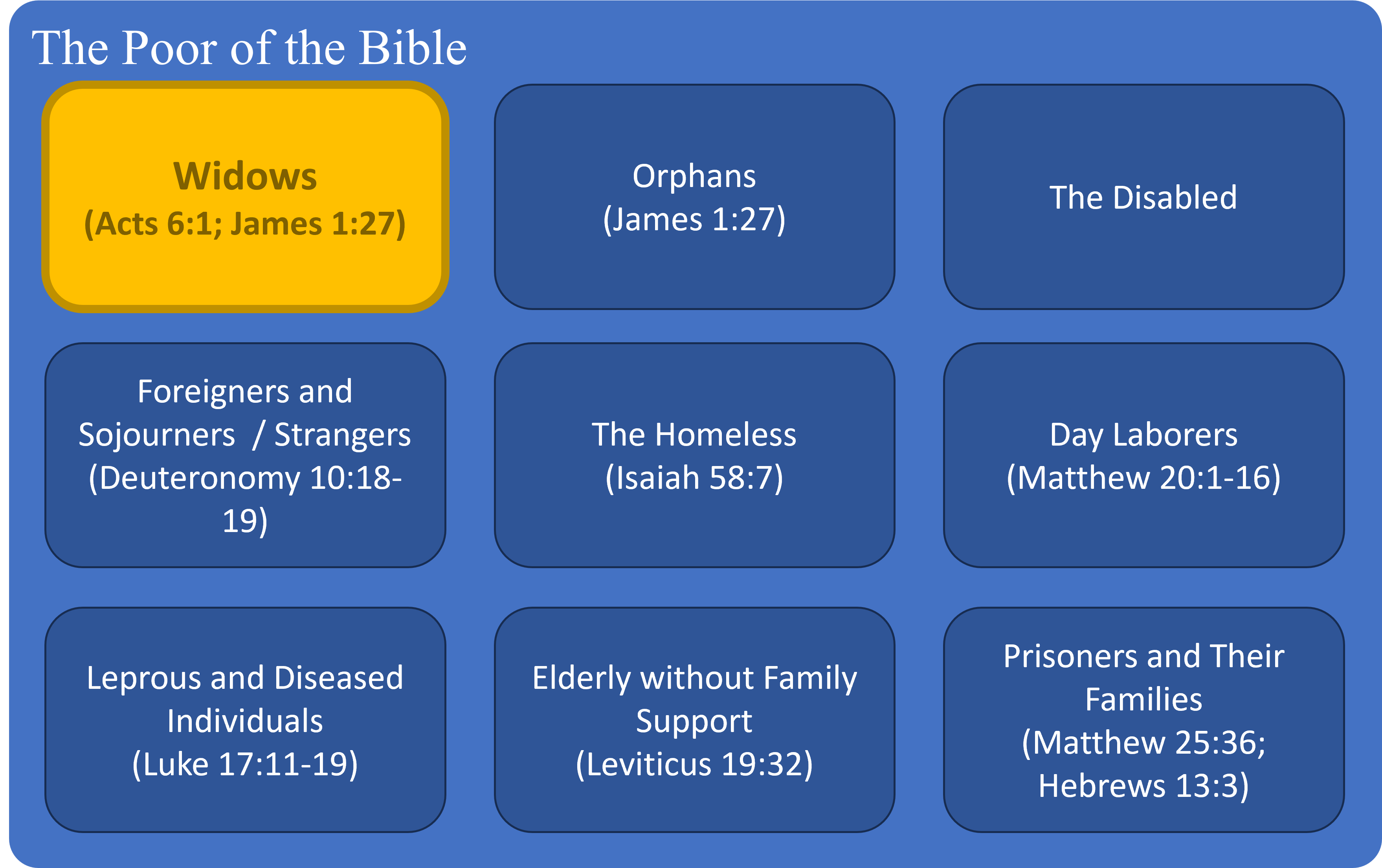
Figure 1 – Poor people in the Bible come in many types. Especially important to God are widows (James 1:27).

Within the segment of society regarded as poor there is a subsection that is especially dear to God’s heart: widows and orphans (Exodus 22:22-24; Deuteronomy 10:18; Psalm 68:5; Proverbs 15:25; James 1:26-27). Widows, especially in the time of the first church, were particularly vulnerable to poverty. The agencies of modern governments that care for the poor did not exist. But the early church, under its apostolic leadership, had been mindful of this group. There was a daily distribution of alms aimed at meeting the needs of widows. This distribution to the widows had worked for a while; it had been effective when the church was fairly homogenous. But with exponential growth in the fellowship came a corresponding diversity in the demographics. The church is now comprised of local Jews and those that have immigrated to Jerusalem. The local Jews speak Aramaic (or Mishnaic Hebrew). Those that have immigrated to Jerusalem are called Hellenists (Acts 6:1). Who are the Hellenists and how do they differ from the Hebrews? F.F. Bruce summarizes:

The church of Jerusalem, we are now told, comprised both “Hebrews” and “Hellenists.” The main distinction between the two groups was probably linguistic: the Hellenists were Jews whose habitual language was Greek and who attended Greek-speaking synagogues; the Hebrews spoke Aramaic (or Mishnaic Hebrew) and attended synagogues where the service was conducted in Hebrew. Many of the Hellenists had affinities with the lands of the Jewish dispersion around the Mediterranean shores, whereas the Hebrews were Palestinian Jews; there were doubtless several minor social and cultural differences between the two groups. In the Jewish world as a whole there were tensions between them, and some of these tensions endured between members of the two groups who had joined the “disciples” (Bruce, 1988, p. 120).

The Hellenists are Jews of the Diaspora that have assimilated some aspects of Greek culture – especially language. Arnold G. Fruchtenbaum, in his commentary on Acts explains that their was a grievance growing among the Hellenists against the Hebrews:

[W]hile the church was deeply concerned about taking care of the widows, there seems to have been a prejudice in favor of the locally born, Hebrew speaking widows, over the Greek speaking widows who had immigrated into the country. The latter felt neglected and overlooked in the daily distribution (Fruchtenbaum, 2005, Kindle Locations 2723-2725).

Out of the growth caused by the ministry of the word (Acts 5:42) came diversity. Out of the diversity arose discrimination and inequity. In order to deal with inequity and discrimination there would need to be an intervention by the apostles. The handling of the matter by the twelve contains principles of missional living that are sorely needed by many fellowships and individuals today. If we are willing to listen to the voice of the early church apostles, our ministries, personal and corporate, can become more efficient and more effective. The twelve tell us to concentrate on our calling, delegate duties, and then watch God work.

Questions for Personal Study

  1. Are there indicators that your ministry is operating below its potential? This could be seen in missed opportunities due to obligations outside your calling or quality that is lower than what you are capable of?
  2. Has anyone shared with you criticism concerning your ministry that could be useful in looking for places to improve?
  3. Do you desire to raise the quality of your ministry and the quantity of people reached?

References

Bruce, F. F. (1988). The Book of the Acts. Grand Rapids, MI: Wm. B. Eerdmans Publishing Co.

Fruchtenbaum, Arnold G (2005). Commentary Series: The Book of Acts. Ariel Ministries.

Notes

The women seen in the featured image of this post were at a conference in Atlanta. Immediately to my right is Yvonne. Across the table is Virgina. I was there for the company owned by my wife and I, BIF Technologies, on business with Xtreme Solutions. After our respective work we met over prayer, the Scriptures, and worship in a public setting. We endeavored to (1) be above reproach and (2) make the most of the moment. Maximizing your ministry may be as simple as using moments that seem secular for purposes sanctified.

Five Principles for Paired Ministry

1 Now Peter and John went up together to the temple at the hour of prayer, the ninth hour. 2 And a certain man lame from his mother’s womb was carried, whom they laid daily at the gate of the temple which is called Beautiful, to ask alms from those who entered the temple; 3 who, seeing Peter and John about to go into the temple, asked for alms.

3:1 We have seen these two men together in the past. When the Lord is transformed on the mountain Peter and John are there with James (Matthew 16:27-17:2; Mark 9:1-2; Luke 9:27-29). They are together with Jesus in the garden of Gethsemane (Matthew 26:36-38; Mark 14:32-33). We see them running together to the tomb of Jesus when the women say that the body is missing (John 20:1-4). And they are together in a boat when Jesus appears to them on the shore after His resurrection (John 21:6-7). Finally, when Jesus would talk with Peter alone, these two men are not entirely separated; the disciple whom Jesus loved was compelled to walk nearby (John 21:20-22). And so there is continuity from the other gospel narratives and the prior volume when we see Peter and John frequently together in the early parts of The Acts of the Apostles (Acts 3:1, 3, 11; 4:13, 19; 8:14).

They are a dynamic duo. Peter tends to be the speaker but John is always there, also with power, supporting the actions and words of his friend and fellow apostle. Their pairing may have been merely the outworking of their friendship. More likely it was also their commitment to the earlier commands and ministry conventions of Christ; He sent them by twos (Luke 10:1; Mark 6:7). It is by twos that they are going to pray… and to preach if given an opportunity. It is by twos that Peter and John, Jewish men, are still practicing Judaism. They are going together to the second and last offering of the day. It would have been about 3:00 PM.

The time of the apostles’ visit was the “ninth” hour, three in the afternoon, i.e., the hour of prayer. It was also the time of the evening Tamid, one of the two sacrifices held daily in the temple. These had become prescribed times of prayer, and people would come to the temple at the sacrifice times to observe the ceremony and pray. (Polhill, 1992, p. 126)

The apostles continued to live as observant Jews, attending the set services of worship in the Jerusalem temple. The two principal daily services accompanied the offering of the morning and evening sacrifices. One afternoon, as two of the apostles, Peter and John, went up the steps leading from the outer court to the inner courts, in order to be present in the Court of Israel for the service of prayer which accompanied the evening sacrifice (about 3 p.m.), they were arrested by the sight of a [lame man] who lay begging at the “Beautiful Gate.” (Bruce, 1988, p. 77)

Peter is often with John. Paul was often with Barnabas. Before them David, when he could, was with Jonathan. The pairing that was started in Jesus’ ministry continues in Peter and John after their Teacher has ascended. Should it? The principles that make pairing good say that it is the best way to do ministry. Here are five fundamental truths that serve as the foundation for operating in nothing less than pairs:

Mutual Support and Encouragement

  • The Principle — The mutual support is essential to effective ministry. When disciples or apostles are sent out in pairs, they can support and encourage each other in times of challenge and difficulty.
  • Biblical Basis (Ecclesiastes 4:9-10) — Two are better than one, because they have a good reward for their labor. For if they fall, one will lift up his companion. But woe to him who is alone when he falls, for he has no one to help him up.
  • Assessment Question — In what ways has my prior ministry experience proven that challenges and difficulties are best faced with a ministry partner?
  • Action Steps — Review the passage above and pray for strong resolve to honor this ministry principle. Give thanks for the persons that God has paired you with. If you are operating alone, prayerfully consider the possibility that your ministry is out of order and needs to be corrected immediately.

Witnessing and Testimony

  • The Principle — Jesus sending disciples in pairs aligns with the Jewish legal principle that a matter is confirmed on the testimony of two or three witnesses. This ensures that the message of the ones sent is credible and firmly established. Also, the ministry of a single person is especially vulnerable to false accusations from the adversaries of Jesus.
  • Biblical Basis (Deuteronomy 19:15) — One witness shall not rise against a man concerning any iniquity or any sin that he commits; by the mouth of two or three witnesses the matter shall be established.
  • Assessment Question — In what ways has the credibility of my ministry been enhanced or suffered according to either its compliance or deviation from this principle?
  • Action Steps — Review the passage above and pray for strong resolve to honor this ministry principle. Important ministry activities should not be executed alone. Even if it means slowing things down, things like mission trips and visiting the sick should be done with someone else — someone with integrity. Calendar activities that are ministry that only involve you should be shared or canceled.

Strength and Protection

  • The Principle — Jesus was sending his disciples into places where there were needy people and people who would do them harm. Traveling in pairs provided a level of protection and strength in potentially hostile environments; the disciples were sent as “lambs among wolves.”
  • Biblical Basis (Luke 10:1, 3) — After these things the Lord appointed seventy others also, and sent them two by two before His face into every city and place where He Himself was about to go… Go your way; behold, I send you out as lambs among wolves.
  • Assessment Question — What is the history of hostility in the areas where I am going to serve? In what ways do I show (1) naivete about human nature and (2) delusions about my ability to care for myself in hostile situations.
  • Action Steps — Know the history of hostility in an area where you are going to serve. If the area or people have persecuted other ministers, prayerfully choose who goes with you. That person should be capable of keeping their cool in conflict and helping you in hostile situations.

Spiritual Accountability and Discernment

  • The Principle — Working in pairs allows for spiritual accountability. Partners can help each other maintain spiritual disciplines (prayer, Bible study, worship), confront sinful tendencies, and enhance discernment through shared insights and prayer.
  • Biblical Basis (Proverbs 27:17) — As iron sharpens iron, so a man sharpens the countenance of his friend.
  • Assessment Questions — Am I paired up with people that promote growth in me? Do I encourage the person that I serve with in their commitment to Christ? Am I willing to serve with people who will challenge my ideas, disagree with my position, or gently critique my conduct?
  • Action Steps — Assess your ministry partners to make sure that you are not choosing people on the basis that they are always agreeable. Recognize the value in working with people that will promote growth even when it means some painful honesty.

Division of Labor and Diverse Gifts

  • The Principle — Different individuals bring different spiritual gifts and abilities to ministry. By pairing disciples, these diverse gifts can complement each other, making the ministry more effective and adaptable to various situations and needs.
  • Biblical Basis (1 Corinthians 12:4-6) — There are diversities of gifts, but the same Spirit. There are differences of ministries, but the same Lord. And there are diversities of activities, but it is the same God who works all in all.
  • Assessment Question — In the group that I “go” with (Matthew 28:18-20), is their a diversity of gifts? What would it look like to pair up with someone whose gifts are not the same as my own?
  • Action Steps — Take an inventory of spiritual gifts for yourself and the people that you ministry with. Prayerfully consider recruiting to fill gaps.

Take your ministry to another level by pairing. If you are currently doing it alone, what you do for the Lord could be better with the help of other people that also want to live effectively in the service of Jeus.

In His grip by His grace,
Roderick L. Barnes, Sr.

References

Bruce, F. F. (1988). The Book of the Acts. Grand Rapids, MI: Wm. B. Eerdmans Publishing Co.

Polhill, John B. (1992). The New American Commentary: Acts. Nashville, TN: Broadman & Holman Publishers.