Concentrate on His Presence Not Performance

The spiritual disciplines are not the focus; we cannot reduce Christianity to regular practices. Spiritual disciplines are aimed at getting the Jesus follower into Jesus’ presence. Through spiritual disciplines we are not trying to optimize our Christianity; we are abiding in His presence. Each discipline is a way of sitting at His feet like Mary (Luke 10:38-42); the discipline is merely a context for being with Christ and receiving desperately-needed grace.

The focus is not the discipline. When we are busy with the business of spiritual disciplines we are Martha — more concerned with performance than the Presence that makes it possible to serve well. Discipline-centered living will have us scurrying around Jesus but not enjoying His fellowship or hearing His words. Focus on the disciplines leads to pride over our regular praying, ritual fasting, meditation routines, and visible acts of submission. It leads to an attitude of disdain for the sad folk who ain’t doing what we do.

We need to focus on Christ through the discipline. Praying is pressing into the presence of Christ to acknowledge His worth, admit our need, and seek His help. When the goal is not God Himself, the discipline of praying becomes a practice that makes us smug.

He wants us to draw near. He has revealed how to do that in the Scriptures through the explanations and examples of Jesus and others; the means of drawing near as revealed in the Scriptures are spiritual disciplines.

Prayer and Conflict Part 1 (Acts 16:16-18)

16 Now it happened, as we went to prayer, that a certain slave girl possessed with a spirit of divination met us, who brought her masters much profit by fortune-telling. 17 This girl followed Paul and us, and cried out, saying, “These men are the servants of the Most High God, who proclaim to us the way of salvation.” 18 And this she did for many days.

We pick up our story with Paul and his company going to join new converts (Acts 16:14-15) in something non-negotiable — prayer. Among the things that did not change for Jesus followers after (a) the birth of the church on Pentecost or (b) the decision to come to Christ, was the practice of going to prayer (Acts 3:1; 16:3). Before they met Paul and his company, Lydia (Acts 16:13) and Cornelius (Acts 10:1-3; 30-31) were regularly retreating to call on God. After making a decision to trust Christ (Acts 16:14-15) they are found continuing in the practice with support from an apostle and his missionary band.

We are often found saying that we would like to see more of the spectacular work of the Spirit mentioned in the gospels and Acts in our own day. “Where is this work of Jesus in our church and our community?” But we cannot overlook the fact that in the ministry of Jesus (Luke 5:16), His apostles (Acts 1:14; 3:1), and people who experienced exceptional grace (Cornelius – Acts 10:1-3; 30-31; Lydia – Acts 16:13) that prayer is conspicuously present.

For those of us who would earnestly desire to see God move now like He did then the counsel is clear:

To see the hand of God move in our lives in ways similar to what we see in the Scriptures importunate prayer, individual and corporate, must be made primary and continuous.

We can see this in the example, exhortation, and explanations of Jesus.

  • The Example of Jesus (Luke 5:16; Matt. 14:23; Mark 1:35; Luke 6:12; 9:18; 11:1) — So He Himself often withdrew into the wilderness and prayed. (Luke 5:16)
  • The Exhortation of Jesus (Luke 11:5-11; Luke 18:1) — Then He spoke a parable to them, that men always ought to pray and not lose heart… (Luke 18:1)
  • The Explanation of Jesus for Dealing with Exceptional Problems (Matthew 17:21; Mark 9:29) — However, this kind does not go out except by prayer [and fasting]α. (Mark 9:29) Jesus made it clear that the power of the one he sends is derivative and borrowed; it is like the fading glory of Moses. The ability to cast out a demon was not based on an inherent authority of the exorcist but on the name and authority of Jesus Himself. In prayer the one asking acknowledges their inability to solve the problem on their own and their great need for help. Apart from this humbling of self and asking for help it will not be possible to command unclean spirits to come out of their victim.
  • The Apostolic Admonitions (Acts 16:16; Acts 1:14; 3:1; 1 Thessalonians 5:17; Ephesians 6:18; Colossians 4:2; Romans 12:12) — The apostles have a special ministry of clarifying the commands of Jesus, unpacking His precepts, exemplifying His edicts. Through them we learn that the Lord, as He Himself demonstrated, would have us continuous and fervent in praying.

We will not see God work like He did until we are willing to make supplication like the Son, to appeal to for help like His apostles did, and charge the throne of grace like the early church. But how, you ask, do we do that? The likelihood of getting into the regular practice goes up with better planning. Here are three things needed if we are going to become people of prayer:

  • An Established Time (Daniel 6:10) — Our time for prayer should be scheduled. Putting it on the calendar is evidence that we are being intentional. A goal without a date is a dream. Including others in the plan helps us become accountable. For those in leadership, delegating the role of leading prayer time helps to ensure that it is not vulnerable to our personal vicissitudes.
  • A Particular Place (Luke 21:38; 22:39-40) — Jesus regularly retreated to pray. When in Jerusalem He had a custom of going to the Mount of Olives; He would, at times, be there all night in prayer. Why Olivet? It was removed from the hustle and bustle of Jerusalem but near enough to be a practical retreat from day-to-day teaching in the temple. The distance between temple and the Mount of Olives was a Sabbath’s journey (Acts 1:12). How far is that? It would be 2,000 cubits or 0.57 miles.
  • A Clear Purpose — Prayer, if it is not focused on what matters to God, can become a thing of (1) pride and (2) a dead ritual. Our prayers should have as their goal getting from God what we need to do His will; this is good praying (Luke 10:2; Mark 14:38; Luke 22:42; Matthew 6:10).

Questions for Discussion

  1. What Paul’s commitment to prayer shape the way you personally approach spiritual conflict? Paul and his companions were on their way to prayer when this confrontation began (Acts 16:16). This post highlights that prayer wasn’t incidental to their mission — it was non-negotiable and continuous. Reflection: When challenges or spiritual opposition arise in your life, do you go to prayer first or to other solutions? What would it look like to make prayer the default response to every struggle?
  2. What does this passage teach about discerning between true spiritual work and false testimonies? Reflection: Are there influences in your life (voices, opinions, habits) that sound spiritual but don’t align with the heart of Christ or God’s ways of prayer and obedience? How can prayer help you discern truth from distraction?
  3. In what ways does prayer prepare you for the conflicts you face in everyday life? Reflection: Are there influences in your life (voices, opinions, habits) that sound spiritual but don’t align with the heart of Christ or God’s ways of prayer and obedience? How can prayer help you discern truth from distraction?


Spiritual Disciplines – Prayer

32 At evening, when the sun had set, they brought to Him all who were sick and those who were demon-possessed. 33 And the whole city was gathered together at the door. 34 Then He healed many who were sick with various diseases, and cast out many demons; and He did not allow the demons to speak, because they knew Him. 35 Now in the morning, having risen a long while before daylight, He went out and departed to a solitary place; and there He prayed. 36 And Simon and those who were with Him searched for Him. 37 When they found Him, they said to Him, “Everyone is looking for You.” (Mark 1:32-37)

Although the day is done, the demands have not diminished. When the sun had set the people are still bringing their diseased and demon-possessed loved ones to Jesus. Why? For healing and the delivering effect of the power that was in Him (Mark 1:32; Acts 10:38). Diseases and demons are no match for Him… and the people now know it; accordingly they are going to Him for help even when the hour is late (Luke 4:40-41). Notice this, fellow Jesus follower:

There is an occupational hazard to becoming effective in the enabling of God. It is an unending pressure to relieve pain, release prisoners, and remain in place (Luke 4:42).

There are no off hours. Jesus has no time to call His own. Look at our Lord in this scene and get insight for what lies ahead for those who would become Spirit-filled servant leaders (John 12:26).

The best part, though, is the response of Jesus to the pressures. (See also Luke 5:12-16.) In His handling of the situation I am made to see at least two things. First, I can what pleases the Father. (This is always true when watching Jesus. See John 8:29.) Second, I can see the main thing for my own ministry (Mark 9:28-29; Luke 6:12-13; Matthew 9:37-38; John 15:5-7; Luke 11:1-13; Mark 1:35-38). For the sake of time, let us focus on the former – what pleases the Father as it is revealed here in this part of Mark’s narrative.

More important than getting enough rest is the practice of pulling myself away from the crowed to be before God requesting His help for myself and His people. I must be willing to lay aside lying down, set aside slumber, and become at times intentionally inconvenient to reach (Matthew 6:6; Luke 5:15-16; Luke 6:12; Matthew 14:22-23). Why? So that I can, at last, be undistracted in hearing God (Acts 6:4) and unhindered being helped by God for His ministry. It was pleasing to the Father that His beloved Son prioritized the humbling act of prayer before rest, before planning, and the unending pressures of the crowd.

Jesus’ Model of Ministry versus Hyper-Connectivity

In our text Jesus has retreated to pray. Both his core and the crowd are looking for Him (Mark 1:36; Luke 4:42). They have to look, beloved, because Jesus made Himself less available on purpose. You have to see that the Son of Man removed Himself from easy access so that he could be uninterrupted in prayer.

Momentarily detaching from the social scene was intentional. Jesus wants unbroken time asking and listening; He is not going to be disturbed by casual conversation in the room or the person just passing by where He was praying.

God’s grace for personal growth and effective living has been made available to us for the asking (Matthew  7:7-8). In the spiritual discipline of prayer we position ourselves to receive that grace. But there is a modern theological and practical model of ministry irreconcilably at odds with the way of Jesus in prayer and ministry. The inveterate antagonist of Jesus’ model is hyper-connectivity. Let us compare these models:

Jesus’ Model Hyper-Connectivity
Accessibility Go into your room and shut the door (Matthew 6:6). Keep the channel of communication constantly open.
Effectiveness The inevitable outcome of an unseen commitment to being in the presence of God praying. [Moses (Sinai), Elijah (Horeb), Jesus (wilderness), Peter (housetop)] The inevitable outcome of increasing our reach through uninterrupted and increased visibility.
Prayer Quality Extended, unbroken, immersive Shallow presence with God due to a readiness to respond to every request.
Dependency and Validation Jesus’ model says that our dependency is on the Father (Deuteronomy 8:3; Matthew 4:4). We must have feedback based on likes, views, and praise in comments.

Making It Practical (Psalm 63:1; Acts 6:4)

  • PRIORITIZE YOUR PRAYING (Psalm 63:1; Mark 1:35) → Psalm 63:1 presents prayer as the first movement of the soul: “Early will I seek You.” David’s prayer is oriented toward God before circumstances are addressed. Mark 1:35 shows Jesus rising “a long while before daylight” to pray. He is going after time with the Father after a successful ministry day and before the next demands arrive.

Practical Implication – Give God the first fruits of the day, not the tired remainder. It must be regarded as non-negotiable.

Figure 1: Pirates do not politely ask for valuables.
We should not be too nice about getting time with
God. It is a non-negotiable.

  • PROTECT and PLAN YOUR PRAYING (Acts 6:4; Luke 5:16) → Acts 6:4 records a deliberate apostolic decision: “But we will give ourselves continually to prayer and to the ministry of the word.” The phrase “give ourselves” implies intentional allocation and protection. Luke 5:16 says of Jesus: “So He Himself often withdrew into the wilderness and prayed.” “Often” indicates a pattern, not an exception. Prayer does not survive on good intentions. In Scripture, it survives because it is: (1) Protected from intrusion, (2) planned into life rhythms, and (3) pursued when other things are pressing in.

Practical Implication – Schedule prayer (time with God) as deliberately as meetings with supervisors, coworkers, congregants, and friends. Create physical and temporal boundaries. Be okay with the fact that some good things are going to be sacrificed for the best.

  • PERSIST in YOUR PRAYING (Daniel 6:1-10) → Daniel 6:10 records Daniel’s response to a legal threat against prayer: “He knelt down on his knees three times that day, and prayed and gave thanks before his God, as was his custom since early days.” Prayer here is three things: (1) Custom (“as was his custom”), (2) Costly (it risks death), and (3) Continuous even when the conditions were contrary. Daniel does not increase prayer for show, nor does he reduce it for safety. He simply continues.

Practical Implication – Persisting in prayer means praying when answers delay (Daniel 10:2-3; Daniel 10:12-13), when obedience becomes costly, and when pressure increases rather than receding.

Figure 2: Daniel did not compromise his commitment to prayer.
W
hen it became inconvenient or could cost him his life. This
custom
has been part of forming his excellent spirit (Daniel 6:3).


In His grip by His grace,
Roderick L. Barnes, Sr.


Five Reasons for Scripture Memorization

It is more than a little cool to hear someone recite Scripture as they answer a question, deliver a sermon, or when praying. (Sometime it is done in a way that is showy and with the aim of drawing attention to themselves. Those times are not more than a little cool. At other times, though, the word-for-word recalling of Scripture in conversations can be helpful in unpacking an argument, encouraging the listener, or ensuring that the language and aims of prayer are in line with the will of God.) Consistently memorizing scripture offers several spiritual, mental, and other day-to-day practical benefits. Here are five:

Reason 1 — Strengthening Faith and Promoting Spiritual Growth

Memorizing Scripture helps internalize God’s Word. When the words of the Bible are readily available, they becomes easier to apply in daily life. Memorizing Scripture also helps to deepen our understanding of God’s promises, increasing trust and faith. How? In meditation we should talk out loud about Scripture with God and ourselves (Psalm 1; Joshua 1:8-9; 1 Timothy 4:15). This is what the writers have in mind when they use the word meditate. When Scripture has been memorized we are able to ruminate over it to ourselves and with the Lord without having to have a physical Bible on hand. This could be while walking, during exercise, or in the midst of chores around the house (yard work, dishes, or cleaning).

Reason 2 — Provides Strength in Trials and Temptations

When faced with challenges, having Scripture in our hearts provides comfort, wisdom, and encouragement. Jesus Himself used Scripture to resist temptation (Matthew 4:1-11). As the enemy of all mankind attacked Jesus, full of the Holy Spirit, responded with quotes from Deuteronomy. He had memorized those passages and was able to readily recall them in His moment of need. The Spirit was also involved; He assists believers in using and wielding the Scriptures as a sword (Ephesians 6:17; Hebrews 4:12). Memorized Scripture will help us in the ongoing effort of pursuing holiness. Hear King David on the matter:

Psalm 119:11 – “Your word I have hidden in my heart, that I might not sin against You.” (NKJV)

Reason 3 — Enhances Prayer and Worship

Memorized scripture allows you to pray more effectively, aligning your prayers with God’s will. It enriches personal and corporate worship, as scripture-filled prayers and songs become more meaningful.

Reason 4 — Equips for Sharing the Gospel and Encouraging Others

Knowing scripture makes it easier to witness to others, defend your faith, and offer biblical encouragement. Dr. Kyumin Whang, a godly man and friend of mine were reconnecting yesterday. After catching up I reached out this morning to ask him for a reason for Scripture memorization. This is what Dr. Whang had to say:

[Scripture Memorization] helps substantiate what you are saying to people.

Dr. Whang has served as a pastor, currently teaches medicine, and is a solid thinker. I appreciate is clear and brief reason on a practical reason for Scripture memorization for people who want to be effective in giving an answer for the faith that is in them; it is part of being ready to share our faith (1 Peter 3:15).

It allows you to give wise, scriptural advice in conversations. Whether offering words of biblical teaching (doctrine), reproof of ungodly attitudes or actions, or guidance for godliness, the Scriptures should be a primary source. Paul put it this way

2 Timothy 3:16-17 – “All Scripture is given by inspiration of God, and is profitable for doctrine, for reproof, for correction, for instruction in righteousness, that the man of God may be complete, thoroughly equipped for every good work.” (NKJV)

Reason 5 — Improves Mental Focus and Cognitive Health

  • Memorization is an excellent exercise for the brain, improving mental discipline, focus, and memory retention.
  • Studies suggest that engaging the mind in memorization helps with mental clarity and long-term cognitive health.
  • Example: Isaiah 26:3 – “You will keep him in perfect peace, whose mind is stayed on You, because he trusts in You.” (NKJV)

References

Principles for Effective Ministry with Miracles – Part 2 of 2 (Acts 9:36-43)

Introduction

In Acts 9:32-35 Luke recounts how the message of the gospel was given a greater audience through the miraculous healing of a paralytic named Aeneas in Lydda (Acts 9:32-34). In that small passage we took time to look at two principles that must be honored if miracles are to be used effectively in ministry.

  • The Principle of Right Going – all going must be by people empowered to present the gospel. There must be an anointing that enables the wonder and most importantly the witness for Jesus.
  • The Principle of Right Giving – all glory goes to God. Miracles must be used to make Him known. They are not permanent fixtures of discipleship community but seasonal signs pointing to the Savior.

The miracle was so marvelous that all who dwelt at Lydda and Sharon saw [the healed man] and turned to the Lord (Acts 9:35).  Sharon is not a city but a coastal plain of some 30 miles stretching from Joppa to Caesarea. See Figure 1 below.
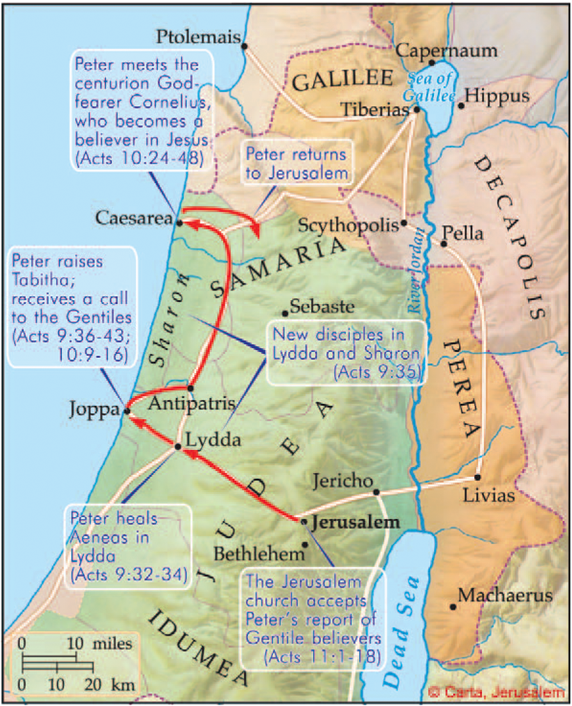
Figure 1 — The regions reached by Peter when Aeneas and Tabitha are healed. Sharon is not a city but a coastal plain of about 30 miles.

Luke makes mention of  Sharon as a segue into a new story using the same main character — Peter the apostle. As we consider this next passage we will also encounter a third principle that must be honored if a ministry is going to use miracles effectively: The Principle of Right Getting.

After Aeneas (Acts 9:36-39)

36 At Joppa there was a certain disciple named Tabithaa, which is translated Dorcasb. This woman was full of good works and charitable deedsc which she did. 37 But it happened in those days that she became sick and died.d When they had washed here, they laid her in an upper room. 38 And since Lydda was near Joppa, and the disciples had heard that Peter was there, they sent two men to him, imploring him not to delay in coming to them. 39 Then Peter arose and went with them. When he had come, they brought him to the upper room. And all the widows stood by him weeping, showing the tunics and garments which Dorcas had made while she was with them.

The contrast is stark. Luke takes his reader away from the scene of repentance, revival, and rejuvenated life in Lydda to a scene of tragedy and mourning about 12 miles away in Joppa. (See Figure 1 above.) Where Aeneas has made his bed and is walking in the gracious gift of restored health, Dorcas is dead. Her lifeless form lies on a table or bed surrounded by weeping widows (Acts 9:39).

While we are wanting to get to the principle of effective use of miracles in ministry we must not be so hurried that we miss other truths that, when prayerfully considered, will do much to help us live effectively in the Lord’s service. First, do not overlook the fact that the person upon whom this illness came was a Jesus follower – a disciple. Disease and even Death itself had visited a woman full of good works and charitable deeds. Think on the facts: (1) Dorcas was a disciple. (2) Dorcas was full of good deeds; her hands were neither idle nor involved in evil. (3) Dorcas got sick. (4) Dorcas died. We do well to consider these facts when we suggest that a person’s sickness today is (a) not God’s will because the person is a Christian or (b) that the sickness will be eliminated by casting it out in Jesus’ name.

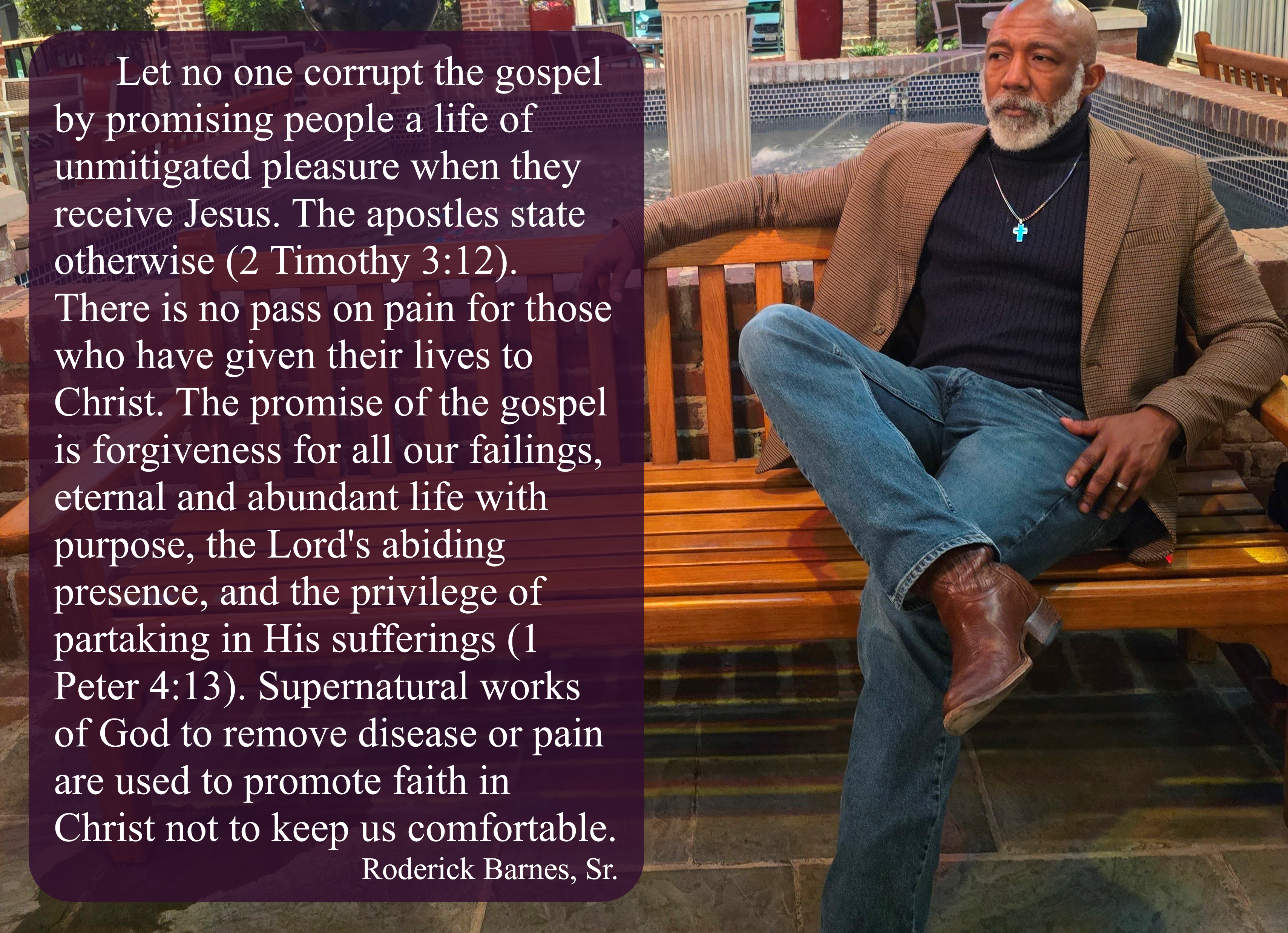
Let us not corrupt the gospel by promising people a life free from sickness when they receive Jesus. There is no pass on pain for those who have given their lives to Christ. The promise of the gospel is forgiveness for all our failings, eternal and abundant life with purpose, the Lord’s abiding presence, and the privilege of partaking in His sufferings (1 Peter 4:13).

Dorcas had used so much of her time and talent and treasure to help the poor that her passing was the cause of exceedingly great sorrow among the disciples… especially the people she had helped. The second thing we must not miss is that Dorcas is missed so much that the disciples decide to ask for something that has not happened in the recorded history of the church at this point: raising the dead. Do not miss the questions that you should ask yourself:

  • Could it be proven that I have, in serving the Lord, provided help for the poor and made a difference that will be missed?
  • Could anyone gather enough evidence of my good deeds to show that my life was a blessing and not a blight on the community?
  • Would the sum total of my good works warrant a crazy plan to get a busy man to come and raise me from the dead?

Having heard about the healing of Aeneas the disciples sent two men to ask Peter to come immediately. He goes with them and, when he has arrived at the home in Joppa, is taken to the upper room. At this point the widows begin working on Peter. They aim to convince him that Tabitha’s life was worthy of a special work of God through him.

Unprecedented Power Displayed Through Peter (Acts 9:40-42; Mark 5:21-43)

40 But Peter put them all out, and knelt down and prayed. And turning to the body he said, “Tabitha, arise.” And she opened her eyes, and when she saw Peter she sat up. 41 Then he gave her his hand and lifted her up; and when he had called the saints and widows, he presented her alive. 42 And it became known throughout all Joppa, and many believed on the Lord.

Peter has seen a situation like this before. During His master’s ministry there was a little girl that had just died. Her father was a ruler in the community (Matthew 9:23) and their position made his daughter’s death highly visible. Jesus assesses the situation and then puts out the people (Matthew 9:24).

Peter sent them and the other mourners out of the room, as he had seen his Master do before he raised Jairus’s daughter from her deathbed; then he uttered a short sentence in Aramaic, differing only in one letter from Jesus’ words to Jairus’s daughter. Whereas Jesus had said Talitha qum (i) (Mark 5:41), Peter now said Tabitha qum (i))—“Tabitha, get up.”

Bruce, F. F. (1988). The Book of the Acts (p. 199). Grand Rapids, MI: Wm. B. Eerdmans Publishing Co.

The ministry of Peter to Dorcas and the community was not occasioned by his presence or his preaching. He became effective in helping them only in his willingness to be humbled. Every knee must bow. His words toward the body were imbued with power only after his pleading. Before he could give the command he needed to get the power. Peter follows Jesus’ lead and gives us the following principle for ministry with miracles:

The Principle of Right Getting (Get Down, Get Help)

What the Church needs to-day is not more machinery or better, not new organizations or more and novel methods, but men whom the Holy Ghost can use — men of prayer, men mighty in prayer. The Holy Ghost does not flow through methods, but through men. He does not come on machinery, but on men. He does not anoint plans, but men — men of prayer. (Bounds, Kindle Locations 46-48)

Figure 2 — Time in prayer with Chancellor Barnes on 2024-11-11 at the home of Austin and Aubrey lane during a Compass Young Adults meeting.

The language of the quote above is old. It speaks of prayer in ways that seem to make it the province and power of men. I will not charge E. M. Bounds with being chauvinistic; he spoke in a manner customary of his times. An updated version of the quote would change the word men to people; people of prayer are an indispensable part of a ministry that will be able to use the miraculous for the glory of God and the good of many. Such people take to heart the words of the Lord regarding prayer and make it their business to both be obedient and follow his example.

  • Receiving Requires Prayer and Faith (Matthew 21:22) And whatever things you ask in prayer, believing, you will receive.
  • Some Changes Require Prayer (Mark 9:29) So He said to them, “This kind can come out by nothing but prayer and fasting.”
  • The Ultimate Purpose of the Prayer is the Glorification of the Son (John 14:13-14) And whatever you ask in My name, that I will do, that the Father may be glorified in the Son. If you ask anything in My name, I will do it.
  • Corporate Prayer in Jesus’ Name Has Special Influence with the Father (Matthew 18:19-20) Again I say to you that if two of you agree on earth concerning anything that they ask, it will be done for them by My Father in heaven. For where two or three are gathered together in My name, I am there in the midst of them.

The Persistence of Peter (Acts 9:43)

So it was that he stayed many days in Joppa with Simon, a tanner.

Aeneas has been healed and Dorcas has been raised from the dead. The miracles were used by Peter to occasion faith in Jesus. And now that there are a number of new believers the real work begins – discipleship (Matthew 28:18-20). Peter stays in the region in order to teach the new believers all that Jesus commanded. Beyond the excitement of the miracle is the more mundane work of day-to-day teaching, mentoring, and helping the Jesus followers in their new relationship with the Lord. Unlike the mass revivals of our day where people are reached and then left to the locals for teaching, Peter stays for a hands-on approach to making disciples.

Questions for Community Discussion

  1. Why did the healing of Dorcas cause many to believe? (Acts 9:37, 42)
  2. Why did Peter stay? (Mark 3:14; Matthew 28:18-20)
  3. Peter prayed before he did anything. Why did he do that? (John 15:15)
  4. Does your approach to helping others and discipleship look like Peter’s?
  5. In what ways should your approach to helping people be changed to match the example of Jesus and the apostles?

Footnotes

a Literally in Aramaic her name means Gazelle.

b Dorcas is Greek for Gazelle. It is obvious that Luke wanted to make his work accessible to an audience that was not Jewish.

e The text that follows is from the Mishna Shabbat – a written redaction of the Jewish oral traditions known as the Oral Torah. Mishna Shabbat 23:5 One may perform all the requirements for a corpse [on Shabbat]: [One may] anoint and wash him, provided one does not move a limb. One may move the pillow from under him to place him on the sand so that he will keep [from decomposing]. One may tie his jaw, not so that it rises but so it does not fall. And similarly, [if] a beam has broken one may support it with a bench or boards from a bed, not so that it rises but so it does not fall. One may not close the eyes of a corpse on Shabbat, nor [even] on a week-day while he is [still] expiring. [If] one closes the eyes of a dying person while he is [still] expiring he has shed blood.

References

E.M. Bounds (2015-11-23). Power Through Prayer (Kindle Locations 46-48). Scriptura Press. Kindle Edition.

The Relentless Love of God for a Non-Prophet

The Relentless Love of God
Jonah 1:5-6
Mariners are professional sailors. They are experts in the matters of traveling on the sea and dealing with problems that are faced with sailing. Their situation is not run-of-the-mill bad weather at sea; these mariners are afraid. The situation is so bad that the sailors have given up hope of saving their cargo; it is being thrown overboard in an attempt to make the ship lighter. I can hear them saying
Forget the cargo! We can lose
the livelihood; we just want to
live. Men, let us try to live through
this. We will deal with the issue
of lost cargo if we can survive this
storm.
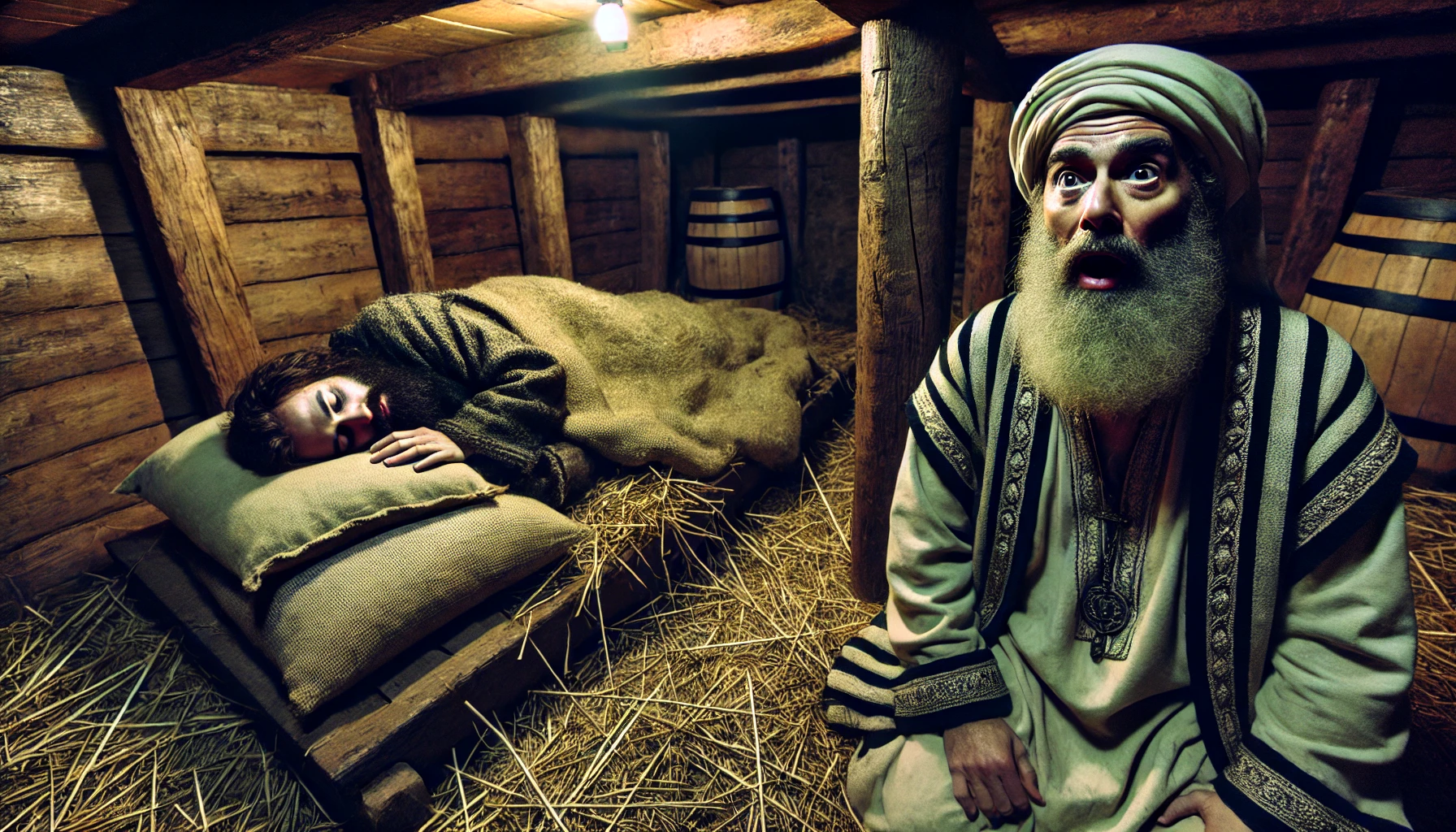
And their efforts to live were not just in the physical; before throwing cargo into the sea they reached out in the spiritual realm for help: 𝐞𝐯𝐞𝐫𝐲 𝐦𝐚𝐧 𝐜𝐫𝐢𝐞𝐝 𝐨𝐮𝐭 𝐭𝐨 𝐡𝐢𝐬 𝐠𝐨𝐝 (Jonah 1:5). It is a chaotic scene. There is a storm threatening to destroy the ship and its crew, men are crying out to their gods for help, and cargo is being thrown out in a desperate attempt lighten the load and survive. But down in the lowest parts of the ship, Jonah is sleeping hard or was fast asleep. When the captain finds the slumbering prophet he is confused. “𝐖𝐡𝐚𝐭 𝐝𝐨 𝐲𝐨𝐮 𝐦𝐞𝐚𝐧, 𝐬𝐥𝐞𝐞𝐩𝐞𝐫?” That is, “What are you trying to tell us, man? What is the meaning of taking a nap when we are about to die? Call on your god!”
Jonah, oblivious to what has been happening, is depressed and has been trying to escape from (1) the presence of the Lord and (2) his own feelings of dismay. Sleep, like drugs or sex, is a coping mechanism and form of escape. He may be sleeping because he walked a bit to get to Joppa. But the fact that he retreated to the lowest part of the ship in an indicator that Jonah does not want fellowship with God or men. He rages against all wise judgement and is running from his calling (Proverbs 18:1).
A man who isolates himself
     seeks his own desire;
He rages against all
     wise judgment.
But his disobedience has put him and the people around him in peril. God had called the prophet for help; the Lord wanted Jonah to bring his word to a wicked city (Jonah 1:1). Jonah refused the call and ran from the Lord. Now he is the one that needs to call out for help. Ironic? Not really. His sin has found him out (Number 32:23) and God is relentlessly pressing on his prophet to come out of his hate-fuled rebellion back into relationship and back into service. The Lord loves Jonah and won’t let him go. Love never fails.
In His grip by His grace,
Roderick Barnes

Missional Living — To Boldly Go! Part 4 (Acts 4:31)

31 And when they had prayed, the place where they were assembled together was shaken; and they were all filled with the Holy Spirit, and they spoke the word of God with boldness.

The answer from Heaven was immediate. As if to say “Let’s shake things up,” the place where they were assembled together was shaken. It says that they were then all filled with the Holy Spirit. This was not a new anointing or fresh anointing as it is called in some circles. The same anointing they had received earlier, in response to the request and renewed surrender, is active in them with expression. What expression? They spoke the word of God in the boldness that they had requested.

But we are made to might ask, (1) why was the building shaken and (2) why is that not happening today when we ask for boldness? First, we must see that a sign was being used as an indicator of a spiritual response. What response, then, is being indicated? When you and I gather to request boldness and backing signs for a ministry that aligns with the mission of witnessing, God answers. The building was shaken as a sign that their prayer was being answered.

Second, for those of us who ask why this is not happening today, we are mistaken. The Spirit is still being poured out on people who believe just as He was poured out on Pentecost; the signs of rushing wind sounds and flaming tongues, however, are no longer needed. Each time a believer receives Jesus the Holy Spirit is given to them (Ephesians 1:13). With the Jews the sign of the promise of the Holy Spirit being provided was heard and seen and experienced as rushing wind, flaming tongues of fire above their heads, and speaking in other tongues respectively. A similar type of sign was given when the Gentiles received Christ (Acts 10:44-48). What was the sign? Gentiles, also known as the uncircumcised, spoke in tongues.

Speaking in tongues was sufficient sign for the circumcised (Jews) to believe that the same spiritual work that had been done in them was now happening in the uncircumcised (Gentiles). There is no mention of the sound of a rushing mighty wind or tongues of fire upon the heads of the Gentiles that heard Peter preach. It was not needed; speaking in tongues was enough to convince Peter and his fellow Jews that the Gentiles had been accepted by Jesus (Acts 10:46). Going forward Jews do not have flaming tongues above their heads when they receive Christ and Gentiles do not erupt in tongues. The purpose of the signs had been served; they had indicated spiritual realities that, when regarded rightly, affect the outlook and conduct of the witnesses. There are times in Scripture where a sign is used to indicate that something spiritual has taken place without seeking to make it normative. That is, there are instances of God performing a work in a special way so as to reveal how He will work in the future in a world we cannot readily perceive. Going forward He continues to do the work but without the sign.

Here is the point, beloved. Pray for boldness and backing signs for the mission of making Him known, the Lord answers these prayers and shakes things up.

God is listening now for prayers to answer. Action: Pray for boldness in the face of persecution. Pray for validation when confronting vicious opponents of the gospel. Let the church convene, call out to God for help, in order that we might succeed in our commission — witnessing.

A word of warning to my fellowship Jesus followers. Don’t try to force God to provide a particular sign. That is, do not insist on signs seen in the early church when there may be one more appropriate for your setting. Backing signs today may be different than what was used in the church in Jerusalem. Do not seek their sign when you may need your own. (In fact, don’t seek signs for yourself at all; they are for those you are trying to reach.) Seek, rather, to have evidence provided by God that will be lend support to the message of the gospel. For example, a sign certifying the gospel in a community that has been ravaged by racism could be real steps toward reconciliation between the races.

In His grip by His grace,
Roderick Barnes

Missional Living – To Boldly Go! Part 1 (Acts 4:23-31; Matthew 28:18-20)

Sharing Problems with People of Faith (Acts 4:23-24)

23 And being let go, they went to their own companions and reported all that the chief priests and elders had said to them. 24 So when they heard that, they raised their voice to God with one accord and said: “Lord, You are God, who made heaven and earth and the sea, and all that is in them,

Immediately upon their release the apostles Peter and John went to their own (ἦλθον πρὸς τοὺς ἰδίους). [The word companions (NKJV) or friends (ESV) has been added for readability. However the text only says they went to their own.] In the company of their fellow Jesus followers they begin to share their experience. What did they share? The threats of the chief priests and elders were reported to their fellowship.

Jesus followers should be intentional and inclined to keep close company with committed Jesus followers… especially when they are being persecuted for Jesus following. (Psalm 1:1-2; Acts 4:23-24)

The companions of Peter and John are said to have raised their voice to God with one accord. What does this mean? Were they were all saying the exact same thing at the exact same time? The word rendered with one accord (NKJV) or together (ESV) is an adverb that literally means with one mind (ὁμοθυμαδὸν). Whether for a good reason (Acts 1:14; 2:1; 2:46; 8:6; 15:25; Romans 15:6) or a bad reason (Acts 7:57; 18:12), they had unity. It is likely that as one in the group was praying aloud the others were sounding out their agreement and support for the words being spoken. We do this by saying “amen” as a person speaks to God on behalf of a group we are in (1 Corinthians 14:16). One-accord praying happens when (1) the Lord’s people convene in His name to make requests (Matthew 18:19-20) and (2) they are unified in purpose. Where the prayers of a single righteous person are effective (James 5:16) there is a special presence and power associated with the gathering of God’s people unified in prayer:

  • The One Accord of God’s People for His Purpose is Indicative of a Special Anointing (Psalm 133:1-2) — 1 Behold, how good and how pleasant it is For brethren to dwell together in unity! 2 It is like the precious oil upon the head, Running down on the beard, The beard of Aaron, Running down on the edge of his garments.
  • The One Accord Praying of God’s People for His Purpose is Especially Effective for Getting Answers (2 Chronicles 7:14; Matthew 18:19-20; James 4:3) — 19 “Again I say to you that if two of you agree on earth concerning anything that they ask, it will be done for them by My Father in heaven. 20 For where two or three are gathered together in My name, I am there in the midst of them.”

Based on the promise of Jesus, this group, unified in purpose and under His person in prayer, will get results. As we consider the prayer we should note that it is very Jewish. It sounds like the worship literature of their Scriptures (Exodus 20:11; Nehemiah 9:6; Psalm 146:6); it begins with an acknowledgement of God’s power and role in the universe – Sovereign Creator.

By starting prayer with a recognition of God’s role in Creation the person praying declares an acceptance of the Lord’s right to rule and their own obligation to obey.

Questions for Consideration

  1. Am I sharing the problems I face with other people of faith? Is it a community that I am committed to?
  2. Is my fellowship unified in purpose? Can we clearly state our purpose?
  3. Do we convene to pray?
  4. In our prayers are we acknowledging God’s right to reign and our decision to obey?
  5. Pray for your government; ask God to give them wisdom for their work and favor in the discharge of their duties.

Being Honest with God (Psalm 13)

Stories That Matter – Your Story (Psalm 13)

1 How long, O Lord? Will You forget me forever?
How long will You hide Your face from me?
2 How long shall I take counsel in my soul,
Having
sorrow in my heart daily?
How long will my enemy be exalted over me?
3 Consider and hear me, O Lord my God;
Enlighten my eyes,
Lest I sleep the death;
4 Lest my enemy say,
“I have prevailed against him”;
Lest those who trouble me rejoice when I am moved.
5 But I have trusted in Your mercy;
My heart shall rejoice in Your salvation.
6 I will sing to the Lord,
Because He has dealt bountifully with me.

David’s Pain (Psalm 13:1-2) – Notice the repetition of “how long.” It stands out in the opening verses as the psalmist’s way of expressing his, as yet, unmet hope of relief. He had been living so long in ongoing discomfort that his pain was erupting in a complaint to the Lord. How long, asks David, will I be forgotten, will your face be turned away, and I live forsaken before my enemies?

    • The Pain of Being Forgotten (Psalm 13:1; Exodus 2:24; Genesis 30:22; Genesis 40:14; Judges 16:28; 1 Samuel 1:11) – When David says You forget me he is speaking in a way that his Hebrew readers would recognize as an unfiltered complaint about not receiving practical help. David is not saying that God’s memory is failing. He is being candid in communicating his disappointment in the Divine decision to leave him so long without real help. “How long, O Lord, will you leave me without practical help?”
    • The Pain of Not Being Faced (Psalm 13:1; Psalm 11:7; Psalm 17:5) – David’s chief desire is to be in face-to-face fellowship with God (Psalm 27:4, 8). His heart, summarily speaking, beats to behold God, longs to look at the Lord, and seeks to see Him. When he says You hide Your face from me David is giving vent to his deepest pain – to not have God’s attention. To see God’s face is to have the privilege of looking at the Lord and, most importantly, to have God look back at you – to see you with approving eyes (Leviticus 26:9; Exodus 2:25). “How long, O Lord, will you not take notice of me. How long will you intentionally ignore me?” He feels like God does not notice him in this moment of difficulty.
    • The Pain of Being Forsaken (Psalm 13:2; Psalm 35:19; Psalm 69:4; ) – David is a man on a mission; he lives to lead the people well. This means leading them in wisdom and against adversaries of God and His heritage. Those who hate God hate David, the representative. It is especially comforting to know that God has your back when you are in trouble for being with Him. It is especially painful to not sense His support when suffering for His sake (Psalm 22:1; Matthew 27:46; Mark 15:34).

Speaking my complaint about God to persuade others that He is not good is called blasphemy; it is an attempt to (1) dissuade faith in Him, (2) denigrate His character, and (3) aligns me with His enemy the devil (Genesis 3:4-5). Speaking my complain to God is part of my relationship with Him. He already knows my grief; getting it out actually brings alignment between my conversation and my contemplation. When I share my disappointment with God I am operating with integrity.

David’s Prayer (Psalm 13:3-4) – The distress of the shepherd king was not just in feeling forgotten. He was also dealing with the threat of death. His enemies were not content to malign the man of God; they would be satisfied only when they were able to take his life; the reference to the sleep of death is a Hebraism indicating belief in (1) life beyond the grave and (2) resurrection (John 11:11-15; Acts 7:57-60).

David is not against the eventual laying aside of his earthly tent in order to go and be with God. He is concerned that his cause, and by extension the reputation and goals of God, would be harmed if his enemies could say they had prevailed against him. Their rejoicing would not be merely over the defeat of David but at a win in the war against God. Do this for me, O LORD my God, lest my enemy say, “I have prevailed against him.” The enemies of David are first and foremost enemies of the LORD; David is hated because he is aligned with God (Psalm 69:9):

9 Because zeal for Your house has eaten me up,
And the reproaches of those who reproach
You have fallen on me. 

The prayer of David is not a self-absorbed request for relief from his enemies; it is not about him. It really is about God. Can I say that about my prayers? That is, am I so aligned with God’s will that my prayers for help are really about help for doing His will? Listen to Jesus!

In this manner, therefore, pray:
Our Father in heaven,
Hallowed be Your name.
10 Your kingdom come.
Your will be done
On earth as it is in heaven. (Matthew 6:9-10)

David’s Perspective and Praise (Psalm 13:5-6) – Having cleared the air (Psalm 13:1-2) and called for help (Psalm 13:3-4) the psalmist is able to return to worship. Based on what? He returns to rejoicing and singing to the LORD based on his perspective of God.

    • The Loyal Love of God (hesed) – The character of God is not changing with the times. In His character is His mercy or loyal love (hesed) for his people. Circumstances can make it look like God is distant. However, the truth about who He is should help us to escape the gravity of dark meditations (Psalm 1; Philippians 4:8; 1 Timothy 4:15; Joshua 1:8-9).
    • His Experience with God – David has had a good history with God. In the tribulation of our lives we can forget to remember. We can stop regarding out history of God’s great grace. His present and past goodness is the reason why we can keep singing even when things look bad.

Questions for Reflection

    • In the midst of our issues some of us have felt forgotten? What has caused you to feel forgotten, not faced, or forsaken? Based on Psalm 13:1-2, what can you do with your disappointment in your relationship with God?
    • David’s prayers, on the surface, seem to be about himself. What are his real concerns? (Psalm 13:4; 69:9)
    • The strength to sing and the heart to rejoice are the outworking of our perspective. Looking at my circumstances will make me unstable and sometimes unable have a positive attitude. To steady my heart and promote a positive outlook in the midst of my mess what should I focus on? (Psalm 13:5-6)

Prayer

God, I admit my disappointment with how things have been going. In fact, I confess my frustration with Your handling of some things. Thank you for allowing me to be honest about how I feel and revealing Yourself to be approachable.

Help me to align myself with Your will. And as I deal with the difficulties of today and tomorrow keep pushing me to remember how good You are and how good You have been to me. I commit again to praising you through the storm.

References

Kidner, D. (1973). Psalms 1–72: an introduction and commentary (Vol. 15, p. 94). Downers Grove, IL: InterVarsity Press.

Ross, A. P. (1985). Psalms. In J. F. Walvoord & R. B. Zuck (Eds.), The Bible Knowledge Commentary: An Exposition of the Scriptures (Vol. 1, pp. 801–802). Wheaton, IL: Victor Books.