Spirit-Filled People

54 When they heard these things they were cut to the heart, and they gnashed at him with their teeth. 55 But he, being full of the Holy Spirit, gazed into heaven and saw the glory of God, and Jesus standing at the right hand of God, 56 and said, “Look! I see the heavens opened and the Son of Man standing at the right hand of God!”
57 Then they cried out with a loud voice, stopped their ears, and ran at him with one accord; 58 and they cast him out of the city and stoned him. And the witnesses laid down their clothes at the feet of a young man named Saul. 59 And they stoned Stephen as he was calling on God and saying, “Lord Jesus, receive my spirit.” 60 Then he knelt down and cried out with a loud voice, “Lord, do not charge them with this sin.” And when he had said this, he fell asleep. (Acts 7:55-60 See also Zechariah 4:6)

God is pleased to accomplish His work in this world through men and women who are yielded to Him. Again and again in Scripture, when the Lord purposes to build, guide, strengthen, confront, comfort, or advance His saving mission. He does so by filling surrendered vessels with His Spirit. Zechariah 4:6 over a list like this one below giving it summary: “Not by might nor by power, but by My Spirit,” says the Lord of hosts. The names below remind us that the progress of God’s kingdom does not rest finally on natural talent, human energy, or earthly strength. The Spirit of God, working through those who are willing to be used by Him, is the means by which His ministry moves.

On this list, Stephen shines as one of the clearest examples of what Spirit-filled surrender looks like. He was full of faith, full of power, and full of the Holy Spirit in life. When the hour of his death came, he remained full of the Holy Spirit still. Even as he was opposed, falsely accused, and finally killed, Stephen stood as a surrendered vessel through whom Christ was put on display. In him we see that to be filled with the Spirit is not merely to be useful in moments of visible ministry, but to belong so wholly to God that one may bear witness to Christ faithfully even unto death. Stephen, therefore, does not merely appear on this list; he epitomizes the very meaning of being surrendered and used by the Spirit of God.

  • Bezalel was filled for craftsmanship, tabernacle work, and teaching (Exodus 31:2–5; 35:31-34)
  • Seventy elders of Israel were filled and enabled to help bear leadership (Numbers 11:16–17, 25)
  • Joshua was full of the spirit of wisdom for leadership (Deuteronomy 34:9)
  • Othniel was a man upon whom the Spirit for judgment and deliverance for oppressed people (Judges 3:9–10)
  • Gideon was also a judge; the Spirit clothed him for leadership in battle (Judges 6:34)
  • Jephthah was a judge; the Spirit came upon him for conflict and deliverance (Judges 11:29)
  • Samson was empowered by the Spirit to help God’s oppressed people (Judges 14:6, 19; 15:14)
  • Saul was anointed by the Spirit and for a while served with extraordinary good character and courage (1 Samuel 10:6, 10)
  • David was anointed and used by the Spirit to lead God’s people as Israel’s second king (1 Samuel 16:13)
  • Micah was full of power by the Spirit to confront sin (Micah 3:8)
  • John the Baptist was filled with the Holy Spirit from the womb (Luke 1:15)
  • Elizabeth was filled with the Holy Spirit and spoke blessing (Luke 1:41–45)
  • Zechariah was filled with the Holy Spirit and prophesied (Luke 1:67–79)
  • Jesus was filled with the Holy Spirit and ministered in the Spirit’s power (Luke 4:1, 14, 18)
  • The believers at Pentecost were all filled and spoke as the Spirit gave utterance (Acts 2:4)
  • Peter was filled with the Holy Spirit for bold witness (Acts 4:8–12)
  • The gathered church was filled and spoke the word boldly (Acts 4:31)
  • Stephen was full of the Holy Spirit, did wonders, and remained full of the Spirit at his death (Acts 6:5, 8; 7:55–60)
  • Barnabas was full of the Holy Spirit and faith, with fruitful ministry (Acts 11:24)
  • Paul was filled with the Holy Spirit in powerful confrontation and ministry (Acts 9:17; 13:9–11)

Samson’s Humiliation, His Help for Others, and God’s Hope for Us

There are four women mentioned in the life of Samson. Three of the four are nameless. His mother is the first of the nameless in the story. She is, in a very literal way, called upon by God to help make the man (Jeremiah 1:5; Isaiah 49:1); in the matrix of her womb God fashions a judge for the special task of bringing deliverance to His people (Judges 13:5; 15:18). It was his mother, no doubt, that conveyed to him the special instructions given her by the Angel of the LORD (Judges 13:5, 7). Of great import was the part about no razor coming upon his head. I believe that it is to her that we should attribute Samson’s understanding of where his great strength lay. (My view is also based on the fact that the Angel of the Lord repeatedly appears to her… not her husband.) His mother’s words are quoted when he told his secret to the fourth woman of his story (Judges 16:17).

“…he told her all his heart, and said to her, “No razor has ever come upon my head, for I have been a Nazirite to God from my mother’s womb. If I am shaven, then my strength will leave me, and I shall become weak, and be like any other man.” (Judges 16:17, NKJV)

Why are three of the four women in Samson’s story kept nameless? Their purpose does not require their names and the use of a name, when the author does provide one, serves to move the reader from concept to a final concrete example of what ails Samson. They are featured as foils; the second and third woman are the means by which the author reveals Samson’s tragic character flaws. Through his interactions with them we become witness to the worst symptom of Samson Syndrome: unbelievable blindness.

The name of his wife is not necessary for what the writer would show the reader. Where she is involved the main points are these:

    1. She is not a woman of God (Judges 14:3).
    2. She pledges allegiance to her people and not her husband (Judges 14:16-17).
    3. She uses his feelings for her to gain information that will be used against him.

The name of the harlot is also not important. Without her name the writer is still able to convey these key facts:

    1. She is not a woman of God.
    2. She pledges allegiance to her countrymen and not her Hebrew customer. Who was it that told the Gazites that Samson was in their midst (Judges 16:2)? I submit that it was the harlot. Between the betrayals of his wife and Delilah this would be a consistent thread in the life of the judge.
    3. She uses his compromise against him.

Having shown the reader Samson’s tendency toward compromise and vulnerability through unsanctioned relations (Deuteronomy 7:3-4), the author is finally ready to reveal the judge’s end. It is not surprising that it is at the hands of a woman. By this time in the story we have been prepared for this. Now, having shown us where his great weakness lies, the woman that will destroy him is given a name – Delilah.

The attributes and subversive activities of the prior women (wife and harlot) are shown to be both proleptic and prophetic. With both his wife and the harlot the judge is unmade. By relentless repetition the reader is made to see that Samson cannot see. “Behold, oh reader, his blindness,” says the writer. “No matter how many times it happens, he cannot see it coming.” As we look upon him in the tragic violence of losing his eyes we have this lesson: his loss of eyesight was due to his lack of insight.

The relationship with Delilah is given more space in the narrative than any other relationship that Samson has had. All the previous material was leading up to this. It was leading up to the calamitous loss that would follow him loving a woman who does not love God. It was leading up to the sad end of a powerful man being in a relationship where the woman is never committed to him. It was leading up to the part where his mistress uses his feelings to pry information out of his heart (Judges 16:16). Through the constant pestering that we saw first in his wife Samson is made to give up his great secret (Judges 14:16-17). But couldn’t he see that every time he revealed something to Delilah that she tried it? Did he not notice that she tested each supposed truth to see if he could really be rendered as weak as any other man?

Questions for Community Discussion

  1. Are you in relationships that compromise your ability to see clearly?
  2. When you evaluate your close relations do they contribute to doing God’s will or get in the way?

Samson, c’mon man, if she has checked each of your lies to see if you can be brought down… didn’t you see that if you told her the truth that you were going to get a haircut? You had to see this coming. Right?

No! He didn’t. The scales of sin have so covered his eyes that he is spiritually blind (Acts 9:18). Samson is blind to the pattern in his life seen first with his wife and then the prostitute. He is blind to the problem of loving a woman that does not love God – his wife (Deuteronomy 7:3-4; 1 Kings 11:3-4). Blind to the problem of being led by his lust – his prostitute. Blind to the plan playing out before him through Delilah – his mistress. It is painful to watch him played. But through his folly we can be made wiser.

11 Now all these things happened to them as examples, and they were written for our admonition, upon whom the ends of the ages have come.  1 Corinthians 10:11 (NKJV)

When a man is suffering with Samson Syndrome he is fundamentally incapable of seeing that his sin is killing him. In his own eyes he is too clever to get caught, too favored to fail, and too emotionally compromised to see that his lover is leading him to his end (Proverbs 7:26). He did not see it coming and neither will you. If you are in romantic and/or sexual relationships outside of God’s will your vision is being lost and with each decision to disobey God you are becoming blind.

What can we do if we find ourselves in this situation?

  1. Be Accountable – Samson was always alone and refused to receive counsel. The decision to be unaccountable was unmaking him and is unmaking you. Confess your sin and become unconditionally accountable to a few godly men. Confess all of it; half-done confessions and inconsistent meetings with your accountability circle are signs that you are not really accountable. It is an indicator that you are more concerned with avoiding consequences of crimes against God than grieving His Spirit.
  2. Be Broken – This means dispensing with the idea that you are indispensable, invincible, and inscrutable. Seeing yourself as desperately needing God’s grace is the opposite of what Samson Syndrome is telling you (Psalm 34:18). Beyond confession their must be contrition and a real willingness to be led by the Lord. Getting mad when people correct or criticize you? This is a sign that you are not broken. You claim a dignity that does not belong to you. Don’t just accept criticism – ask for it. Or, as Dr. Alex Mandes once told me, lean into it.
  3. Be in Christ – Finding your significance in romantic relations is not going to work. You were made for Him not for her. Trying to fill your cup with that type of love will leave you empty and thirsty. Ultimately you must find meaning and happiness in Christ first. When you can be satisfied in Him you can at last be satisfied with her. And before she can be yours… she must be his. Do not make the mistake of loving a woman who does not love God. The results are tragic.

On Another Level (Judges 16:1–3, NKJV)

1 Now Samson went to Gaza and saw a harlot there, and went in to her. 2 When the Gazites were told, “Samson has come here!” they surrounded the place and lay in wait for him all night at the gate of the city. They were quiet all night, saying, “In the morning, when it is daylight, we will kill him.” 3 And Samson lay low till midnight; then he arose at midnight, took hold of the doors of the gate of the city and the two gateposts, pulled them up, bar and all, put them on his shoulders, and carried them to the top of the hill that faces Hebron.

Samson is no longer getting into marriages with Philistine women. But he has not learned his lesson. In fact, things are worse. Now, the judge of Israel is picking up harlots. Why did he do that? It was for the same reason that he married the Timnite; he saw her and desired her (Judges 16:1).

Samson is a long way from home in multiple ways. First, Gaza is roughly 30 miles from his home in Zorah. He is as far in Philistine territory as you can get without getting wet. Second, he is living a debauched lifestyle. Fraternization and the development of family relationships with Philistines has given way to illicit sex with a Philistine harlot. The author wants us to also see how forward Samson has become. He is not just in the territory of the enemy he has the audacity to sleep with their women and then declare his superior martial might by taking the doors of the city.
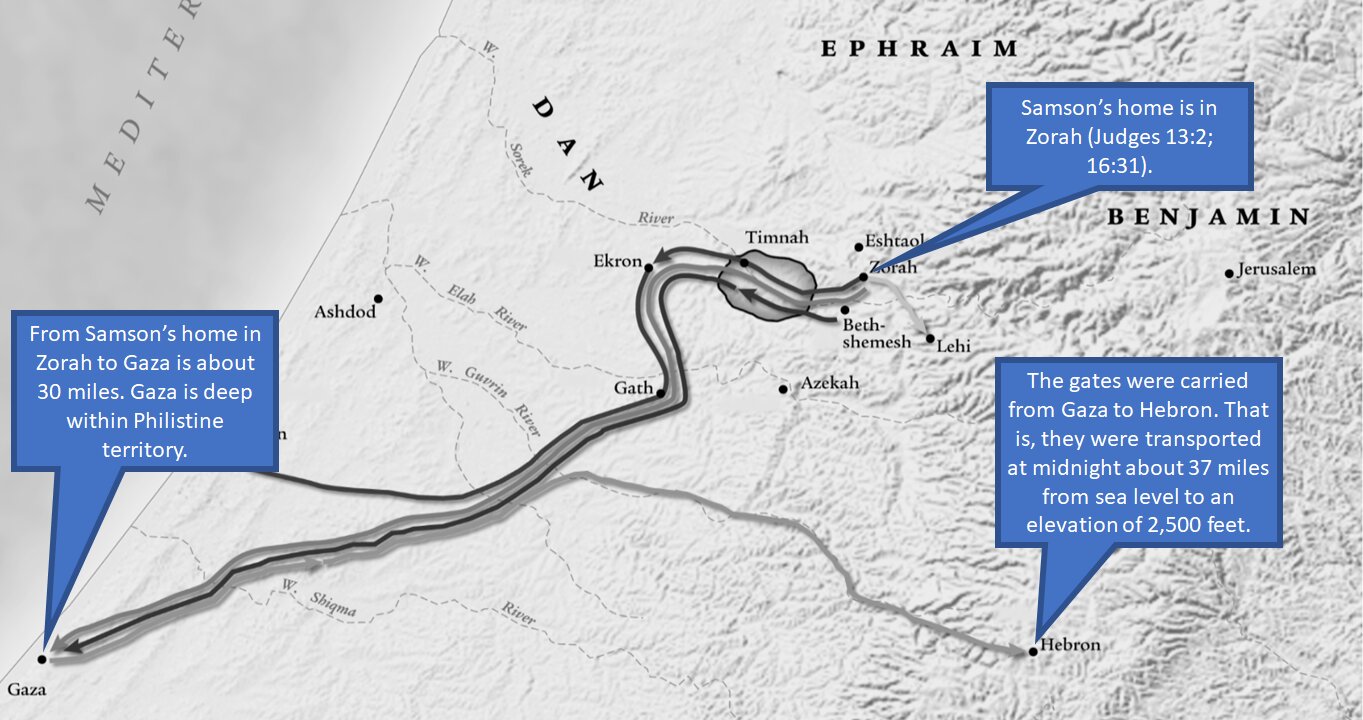
On this point we do well to stop and think on these last two verses. Otherwise the import and impact of what the writer is saying will be lost. Regarding the situation, character and capabilities of the judge, and outcome, the following four things should be noticed. First, the adversaries were lying all night in wait at the gate of the city (Judges 16:2). Second, Samson goes to the place where they were waiting, took hold of the doors of the gate of the city, pulled them up, bar and all, and put them on his shoulder (Judges 16:3). Most commentaries find it perplexing that he is not caught. But I think that is the writer’s point. D. I. Block does a great job of pointing out the difficulties in explaining a quiet escape:

These elaborate gate houses were often two or three stories high with guard rooms flanking the tunnel-like opening. If the defensive gates of Gaza were like those of other cities of the time, to get to the gate of the city Samson would have had to get past four or six groups of guards stationed in the guard rooms. Did the men posted here assume Samson would stay with the prostitute all night, or did they simply doze off? Surely Samson would have created considerable noise unlocking the gate, lifting the doors, and pulling the hinge posts out of their sockets. Is one to assume that Yahweh put the night sentries into a sleep so deep they did not wake up even from this racket? (Block, 1999, p. 450)

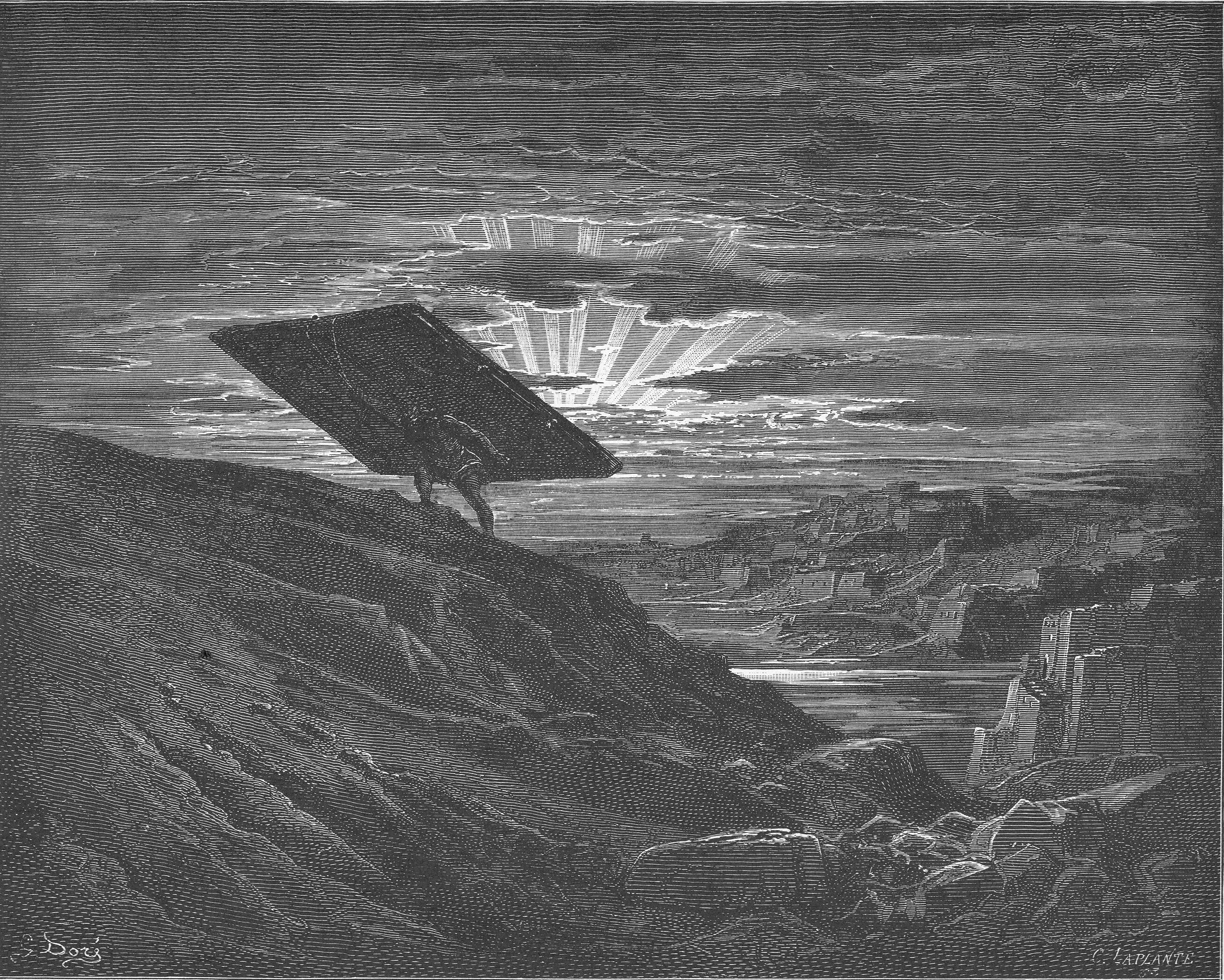
Most commentaries assume he was trying to make a quiet escape. However, the writer is describing a man that has become acquainted with excess and is brazen enough to travel deep into enemy territory for a night of pleasure. Third, he carries the doors, likely in excess of 800 lbs each, from sea level to an elevation of 2,500 feet 37 miles away. Quietly? It is not likely that the operation was done in stealth. But it was done quickly. Let that sink in. Fourth, he did it without the benefit of daylight – it was midnight. It has been 20 years since the incident at Lehi. In that time the judge, now a man in his mid 40s, has not lost a step. In fact, based on this passage, he is significantly more capable than he was as a younger man. Remember that after his last show of strength he was depleted and near death (Judges 15:18). There is no record of our judge being winded or weary. The passage is silent on his physical state when he arrived at the top of the hill that faces Hebron (Judges 16:3) – 37 miles away. But if you read to the end you cannot help but wonder if his abilities have increased with the lengthening of his hair. Just sayin’.
Questions for Community Discussion

  1. Do you think that Samson’s morality has increased, decreased, or remained the same?
  2. Has your life trajectory changed for better or worse? Are you on a trajectory that leads to more holiness and more helpfulness to the people of God?
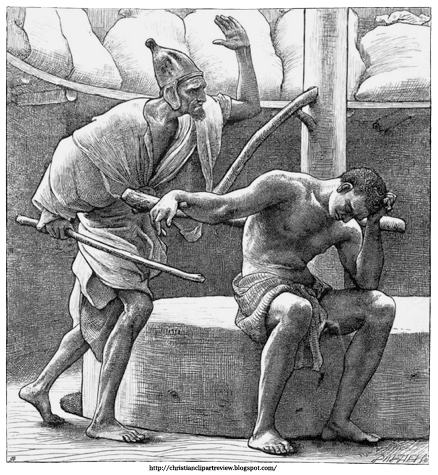
The Defeated Minister of Deliverance (Judges 16:23-24; Jeremiah 10:14; Isaiah 42:17; Romans 1:22-23; 1 Corinthians 1:20)

23 Now the lords of the Philistines gathered together to offer a great sacrifice to Dagon their god, and to rejoice. And they said: “Our god has delivered into our hands Samson our enemy!” 24 When the people saw him, they praised their god; for they said: “Our god has delivered into our hands our enemy, The destroyer of our land, And the one who multiplied our dead.”  

From the perspective of the Philistines the proof of Dagon’s superiority to other deities is obvious and practical. As the Philistines see it, concerning the question of who is a greater god, the case is closed: the champion of Yahweh has been humiliated and delivered into their hands? In their view Dagon is to be credited with blinding, binding, and breaking Samson their enemy (Judges 16:23). They are gathered together to offer a great sacrifice to Dagon their god, and to rejoice, because their suffering has ended; their god has put a halt to the activities of an Israelite that was hitting them where it hurt.

Samson has earned the title destroyer of the land; the long-haired Hebrew had burned Philistine grain, olives groves, and vineyards (Judges 15:5). And that is not all. Samson had also earned the moniker one who multiplied the dead because he had single-handedly killed a thousand Philistine men using only the jawbone of a donkey (Judges 15:14-17). In him the talk of the Torah became a modest mention of how the hand of God could use a single man to put enemies to flight (Leviticus 26:8).

When the people saw Dagon (Judges 16:24), they praised their god. You should read this and imagine that Dagon has been brought into view. The carved image has been carted onto some type of stage and the place erupts in a roar of worship for the false God. It may have been a chanting of the false god’s name or a song. The reason for their breaking forth into praise is given:

for they said: “Our god has delivered into our hands our enemy, the destroyer of our land, and the one who multiplied our dead.” (Judges 16:24, NKJV)

All of this rejoicing because of the blinding and binding of one man. Why? One man, used by the Spirit of God, was all that it took to bring Israel some real relief and begin (note the begin of Judges 13:5) breaking the hand of oppression. It was a deliverance ministry that the people of God were too dull to discern, too hard-hearted to have, and too acclimated to affliction to accept. Even though Samson was overpowering the oppressors his brethren were bothered and ready to betray him:

…three thousand men of Judah went down to the cleft of the rock of Etam, and said to Samson, “Do you not know that the Philistines rule over us? What is this you have done to us?” … (Judges 15:11, NKJV)

Can you hear their acceptance of forced servitude? Can you hear their surrender to subjugation. In the minds of the men of Judah the fight is over and the Philistines are in control. This hairy man is messing up the status quo. They were as blind as their judge. They have eyes but could could not see it happening (Isaiah 6:9; Jeremiah 5:21; Matthew 13:14). See what? a deliverance ministry. Nobody steps up to help Samson. Nobody steps in to encourage him in his calling to bring deliverance (Judges 13:5). Instead they cry out, “Stop it, Samson!” The irony is that, although Israel did not get it, their enemies did.

To be sure, Samson as a deliverance minister was seriously hindered by his sensual appetites. And he was hardly willing to rally his brethren to work against their yoke of oppression. But he was not more deplorable than any other man. He was like every other man in an unwillingness to be solemnly dedicated to God’s will – to a deliverance ministry. For Samson the heavenly mission of making freedom available to the men and women of Israel was not as important as his mission to be sexually satisfied. Just as bad as his failure to focus on delivering God’s people is the people’s don’t-give-a-flip attitude about getting help. Unlike previous cycles into disobedience and chastening, the people had not cried out for help. They didn’t want it. And now Israel’s deliverer is in a dungeon and a false god is being credited with defeating him. It looks bleak. But the grace of God is greater than our fallenness and His deliverance ministry Is. Not. Done.

I Was Blind But Now I See (Judges 16:25-27)

25 So it happened, when their hearts were merry, that they said, “Call for Samson, that he may perform for us.” So they called for Samson from the prison, and he performed for them. And they stationed him between the pillars. 26 Then Samson said to the lad who held him by the hand, “Let me feel the pillars which support the temple, so that I can lean on them.” 27 Now the temple was full of men and women. All the lords of the Philistines were there—about three thousand men and women on the roof watching while Samson performed.

The scene is a party. And what secular party does not include copious amounts of alcohol. The phrase when their hearts were merry is used to indicate that the people have become intoxicated (Judges 9:27; Ruth 3:3, 7; Luke 12:19; 15:29, 32); it is in that light that we are to see their summons for Samson. Drunkenness has made the people less wary than usual. With their inhibitions suppressed they are not thinking things through and not likely to notice that the man-made-strong-by-hair has hair again (Judges 16:22). Their mistake of not noticing his mullet is made worse, for them, by his strategic positioning – between the pillars (Judges 16:25). Between the large supports for Dagon’s temple the judge of Israel is made to perform.

Samson never let on to his plan. In fact he played along in order that at last he might play his persecutors. Instead of asking to lean against just any pillars, Samson specifically requested the pillars which support the temple. The lad was likely not inebriated. However, lacking adult insight into the mindset of captors, he missed the red flags:

Red Flag 1: Bad Hair Day – An enemy whose super strength was found to be in his hair was shaved and then his eyes were put out. He should be bald but he has hair again.

Red Flag 2: Prisoner Positioned According to His Petition – The enemy is asking to be positioned so that he has access to the one place that can bring this whole building down on the people mocking him. Nobody has a problem with giving the prisoner what he wants.

The author takes a moment to help the reader understand the import of what has been said: the temple was full of men and women. Most importantly, in the crowd of sauced revelers were the people who had paid handsomely for Samson’s betrayal and by extension his blindness – the lords of the Philistines (Judges 16:5). Besides the people in the temple there were three thousand men and women on the roof enjoying the spectacle of a humiliated Hebrew enemy.

Despite his blindness Samson has gained perspective. “I was blind but now I see,” says Samson. What do you see, Samson? You lack eyesight. “But now I have insight.” His eyes are gouged out but his heart has unprecedented clarity. He sees a singular and costly opportunity to be used by God for deliverance ministry.

Questions for Community Discussion

  1. Why might God have been disappointed or upset with his judge Judges 16:23-24; 2 Samuel 12:14)
  2. Do you see in this passage any indicator that God is actually orchestrating events?
  3. When things are at their worst Samson sees an opportunity. Are you inclined to look for ways to serve God when things are bleak?

The Weak Made Strong (Judges 16:28-30; Hebrews 11:34)

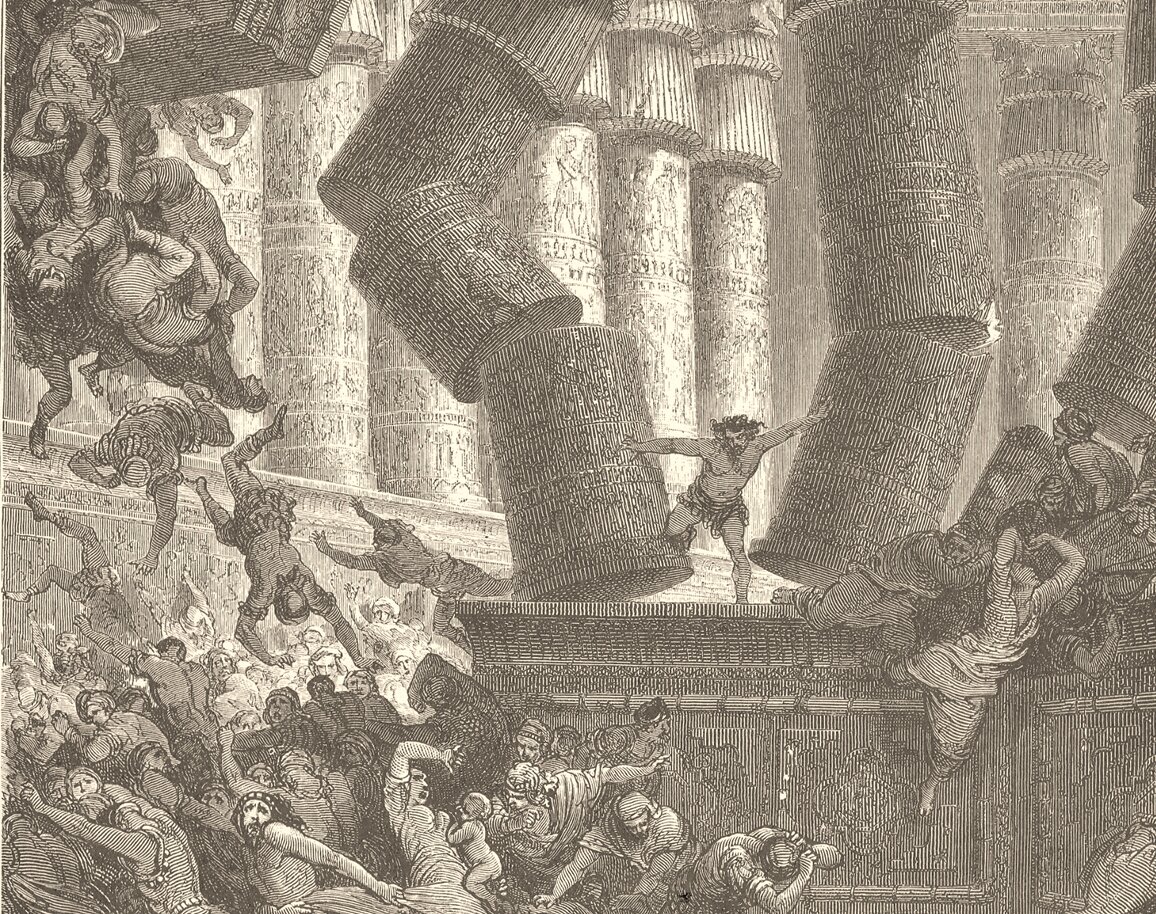
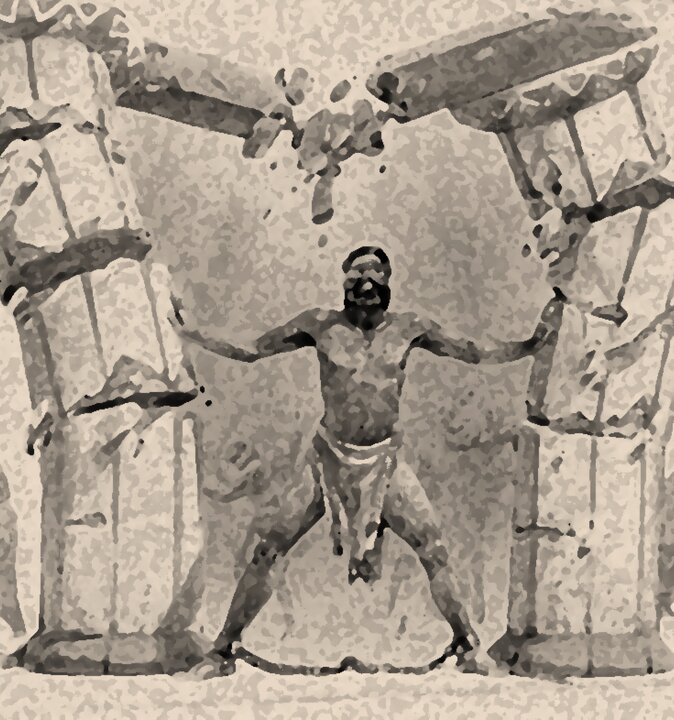
28 Then Samson called to the Lord, saying, “O Lord God, remember me, I pray! Strengthen me, I pray, just this once, O God, that I may with one blow take vengeance on the Philistines for my two eyes!” 29 And Samson took hold of the two middle pillars which supported the temple, and he braced himself against them, one on his right and the other on his left. 30 Then Samson said, “Let me die with the Philistines!” And he pushed with all his might, and the temple fell on the lords and all the people who were in it. So the dead that he killed at his death were more than he had killed in his life.

Many are the commentaries that draw attention to the number of times that Samson says I in his prayer. None overlook the opportunity to draw attention to his apparently selfish reasons – vengeance… for my two eyes (Judges 16:28). Finally, and almost invariably, Bible scholars regard Samson’s request to die with the Philistines with derision (Judges 16:30). I do not share the perspective of erudition. Maybe that means you should stop reading now and stay with popular perspectives put forward by the learned.

Well, you kept reading. o, having been warned, let us look at these verses through the lens of the context and in the light of other Scriptures. That is, let us peer at this passage with interpretation help that comes from surrounding material and other biblical writings that mention Samson and this incident.

To impugn Samson’s prayers because of his repeated use of the personal pronoun I seems to miss the fact that it is a special affront to raise a hand against the Lord’s messenger or the Lord’s anointed (1 Samuel 24:6, 10; 19:21) – even when that person had behaved dishonorably. King David killed a man for as much (2 Samuel 1:14, 16). When David, an anointed king, writes during his flight from his own son he is profuse in his use of the words me/my (7 times) and I frequently (Psalm 3:1-4). There are other psalms where the psalmist asks for retribution and mentions rejoicing in vengeance (Psalm 13; 18:37-50; 58:10). But is Samson anointed? The works he had done were by the Spirit (Judges 13:25; 14:5-6; 14:19; 15:14). But you will say that the Lord had departed from him (Judges 16:20). The Lord would also depart from Israel’s first king, Saul (1 Samuel 16:14). However, once anointed that king was still regarded as anointed (2 Samuel 1:14, 16).

In his humiliation Samson has had time to think. The calling on his life and his callous casting away of the needs of his people are fresh on his heart. His newfound identification with Yahweh meant that the mockery aimed at him was also against the Lord, that the praising of Dagon was his fault, and that the gouging of his eyes was seen as a defeat of the one true God. Did he want vengeance for his lost eyesight. Certainly. Just be careful not to see Samson as lacking faith and an awareness of his mission. Why? Because the writer of Hebrews helps us to see that it was by faith that the weak became strong (Hebrews 11:32, 34). A man lacking commitment to the cause found the strength to (1) make the ultimate sacrifice and (2) be superhuman one more time. But for a better reason – a great work of deliverance. Some say that Samson’s prayer was bad and suicidal. Hardly! It was finally a crying out from complete commitment, a wayward man’s willingness to wage war and fight the good fight, and a determination to die doing what he was born to begin – deliverance ministry.

“Don’t let me die of natural causes. O God, don’t let me die apart from what you fashioned me to do. Let me die as your agent of angst against your enemies and the enemies of your people. Oh God, let me die on purpose.”


Conclusion (Judges 16:31)

31 And his brothers and all his father’s household came down and took him, and brought him up and buried him between Zorah and Eshtaol in the tomb of his father Manoah. He had judged Israel twenty years.

Israel’s judge is dead. And in the end he killed so many of the enemy that there is no one left to protest the claiming of his broken body; the five lords of the Philistines are among the dead. And so his family is able to come down and take him. They bury him in a place that has not been mentioned since Judges 13:2 – the beginning of the story. In this bookend of words the author indicates closure on the story of Samson. Between these markers there has been a strong message about Israel’s last great judge.

  • The Calling — There was a great calling on his life to liberate his people from oppression. God equipped him to carry out the mission with supernatural gifts from the Spirit.
  • The Compromises — Early on it is clear that his calling is undermined by his continuous compromises through the company he keeps.
  • The Consequences — Finally the strong man is made weak by his decision to love a woman who does not love God.
  • The Compassion — God graciously grants Samson strength so that he can use the last of his life for what he was born to do.

There is a great calling on our lives and God has equipped us to carry out that calling in the power of the Holy Spirit. Our calling is hindered or else helped by the company we keep. And our strength will be greatly reduced by the consequences of folly. However, the grace of God is greater than our sin. If we will turn your eyes upon Jesus we can find grace to help in our hour of need. In the power of His Spirit we can go back to doing what we were born again to do.
Questions for Community Discussion

  1. What would it look like to become more accountable?
  2. Do you know what calling is on your life and what abilities you have been given?
  3. How could your gifts be used to bring help to those who are oppressed and in need of deliverance?

References

Block, D. I. (1999). Judges, Ruth (Vol. 6, p. 450). Nashville: Broadman & Holman Publishers.

Wrath without Wisdom, Power without Purpose

Key Verses:

  • Exodus 17:6-7 – per the command of the LORD, the rock is struck twice and water came out of it for the people to drink. The place was called Massah and Meribah because there the people tempted the Lord saying “Is the LORD among us or not?” and because it was a place of contention.
  • Numbers 20:7-13 – against the command to speak to the rock Moses strikes the rock twice and monologues about the rebellion of the people and the onerous work of providing for their needs. (Striking twice was the direction given the last time this situation occurred.)
  • Judges 15:18-20 – We are witness to a turn in the story: Samson’s supplication. In the strong man’s praying we are able to discern his perspective on the meaning of this event (great deliverance), his recognition of his role in God’s work (servant), his primary concern (I die of thirst), and fear (fall into the hand of the uncircumcised).

Samson Syndrome causes a man to see the world as an extension of himself. Family, friends, the household of faith, and even foes are nothing more than foils in theatre in which he is the main character. He says through his words and actions, “It is all about me! And, until you are needed or wanted, you are to wait until I call you.” (Judges 15:1)

In a world that operates in full cooperation with the self-centeredness of Samson Syndrome, no one has the right to move on with their own life. The man (or woman) gripped by Samson Syndrome views themself as entitled to your undivided devotion. Regarding the giftedness of such a person, that too is really for them. (Do not get lost is a smog of words about how they see the gift. Look closely and it becomes apparent whether the gift is for service or self service.) That is, the giftedness of a man with Samson Syndrome, is not willingly given to God for His glory or used for the good of others; it is used, if at all, for the man himself.

Although Samson’s gifts and talents could be leveraged to set at liberty those who are oppressed, the man will not engage. To use him to help others God has to factor in his narcissism. The community will benefit from the special abilities in the man with Samson Syndrome only when he is doing it for himself.

Burn, Baby, Burn (Judges 15:1-5)

15 After a while, in the time of wheat harvest, it happened that Samson visited his wife with a young goat. And he said, “Let me go in to my wife, into her room.” But her father would not permit him to go in. Her father said, “I really thought that you thoroughly hated her; therefore I gave her to your companion. Is not her younger sister better than she? Please, take her instead.” And Samson said to them, “This time I shall be blameless regarding the Philistines if I harm them!” Then Samson went and caught three hundred foxes; and he took torches, turned the foxes tail to tail, and put a torch between each pair of tails. When he had set the torches on fire, he let the foxes go into the standing grain of the Philistines, and burned up both the shocks and the standing grain, as well as the vineyards and olive groves.

When Samson was last in Timnah at his own wedding feast there was much drama. Believing himself to be more clever than anyone else, he posed a riddle to the guests (Judges 14:12-14). If they were able to figure out his riddle he would give them 30 changes of clothing. If not, the guests would give him 30 changes of clothing. The men of the wedding feast cheated in order to get the answer; they threatened his wife and her family with death by burning if she did not wheedle the answer out of her husband (Judges 14:15).

When the time came to give an answer they used the information obtained through Samson’s wife. The Nazarite quickly ascertained what they had done. Samson left with sharp words for the cheaters, a word of aspersion for his wife (he referred to her as a heifer), and fulfilled the bargain by killing 30 of their Philistines countrymen and giving the clothing of the slain to the men who had figured out his riddle. Yes, the clothes of the dead men were given to the wedding guests who had answered his riddle. Then, instead of focusing on repairing relations with his wife, the angry Samson left. The only thing aroused was his anger.

Now he shows up after a while (Judges 15:1) expecting to enjoy conjugal relations with his wife. Because, from his point of view, what else was she to do but wait for her angry husband to return? It is all about him. But reality does not match his expectations. His wife’s father, surprised to see him, will not permit Samson to enter his daughter’s quarters. His wife’s father then explains why:

I really thought that you thoroughly hated her; therefore I gave her to your companion. Is not her younger sister better than she? Please, take her instead. (Judges 15:2, NKJV)

Oh snap! Samson did not see this coming. And he is not happy about what has been done. No man would be. Jealousy is depicted as fierce and resistant to appeasement. The father-in-law offered compensation. But gifts cannot heal betrayal (Judges 15:2).

32 Whoever commits adultery with a woman lacks understanding;
He who does so destroys his own soul.

33 Wounds and dishonor he will get,
And his reproach will not be wiped away.
For jealousy is a husband’s fury;
Therefore he will not spare in the day of vengeance.

35 He will accept no recompense,
Nor will he be appeased though you give many gifts.
Proverbs 6:32–35 (NKJV)

And God was counting on it. The subjugation of His people, the moral relativism that corrupted everyone’s thinking, and the idol worship all needed to be stopped. Although Samson had no real interest in leading the people or liberating them from Philistine rule, he could be counted on to satisfy his own desires and protect his own interests. God was leveraging the covenant-breaking inclinations and jealous husband tendencies of Samson to start strife. The Lord factored in the faults of this judge in order to start a fight that would help His people. Remember what the writer said in the previous chapter:

1 Now Samson went down to Timnah, and saw a woman in Timnah of the daughters of the Philistines. 2 So he went up and told his father and mother, saying, “I have seen a woman in Timnah of the daughters of the Philistines; now therefore, get her for me as a wife.” 3 Then his father and mother said to him, “Is there no woman among the daughters of your brethren, or among all my people, that you must go and get a wife from the uncircumcised Philistines?” And Samson said to his father, “Get her for me, for she pleases me well.” 4 But his father and mother did not know that it was of the Lord—that He was seeking an occasion to move against the Philistines. For at that time the Philistines had dominion over Israel.  (Judges 14:1-4, NKJV)

This is what God wanted – an occasion to move against the Philistines. Samson is planning to hurt the people on account of this latest offense. And, in his view, no one came blame him (Judges 15:3). What he does next was aimed at inflicting deep injuries in the Philistine oppressors. How? Economically. He burned up their crops – wheat, grapes, and olives. Using foxes or jackals (the word is the same in Hebrew) he burned their harvest, their vineyards, and their olive groves. The effects of his destructive activities will negatively affect the oppressors for a few harvesting seasons.

Note: Everyone knows that Samson is strong. However, implied in this passage are two other supernatural abilities of Samson. Foxes are solitary animals. Jackals live in packs. Catching three hundred of either would not be trivial. The foxes of that region have a top speed of just over 20 miles per hours. Jackals can move at over 35 miles per hour. If he caught them without snares Samson is fast! If snares were used it must be conceded that preparing enough traps to catch 300 foxes or jackals before the grain could be harvested required Samson to be exceptionally expeditious. And then there is the matter of how he kept the animals until it was time to use them. If snares and pens were used we must see that Samson is fast and smart! His strength is legendary. But, at least to this reader, something more is clearly suggested about his abilities. He seems to be a man of supernatural strength, speed, and intelligence. Unfortunately, with all of that giftedness, he is unmotivated to do anything except gratify himself. To get his help in liberating the people God has to leverage his faults (narcissism) and human tendencies (a husband’s jealousy). The latter is now in play. The father’s offer of the other daughter is irrelevant to Samson. He is hot over the fact that another man has his wife.

Questions for Community Discussion

  1. What does it take to get Samson to use his abilities to help others? (Judges 14:1-4; 15:6-8)
  2. Are you blessed with special abilities? (Judges 13:24-25; 14:5-6) What does it take to get you to use your abilities to help the oppressed?

Who Did This? (Judges 15:6-8)

The burning fields, vineyards, and olive groves caught the attention of the oppressors. It was obvious that what they were seeing was not the consequence of a natural causes. Therefore they did not ask What did this? The question was Who has done this? The answer comes without delay – Samson, the son-in-law of the Timnite. The reason is also given: because he has taken his wife and given her to his companion. When it was heard who had done it and why, the Philistines did unto Samson’s Timnite wife and her father what they threatened to do earlier (Judges 14:15) – they burned her and her father with fire. The irony is that Samson’s wife is at last killed in the way that she sought to avoid by betraying her husband.

It is interesting that the Philistines seem to agree with Samson’s earlier statement. That is, they also regard the actions of the Timnite father-in-law as being wrong. In their description of Samson he is (present tense) the son-in-law of the Timnite. Samson had said he would be blameless in light of the father’s actions. Even the adversaries of Samson seem to agree.

This latest reaction by the Philistines comes to Samson’s attention. In response He promises to take revenge on those who murdered his wife. (Even though he did not seem to care for her until he wanted sex, no one is allowed to take what belongs to him.) Only then, he says, will his streak of harming them cease. But it is an outworking of Samson Syndrome that he believes himself to be the last word on every matter. He consistently underestimates his enemies and then does not anticipate that they will retaliate. Samson is lacking in empathy and concerns himself only with his own feelings; consequently he does not take time to consider the escalation that will follow. This shortsightedness will be used by God. In the meantime the son of Manoah is going to make the Philistines pay for what they did to his wife.

8 So he attacked them hip and thigh with a great slaughter; then he went down and dwelt in the cleft of the rock of Etam.  (Judges 15:8, NKJV)

Questions for Community Discussion

  1. Why does Samson think things will end with his actions of revenge?
  2. Are you ever shortsighted in the way that you handle your anger? Do you work with God to help others or does he have to factor in your faults to get access to your abilities?

Who Asked You to Help Us? (Judges 15:9-13)

Samson does not talk with the leadership of Israel about his plans. Yes, they will be affected. But that does not matter; it is all about him. Thus the men of Judah are in the dark about why the Philistines encamped in Judah. And it was clear that the Philistines were not just camping out; they were deployed against Lehi. The men of Judah, unable to come up with a reason as to why their oppressors are preparing to fight them, asked, “Why have you come up against us?”

Samson had killed their men hip and thigh because of what they did to his wife. (Hip and thigh is a wrestling term indicating a sound defeat.) Now they intend to defeat him soundly. It is likely, especially in light of how the story ends, that they have torture and humiliation in mind (Judges 16:21). Three thousand men of Judah go to get the gadfly. They do not want to approach him without enough men to arrest him; word on the street is that he is quite the fighter.

When they arrive at the rock of Etam they verbally accost Samson with rhetorical questions:

  1. Do you not know that the Philistines rule over us?
  2. What is this you have done to us?

What you and I should notice is that (1) they are acclimated and accepting of oppression, (2) do not see any sense in Samson’s actions, and (3) are ready to hand over their brother to the enemy. After all, they did not ask to be liberated? And, to be fair, he did not offer to liberate them. That is, they did not want help and Samson is not offering. God is unilaterally causing all of this commotion in an attempt to deliver His people (Judges 14:1-4).

Samson, while not trying to lead his people into a better day, is not against them. He does not want to fight them and asks them to not attempt to kill him themselves. (He knows that he is a judge sent by God to help Israel.) They consent to this. Was it because they cared for their brother? It was likely because they knew that their Philistine adversaries wanted to inflict the injuries on Samson themselves. And with that word he surrenders to his brethren. They bind him with new ropes and bring him up from the rock.

Questions for Community Discussion

  1. Why are the men of Judah angry with Samson? (Judges 15:11; John 5:1-16)
  2. Why is Judah ready to hand over her judge?
  3. Are you characterized by deep commitment, care, and courage for the people of God?

Out Like a Lion (Judges 15:14-17)

When he came to Lehi, the Philistines could not contain themselves and came shouting against Samson. Mistake! The last time we see anything come against Samson with a raised voice it does not go well for the one yelling (Judges 14:5). The writer fully intends to create in the mind of his reader a reminder of the lion that came roaring against Samson. Then and now the Spirit of the Lord comes mightily upon him (Judges 14:6; 15:14). Earlier in the story we are told that the effect of the Spirit through him was brutal – he tore the lion apart as one would have torn apart a young goat, though he had nothing in his hand. This part of the story is no less brutal.

A thousand men die at Samson’s hands. The Spirit was at work through him dispatching the adversaries of God’s people. At last the judge is engaged. Notice, though, that he reaches out and grabs the jawbone of a donkey to use as a weapon. It was a fresh jawbone. That means it came from a dead animal and thus is off limits for him as a Nazirite. He is not concerned about this violation and will even brag about how it was used:

With the jawbone of a donkey,
Heaps upon heaps,
With the jawbone of a donkey
I have slain a thousand men! (
Judges 15:16, NKJV)

Picture him standing there with the bloodied mandible in his hand delivering his impromptu poem. After his speech he tosses the implement and names the spot Ramath Lehi – Jawbone Height or Jawbone Hill. No mention of God. No giving of thanks. Just braggadocio and a clever use of the words heap and donkey – they are very similar in Hebrew.

Questions for Community Discussion

  1. Do you think Samson anticipated the outcome? (Judges 14:5,19; 15:8, 13)
  2. Some people say that the end justified the means. Was Samson wrong for using the fresh jawbone? (See Judges 21:25.)
  3. What are you inclined to say immediately after a victory?

This Is How You Remind Me (Judges 15:18-20)

After this great show of strength and military might he became thirsty (Judges 15:18). In this moment, after just bragging about what he had done, Samson is reminded of the truths that were omitted in his soliloquy. Spent and vulnerable he acknowledges each truth in what he says next:

What are the truths? First, it was God who had given the victory: You have given. Second, it was not a personal victory but a great deliverance. Third, it was not about his own deliverance but was accomplished through God’s servant for God’s people. Fourth, he is actually frail and can die of thirst. Fifth, the glory of God should be chief among his concerns; falling into the hand of the uncircumcised would give the false impression that Yahweh had been defeated. The usually self-absorbed Samson has mustered more than a modicum of good perspective and theology to put together a respectable prayer. Of course, God allowed his distress in order to remind him of these truths.

With this earnest request issuing out of a temporarily humbled heart, God is satisfied:

So God split the hollow place that is in Lehi, and water came out, and he drank; and his spirit returned, and he revived. Therefore he called its name En Hakkore, which is in Lehi to this day.  (Judges 15:19, NKJV)

The man is helped by God in a way that is reminiscent of God’s help for his wayward people in the wilderness. On a physical level he is given what he needs to revive and stay alive. But before this, in the crucible of his crisis, he is helped to see the truth about who he is and what God has done. Even now he is God’s man and heaven cares for him. Unfortunately, much more humbling will be required to get Samson to (1) embrace his calling and (2) utter another sincere supplication.

Questions for Community Discussion

  1. Why was Samson allowed to become so thirsty?
  2. Did the prayer of Samson have anything good in it?
  3. Does crisis cause you to see the truth. Does it cause you to cry out to God?

Concerning Our Company (Judges 14)

A Character Committed to Corrupting Company (Judges 14:1-4; Deuteronomy 7:3-4; Nehemiah 13:23-27; 2 Corinthians 6:14-7:1)

Samson was gifted. Among all the judges that God used to bring relief to His rebellious people only the son of Manoah was singled out as blessed by God (Judges 13:24). When the young man with long locks of hair was moved by the Spirit he was invincible and would perform wonders that loosened the oppressive hand of the Philistines on the people of Yahweh (Judges 13:5). But for all his giftedness and the greatness that was upon him, Samson would not willingly be the help he should have been, the liberator he could have been, or the agent of salvation that was so desperately needed. He was gifted. But he was also ailing with defects that would destroy him. What defects? Glad you asked.

Although blessed and gifted by God to help Israel, we see Samson incessantly seeking close companionship anywhere but among his brethren (Judges 16:1, 4). Against the express command of God he will marry an idolator (Deuteronomy 7:3-6; Malachi 2:11). (His closest companion at the wedding was one of his people’s oppressors and a person that was not committed to Yahweh.) The Lord was very clear:

3 Nor shall you make marriages with them. You shall not give your daughter to their son, nor take their daughter for your son. 4 For they will turn your sons away from following Me, to serve other gods; so the anger of the Lord will be aroused against you and destroy you suddenly. (Deuteronomy 7:3-4, NKJV)

Samson Syndrome gives a man the false impression that he can handle himself in situations that God has said to avoid (Genesis 39:7-12; 1 Corinthians 6:18; Ephesians 5:3; Colossians 3:5). His heart defect produces in him strong delusions: (1) He is deserving of what he desires, (2) he is able to escape the consequences of keeping bad company, and (3) that a man will not reap what he sows. “I will partake of forbidden pleasures but will not experience the promised problems! Because… I am me.”

No matter what anyone says, Samson will be married to the Philistine woman. Why? Because she was right in his eyes (Judges 14:3). Translation: She was fine! Samson is not just any man. He is every man that does what is right in his own eyes.

When his parents protested his goal of settling down with the woman from Timnah he tells his father what to do and why. Do not miss it, friend. The son sent the father to do what what the son wanted. Why? Because she looked good to him. She was cute to him. She was hot to him. And he had to have her. That was all the reason that was needed. In his rude command and fallen reasoning the final tragedy of our hero is glimpsed. Do you see it? Samson, in the end, will be undone by his determination to be in love with a person who does not love God. He is gifted and should be able to break the yoke of the Philistines on his people. But he himself will not stop getting yoked to people who undermine his mission.

Have you made a decision to trust Christ? If you have there is greatness on you, my friend. You are gifted as well (Ephesians 1:13). You have the same Spirit that was on Samson. And God would use you to bring relief to others, deliverance to the oppressed, and the message of pardon and abundant life through Christ (John 10:10). But keeping company with people who are not committed to Christ will compromise your mission and limit your effectiveness in your calling.

Do not be deceived: “Evil company corrupts good habits.” (1 Corinthians 15:33, NKJV)

Not liking how your life looks similar to Samson’s? Yeah, I don’t like that feeling either. What can we do? Keep good company. First with Christ and then with His people.

2026-02-28 Morning fellowship with Caleb, Mark, Victor, Tony, and others.

Small Group Questions

Our Company Reflects Our Mission

    1. What kinds of people are you keeping company with right now? Do they help you walk with Christ or hinder you?
      • Think about the statement: “Evil company corrupts good habits.” (1 Cor 15:33 referenced)
      • How does your closest company influence your spiritual priorities?
    2. Samson was gifted by God yet compromised by his choice of companions. In what ways have you seen gifts in your life be undercut by poor relational decisions?
      • Where might you be sabotaging your Kingdom effectiveness through ungodly company?

Doing What Is “Right in Our Own Eyes”

    1. Where are you currently doing “what is right in your own eyes” instead of obeying God’s clear commands?
      • Samson insisted on his own way even when God’s law said otherwise. Consider areas in your life where you’re similarly stubborn.(On Purpose)
    2. Why is it so easy to assume that “I can handle this” or “this is different for me” — especially in areas where Scripture warns us otherwise?
      • How have you rationalized choices that are contrary to God’s Word?

The Nature of Compromise

    1. What are some examples of “small compromises” in your life that might be quietly undermining your relationship with Christ?
      • Samson’s attraction to the Philistine woman was not immediately catastrophic — yet it set the stage for deeper entanglement.(On Purpose)
    2. When you compromise spiritually, what do you lose first — your witness, your strength, your discernment, or something else?
      • How do you guard against spiritual drift?(On Purpose)

God’s Grace and Our Response

    1. Even in Samson’s poor choices, God worked His purposes. How have you experienced God bringing good out of your mistakes?
      • What does this teach you about God’s hesed (steadfast love) and His sovereignty?(On Purpose)
    2. How can we maintain humility and gratitude when God uses flawed people — including ourselves — to accomplish His will?
      • What helps you stay aware that “God works through imperfect vessels”?(On Purpose)

Our Company and Our Calling

    1. What is God calling you to be — and is the company you keep helping you become that man?
      • In what specific ways might you need to realign your relationships this week?(On Purpose)
    2. Samson was meant to be a deliverer, yet he repeatedly chose pleasure over purpose early in life. How can you guard your heart so that your pleasure doesn’t derail your calling?
      • Reflect on practical actions you can take: accountability, prayer rhythms, discipleship, etc.(On Purpose)

Group or Prayer Time Prompts

    • Share one relationship that has helped you grow spiritually and one that has pulled you away from God. Pray for wisdom in both.
    • Ask the Lord to make you a man whose company invites others toward Christ, not away from Him.
    • Confess together the ways you’ve trusted your own judgment instead of God’s — and receive grace to walk in obedience.

In His grip by His grace,
Roderick L. Barnes, Sr.

P.S. Marriage Effectiveness Calculus – I have observed that the kingdom effectiveness of a marriage is approximately the average of the people married. If the wife is hot for God (10 points) and the husband is not (2 points) the marriage operates like a 6. If the wife is hot for God (10 points) and the husband is against God (-10 points) the marriage is a zero. When both the husband (10 points) and wife (10 points) are determined to honor God it makes it easier for their marriage (10 points) to be used for the glory of God and the good of His people. The derivation of this calculus goes beyond my personal observations and reflections and would be posted here but there are too many pages of heinously difficult integrals, operations with complex numbers, and shenanigans with matrices.

He Met Them Where They Were

Before we excuse ourselves from serving God because of our many flaws, we should remember the people that God used mightily were also flawed. And they were used while still full of faults. (God did not endorse their sin. But He also did not refuse to summon them until they had purified their own lives.) The Lord met them where they were. Consider with me just a few examples:

1) Rahab – This woman is introduced not as a moral example. She is presented to the reader as Canaanite prostitute living in a condemned city (Joshua 2). She is triple marginalized: by occupation, by ethnicity, and by gender. What is striking is that God does not reform Rahab before using her to help others. He first reveals Himself to her. Rahab’s journey begins not with covenant knowledge, but with fear-informed faith. Listen to her:

For the LORD your God,
He is God in heaven above
and on earth beneath.
Joshua 2:11

She does not yet possess Israel’s law, worship, or moral framework. What she possesses is a growing conviction about who God is — and the courage to act on it at great personal risk.

2) Gideon – Although many commentators find fault with this man for his repeated requests for proof, God does not reprimand him. Gideon was raised in a household of idolatry and needed time and mentoring to come out of Canaanized thinking. God met Gideon where he was – fearful, secretly threshing wheat in a wine press, and ignorant of what God could do.

3) Samson – Although he had been given great gifts for helping others, this man would not move to help anyone. He was only motivated by self interests. And so God used Samson’s narcissism to nettle the man into the work that was needed by the people. How? When it seemed like all was in ruins, this egotistical womanizer called out to God. And God met him where he was and gave him the strength to die doing what he was supposed to be doing all along. You will reply, “But, he died!” And I will answer, “On purpose! That is, although he had been distracted and nearly destroyed by his own desires, Samson was now focused on striking a blow against the enemies of God and his own people. Yes, he died. But he died in the purpose that God had given him as God met him where he was.”

4) Peter – After his tragic failures, Peter could not bring himself to say that he had agape (ἀγάπη) love for Jesus. So Jesus met the big fisherman where he was and said that if philia (φιλίαbrotherly love) was all that Peter could muster, then let it be demonstrated by feeding Jesus’ sheep.

I could go on. But these are enough to show the truth: God is not waiting for you to get it together so that you can live in a way that pleases Him. He is meeting you where you are. How? Through Jesus Christ. The Father has sent the Son into the world to save us (John 3:16). Christ came here to meet us where we are in the human condition (John 1:14). He went beyond becoming a human being to paying the price of our rebellion against God (1 John 4:10). A life of purpose and living effectively, like Rahab or Gideon or Samson or Peter, begins with acknowledging and accepting who God is and what He has done for us.

Rahab did not know a lot about God. But she accepted that He is sovereign and had a right to reign in her life (Joshua 2:11). Next is admitting our great need (Romans 3:23); it is best if we look to the example of children (Matthew 18:3-4; Matthew 19:14). They know they need help. They are ever mindful of their need for help and the possibility of getting help through a parent or guardian. Acknowledge your need and then receive the Son by faith (John 1:11-12) and begin letting Him teach and care for you (Matthew 11:28-30; John 5:24). Under His teachings you will become a blessing to others… like Rahab, and Gideon, and Peter.

In His grip by His grace,
Roderick L. Barnes, Sr.