Some of my Christian brethren are irritated with me speaking out a word of caution concerning Halloween. A few have even voiced the belief that it does not matter. To my beloved, how many wiccan’s are celebrating Easter with you. We use Easter to promote something. Why are you so against seeing that they are doing the same thing under the cover of a cultural practice. Just sayin’. Many Wiccans observe Samhain around October 31 as a religious festival involving ancestors, the dead, divination (witchcraft), and seasonal renewal.
The following examples come from Wiccans and Satanist documents.
Observance
What some practitioners do
Supporting source
Honor ancestors and departed loved ones
Create ancestor altars, display reminders of the deceased, light candles, and place offerings.
Fox (n.d. – means no date) explicitly recommends ancestor altars, offerings, and candles.
Prepare a meal for the dead
Set an additional place at a feast and offer food or drink to departed relatives or other spirits.
Both Fox (n.d.) and Kardia (2021) describe meals with places reserved for unseen guests. Let that sink in as your consider Deuteronomy 18 and how the Samaritans became so troubled by demons.
Practice divination
Use tarot cards, runes, or other methods to seek insight concerning the coming year.
Kardia (2021) specifically identifies tarot and runes; Fox (n.d.) also recommends divination. On what day? Halloween, y’all. But keep on being irritated with me. I am just delivering mail.
Seek contact with the spirit world
Some light candles to guide ancestral spirits home; others attempt spiritual travel through practices they describe as astral projection, meditation, or visualization.
Kardia (2021) connects these activities with the belief that the boundary between worlds is especially permeable at Samhain. If you are really irritated you have no read this far. But if you have, please stop being so casual about Halloween!
Perform rituals of transformation
Reflect on death, release unwanted habits, and make resolutions for a new cycle. These may be framed as magical or religious acts.
Fox (n.d.) describes Samhain as a festival of endings and transformation. Going to a Halloween party? Might want to ask what kind of resolutions are being made… and how.
Celebrate the harvest and a new year
Share seasonal meals, express gratitude, review the previous year, and prepare for the next.
Kardia (2021) describes harvest feasting, reflection, and planning. These activities can accompany explicitly spiritual observances. Hey, it is just a harmless harvest festival… right?
Can you attend a Halloween celebration? The real question is: Why are you there, and what are you doing? Are you among the people on mission, as Jesus was, or are you participating in and endorsing works He came to destroy (1 John 3:8)?
Avoiding all association with people who practice sin would require leaving the world (1 Corinthians 5:9–10). Our lights are not to be hidden or kept entirely away from the darkness. And we must stay away from judging those outside the church; Someone qualified has that job already (1 Corinthians 5:12–13). Yet being present among unbelievers cannot become participation or promotion of prohibited practices (Deuteronomy 18). We are called to reach people while refusing fellowship with the unfruitful works of darkness (Ephesians 5:11). Let’s go love on some people. But celebrating in the way of the world is taking it to far.
The Poisson distribution answers this question: Given an average rate, what is the probability that an event will occur a specified number of times within a defined interval?
Notice the word probability. The distribution does not tell us what must happen next. It tells us how likely different counts are under a particular model. An average of three arrivals per day does not mean exactly three people will arrive tomorrow. There might be none, three, or more than five. The Poisson distribution assigns a probability to each possible count.
That distinction matters when circumstances are difficult. Will a shelter receive more people than its reserve water can support? Will equipment failures exhaust a rescue team’s spare parts? Will a ship pass close enough to offer a stranded crew a chance to signal for help? These are questions about uncertainty—and the probabilities can help us prepare. Here are five reasons the Poisson distribution deserves a place in our mathematical toolbox.
The Formula: A Probability for Each Possible Count
P(X = k) = (λke−λ) / k!
X is the number of occurrences in the interval. (Note: An interval could be in space, time, or some other dimension.) k is the specific count whose probability we want: 0, 1, 2, and so on. λ (lambda) is the average number of occurrences within the specific interval being studied. It is an average count—not a probability and not necessarily the count observed in one interval. e is approximately 2.71828, and k! means k factorial; for example, 3! = 3 × 2 × 1 = 6, while 0! = 1.
λ = Average Rate × Size of the Interval.
The time units must match. If ships pass at an average rate of one every six hours, then λ = (1/6 ship per hour) × 12 hours = 2 ships for the twelve-hour interval. For six hours, λ would be 1; for twenty-four hours, it would be 4. Lambda changes with the interval, even when the underlying rate stays the same.
Where X is the number of occurrences of an event, the Poisson formula calculates the probability of X will happen that many times. When you use the formula to get the probability for each possible value of X, the set of values returned is the Poisson Distribution for range of values valid for X. That is, for a fixed λ (average), the probabilities assigned to X = 0, 1, 2, … form the Poisson distribution. Calculating them for a selected range of X values displays that portion of the distribution.
For the time-based examples below, assume occurrences are independent and the average rate remains constant, with a negligible chance of multiple occurrences in a sufficiently short interval. These are hypothetical examples. Real emergencies can involve clustering, changing conditions, or connected failures that make a simple Poisson model unsuitable.
Reason 1: The Poisson Distribution Turns an Average into Useful Probabilities
An average gives us a starting point. The distribution lets us ask how likely a particular count is. Suppose a shelter receives an average of three unexpected arrivals per day. What is the probability of exactly five arrivals tomorrow? Interval: one day. λ = 3, the average number of arrivals within that one-day interval. The five arrivals in our question are the possible outcome k = 5; they are not lambda.
The probability is approximately 10.08%. That does not predict that five people will arrive. It means that, across many comparable days governed by this model, about 10 out of every 100 days would have exactly five arrivals.
Reason 2: The Poisson Distribution Helps Us Estimate the Risk of Running Short
Now suppose the shelter’s reserve water covers the next day’s needs of five additional people. The important question changes: What is the probability of more than five arrivals? Exactly five arrivals would use the reserve’s capacity; six or more would exceed it.
Parameters: X = tomorrow’s unexpected arrivals; interval = one day; λ = 3, the average count of arrivals within one day; reserve capacity = 5 people. We want P(X > 5).
Formula: P(X > 5) = 1 − P(X ≤ 5). Add the probabilities of zero through five arrivals, then subtract their sum from one.
There is approximately an 8.39% chance that tomorrow’s arrivals exceed the reserve water’s capacity. This gives planners a numerical description of one risk. Whether that risk is acceptable depends on the consequences of a shortage and the options for obtaining more water.
Reason 3: The Poisson Distribution Helps Us Evaluate Equipment Reliability
During a prolonged power outage, a rescue team’s radio system experiences an average of two failures per week. Each failure consumes one repair kit, and the team has three kits. What is the probability that failures exceed the available kits next week?
Parameters: X = failures next week; interval = one week; λ = 2, the average count of failures within one week; repair capacity = 3 failures. We want P(X > 3).
Formula: P(X > 3) = 1 − P(X ≤ 3). Subtract the combined probabilities of zero, one, two, and three failures from one.
P(X > 3) = 1 − e−2[1 + 2 + 22/2! + 23/3!]
= 1 − 0.857123 ≈ 0.142877 = 14.29%
Under this model, there is approximately a 14.29% chance of needing more than three repair kits. Over many comparable weeks, that is roughly one week in seven. This calculation addresses the chance of exhausting repair capacity; it does not calculate repair time or guarantee uninterrupted radio service.
Reason 4: The Poisson Distribution Measures the Probability of an Opportunity
A stranded crew can signal ships that pass within range. Ships enter that range at an average rate of one every six hours. What is the probability that at least one ship enters range during the next twelve hours?
Parameters: X = ships entering range in twelve hours; rate = 1/6 ship per hour; interval = 12 hours. λ = (1/6 ship per hour) × 12 hours = 2 ships, the average count within the twelve-hour interval. Lambda is 2 here, rather than 1, because the question covers twelve hours, not six. We want P(X ≥ 1).
Formula: P(X ≥ 1) = 1 − P(X = 0). The only alternative to at least one ship is no ships.
P(X ≥ 1) = 1 − (20e−2)/0! = 1 − e−2
≈ 1 − 0.135335 = 0.864665 = 86.47%
There is approximately an 86.47% chance that at least one ship enters signal range within twelve hours. There is also a 13.53% chance that none does. A passing ship creates an opportunity to signal; it does not guarantee that anyone sees the signal or can rescue the crew.
Reason 5: The Poisson Distribution Helps Us Recognize Unusual Network Activity
Suppose a company’s remote-access gateway normally records an average of one failed login every ten minutes during comparable periods. A security analyst observes four failed logins in ten minutes. How unusual is a count this high under normal conditions? For this hypothetical example, assume failed logins occur independently at a constant average rate. Parameters: X = failed logins in ten minutes; interval = ten minutes; λ = 1, the average count of failed logins within ten minutes; observed count = 4. The observed count of four is compared with the baseline average count of one; it does not replace lambda. We want P(X ≥ 4), the probability of four or more failed logins—not merely exactly four.
Interpretation: Under the assumed normal-activity model, a ten-minute period has about a 1.90% chance of containing four or more failed logins. Such a count could prompt an analyst to examine the accounts, source addresses, and timing. It is not a 98.10% probability of an attack: a rare count under one model does not establish its cause. Legitimate users can mistype passwords, repeated attempts can be linked, and login rates can vary by time of day. Across 1,000 comparable periods, this model would predict about 19 periods meeting the threshold even without a change in the baseline. A Java simulation could demonstrate that distinction by comparing calculated probabilities with observed frequencies.
Conclusion
The power of the Poisson distribution is its ability to turn an expected count into probabilities for possible outcomes. It helps us distinguish exactly five, more than five, and at least one—questions that can lead to very different decisions.
In difficult circumstances, an average alone can leave us poorly prepared. A probability gives us a clearer view of the uncertainty we face. Its usefulness still depends on whether our assumptions and estimated rate fit the situation.
A small Java program can help make the point concrete: enter an average rate and an interval, choose a question about a count, calculate its probability, and compare the result with repeated simulations. The aim is to understand how likely an outcome is, so we can make better-informed decisions.
Central passage: Acts 19:1-10; Related Passages: Luke 17:20-21; Acts 1:3; Acts 28:23, 30-31
1 And it happened, while Apollos was at Corinth, that Paul, having passed through the upper regions, came to Ephesus. And finding some disciples 2 he said to them, “Did you receive the Holy Spirit when you believed?” So they said to him, “We have not so much as heard whether there is a Holy Spirit.” 3 And he said to them, “Into what then were you baptized?” So they said, “Into John’s baptism.” 4 Then Paul said, “John indeed baptized with a baptism of repentance, saying to the people that they should believe on Him who would come after him, that is, on Christ Jesus.”
5 When they heard this, they were baptized in the name of the Lord Jesus. 6 And when Paul had laid hands on them, the Holy Spirit came upon them, and they spoke with tongues and prophesied. 7 Now the men were about twelve in all.
8 And he went into the synagogue and spoke boldly for three months, reasoning and persuading concerning the things of the kingdom of God. 9 But when some were hardened and did not believe, but spoke evil of the Way before the multitude, he departed from them and withdrew the disciples, reasoning daily in the school of Tyrannus. 10 And this continued for two years, so that all who dwelt in Asia heard the word of the Lord Jesus, both Jews and Greeks.
Introduction
Getting The People from John to Jesus (Acts 19:1-4)
While Luke does not identify the catalyst for Paul’s question, the question itself suggests that he was probing something he considered important: Had these disciples received the Holy Spirit when they believed? (And what was it that prompted him to ask this question. Did the apostle notice missing marks of the kingdom?) He is asking about the earnest of our inheritance—the down payment guaranteeing what is to come—and the power for witness (Ephesians 1:13–14; Acts 1:8). Through the Spirit, the kingdom proclaimed as “at hand” (Matthew 3:1-2; Matthew 4:17; Mark 1:14-15) becomes a reality personally experienced and in hand (Romans 14:17). Rebirth and renewal, God’s love poured into our hearts, and a life characterized by righteousness, peace, and joy are all features of the kingdom brought through the Spirit (Titus 3:5; Romans 5:5; 14:17).
The reply of the disciples exposes a shortcoming in their understanding and experience. (In his prior work for Theophilus Luke has used the disciples (GK, TL) for followers of John the Baptist. See Luke 5:33 and 7:18f.) Paul addresses this deficiency by directing them to the point of John’s preaching and the mission of John’s ministry (VR). In fact, John’s focus was in getting his hearers to believe on Him who would come after him, that is, on Christ Jesus (). John himself had proclaimed that the Coming One would baptize with the Holy Spirit (Mark 1:7–8). At Pentecost, the risen and exalted Jesus (aka the one who would come after John the Baptist) poured out that promised Holy Spirit (Acts 2:32–33). The kingdom that had been at hand in the Spirit-filled life of Jesus was now among men filled with His same Holy Spirit.
But what happened with these disciples? These particular John-followers appear not to have heard that the promise had been fulfilled: We have not so much as heard whether there is a Holy Spirit. In light of John’s ministry and message, they cannot be saying that they did not know about the baptism of the Holy Spirit by Messiah (Luke 3:16); they meant they had not heard about the fulfillment — the outpouring at Pentecost. They knew only of John’s preparation preaching through a baptism of repentance. Paul now points them to the One for whom John had prepared them:
Paul’s statement in v. 4 is the critical point. John’s baptism was a baptism of repentance, preparatory to the coming of the Messiah. John’s entire role as forerunner was to prepare the people for the Messiah’s coming. The Messiah had indeed come, and he is Jesus. Thus, to be a true disciple of John was to confess Jesus, for he is the one whom John had heralded. (Polhill, 1992, p. 399)
In this light, although this disciples have repented. The kingdom has not come for them; there remains a work to be done in their lives by Christ. And we do well to remember this when preaching.
A ministry that promotes repentance is good. But by itself misses the mark and is impoverished. The repentance required by God is not merely a turning from sin; there must be a turning to the Savior. In response to our decision to transfer the treasure of trust to Christ, God makes a deposit, a down payment – The Holy Spirit. The abundant life promoted by the Christian is not a human effort to abandon sin but the application of a new nature.
Peter and Paul — Parallels and Proof of Authority (Acts 19:5-7)
The disciples of John the Baptist, upon hearing this, are baptized in the name of Jesus. But why? We would say that they have already been baptized. That shows our tendency to conflate the preparatory baptism of the forerunner with the Christian rite of baptism. It uncovers our theology: we make repentance redemption. They are not the same. The difference is Christ. If they were the same Paul would have merely laid hands on them. But, because they have believed on Jesus and been baptized in Jesus’ name, he obeys the commandment of Christ and baptizes them again.
The disciples made a decision to follow Jesus and publicly declared that decision with a water baptism that was an outward confirmation of a inner decision to receive Christ (VR: Ethiopian eunique; Philippian Jailer and his household; Cornelius’ and his household). But they did not receive the Holy Spirit yet. Paul would have to intervene and thereby be validated for his role in their lives and ours:
6 And when Paul had laid hands on them, the Holy Spirit came upon them, and they spoke with tongues and prophesied.
The laying on of Paul’s hands in order to receive the Holy Spirit is not going to be the norm. But it parallels an event that was used to indicate Peter’s unique position among leaders in the church. The big fisherman was set apart among the apostles; he alone was given an authority to release and bind (VR). Luke shows Paul to be among the Gentiles what Peter has been among the Jews and among people in general (Acts 10).
This was done to ensure that the disciples would regard Paul as having authority and that the promise had been kept. If they had received the Spirit without any heavenly fanfare, they may have questioned what changed or why they should listen to Paul. By doing it this way Jesus directed the disciples to head the teachings of Paul going forward. Luke takes great pains to make the reader see the similarities between Peter and Paul with the goal of showing that their words are to be received and obeyed:
Peter
Paul
Heal lame men
Acts 3:2–8
Acts 14:8–10
Cast out demons
Acts 5:16
Acts 16:18
Confront sorcerers
Acts 8:18–24
Acts 13:6–11
Raise the dead
Acts 9:36–41
Acts 20:9–12
Experience miraculous escapes from prison
Acts 12:7–11
Acts 16:25–26
Lay Hands and the Spirit is Received
Acts 8:14–17
Acts 19:5-7
Table 1: Parallels between Peter and Paul (adapted from Bruce, 1988, pp. 367–368)
What is the rule, then, about the reception of the Holy Spirit in the book of Acts? The truth is that apart from the reception of the Holy Spirit a person does not belong to Christ and is not saved. However, there is no one way that it takes place in Luke’s record:
It should also be noted that the reception of the Holy Spirit in Acts does not follow any set pattern. He came into believers before baptism (Acts 10:44), at the time of or after baptism (8:12–16; 19:6), and by the laying on of apostolic hands (8:17; 19:6). Yet Paul declared (Rom. 8:9) that anyone without the Holy Spirit is not a Christian. (Toussaint, 1985, p. 409)
Twice, though, the Holy Spirit is given by Christ only after there was a laying on of apostolic hands (Acts 8:17; 19:6). These cases were used to ensure that the recipients had a right regard for the authority of the apostles and their teaching. In other cases (a) the apostles are not present (VR: Ethiopian) or (b) an apostle is present but there is no laying on of hands (Acts 10:44). Let us get from this the message that Jesus surely meant to send to the disciples:
Paul, like the apostles before him, has been given special authority in the church (Galatians 1:1; 2 Corinthians 10:8). His writings are to be regarded as Scripture and as carrying the authority of the Lord’s commands (2 Peter 3:15–16; 1 Corinthians 14:37; 2 Thessalonians 2:15; 3:14). He received the gospel through the revelation of Jesus Christ and instruction concerning the Lord’s Supper from the Lord Himself (Galatians 1:11–12; 1 Corinthians 11:23–26). Jesus confirmed Paul’s authority when the Holy Spirit came upon the disciples after Paul laid hands on them (Acts 19:6). Jesus says concerning His kingdom, “Listen to Paul!”.
The Kingdom Explained and Seen (Acts 19:8-10)
From the earliest times in Israel, God was acknowledged as king (cf. Ex. 15:18). His kingship is universal (Ps. 103:19), but is manifested most clearly where men and women recognize it in practice by doing his will. (Bruce, 1988, p. 32)
With the fall of the monarchy and the end of national independence, there arose a new conception of the kingdom of God as destined to be revealed on earth in its fullness at a later date (cf. Dan. 2:44; 7:13–14). It is in the light of this later conception that we should understand the New Testament teaching about the kingdom of God. (Bruce, 1988, p. 32)
Jesus inaugurates the kingdom: it “drew near” with the inception of his public ministry (cf. Mark 1:14–15) and was released in power by his death and exaltation (cf. Mark 9:1). (Bruce, 1988, p. 32)
The things relating to the kingdom of God which form the theme of his postresurrection teaching at the beginning of Acts are identical with “the things relating to the Lord Jesus Christ” which form the theme of Paul’s teaching in Rome at the end of the book (28:31). (Bruce, 1988, p. 32)
At Christ’s first coming the age to come invaded this present age; at his coming in glory the age to come will have altogether superseded this present age. Between the two comings the two ages overlap; the people of Christ live temporally in this present age while spiritually they belong to the heavenly kingdom and enjoy by anticipation the life of the age to come. (Bruce, 1988, p. 33)
The topic of his discussion was the kingdom of God which obviously included the person and work of Christ but also must have anticipated His millennial reign (cf. 1:3, 6). (Toussaint, 1985, p. 410)
The kingdom of God does not come with observation; it is in us. Though us it has become at hand to those that are being presented Christ. In us the kingdom is being experienced as we, in the power of the Spirit, bear the fruits of righteousness, joy, and peace in the midst of a crooked and perverse generations.
The Kingdom: Promised, Present, Proclaimed
God Reigns1
Kingdom Promised2
Kingdom Demonstrated3
Kingdom Explained4
Power & Program5
Through Me6
Kingdom in Fullness7
God Reigns. His rule is universal: “His kingdom rules over all.” Psalm 103:19 (NKJV)
Do not merely look for the kingdom; live under the King. Jesus said His kingdom does not come with observation. Through His Spirit, let His rule shape your life in righteousness, peace, and joy, and keep making Him known to others (Luke 17:20–21; Romans 14:17; Acts 19:8–10).
Conclusion
Takeaways: Key Questions and Action Items
Key Question
Action Item
Acts 19:1–4: Am I trusting Jesus to save me, or am I only trying to stop doing wrong?
Tell Jesus that you are trusting Him to save you. Ask the Holy Spirit to help you obey Him, and explain to someone why following Jesus means more than trying to be good.
Acts 19:5–7: Do I listen to what Jesus teaches through Paul and put it into practice?
Read one of Paul’s instructions in Ephesians 4:25–32. Choose one way to obey it today, such as speaking truthfully, forgiving someone, or using words that help others.
Acts 19:8–10; Luke 17:20–21: Can people see that Jesus is my King in the way I live, and do I keep telling others about Him?
Ask the Holy Spirit to help you show kindness, do what is right, and make peace at home, school, or work. Tell one person about Jesus this week, even if an earlier conversation was difficult.
Table 2: Takeaways
References
Bruce, F. F. (1988). The Book of the Acts. Wm. B. Eerdmans Publishing Co.
Polhill, J. B. (1992). Acts (Vol. 26). Broadman & Holman Publishers.
Toussaint, S. D. (1985). Acts. In J. F. Walvoord & R. B. Zuck (Eds.), The Bible Knowledge Commentary: An Exposition of the Scriptures (Vol. 2). Victor Books.
18So Paul still remained a good while. Then he took leave of the brethren and sailed for Syria, and Priscilla and Aquila were with him. He had his hair cut off at Cenchrea, for he had taken a vow. 19And he came to Ephesus, and left them there; but he himself entered the synagogue and reasoned with the Jews. 20When they asked him to stay a longer time with them, he did not consent, 21but took leave of them, saying, “I must by all means keep this coming feast in Jerusalem; but I will return again to you, God willing.” And he sailed from Ephesus.
22And when he had landed at Caesarea, and gone up and greeted the church, he went down to Antioch. 23After he had spent some time there, he departed and went over the region of Galatia and Phrygia in order, strengthening all the disciples.
24Now a certain Jew named Apollos, born at Alexandria, an eloquent man and mighty in the Scriptures, came to Ephesus. 25This man had been instructed in the way of the Lord; and being fervent in spirit, he spoke and taught accurately the things of the Lord, though he knew only the baptism of John. 26So he began to speak boldly in the synagogue. When Aquila and Priscilla heard him, they took him aside and explained to him the way of God more accurately. 27And when he desired to cross to Achaia, the brethren wrote, exhorting the disciples to receive him; and when he arrived, he greatly helped those who had believed through grace; 28for he vigorously refuted the Jews publicly, showing from the Scriptures that Jesus is the Christ.
Headed Home (Acts 18:18-21) —
Priscilla is listed before Aquila in Acts 18:18. If we use the Nestle Aland United Bible Society (NU) text, she is also listed first in Acts 18:26. The Textus Receptus, a sixteenth-century printed Greek text based primarily on a relatively limited group of later Byzantine manuscripts, has Aquila listed first. Luke says, in effect, the wife and husband accompanied Paul. Later in Acts 18:26, if we use NU as a basis for translation (NIV, NASB, NLT, CSB, HCSB, ESV, NRSVue, LEB, NIrV), he says that the wife and husband heard the preaching of Apollos and then took him aside to explain the way of God more accurately. NKJV and KJV read “Aquila and Priscilla.”
The term brethren in Acts 18:18, as a way of referring to the people being left behind, indicates that some of the people in Corinth have become Christ followers; they are now regarded as family in Christ.
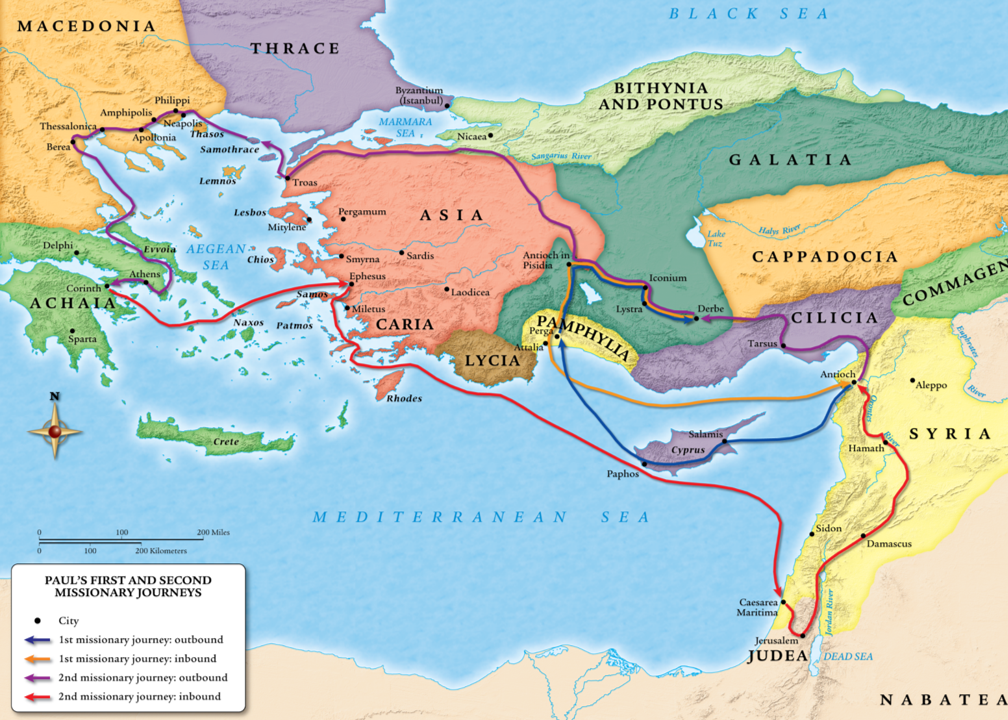
In the text it says that Paul sailed for Syria. It took me a while to realize that Syria is the region that includes Antioch, Damascus, and Caesarea. By saying that Paul sailed for Syria, Luke is saying that the apostle is homebound.
Figure 1: Paul is sailing for Syria because he is homebound. Although he was stop in Judea to attend the feast in Jerusalem, he is returning to his sending church in Antioch. That church is in Syria.
Cenchrea (or Cenchreae) was Corinth’s eastern seaport on the Saronic Gulf, in the Roman province of Achaia. Luke’s reference to Paul’s haircut functions as a parenthetical explanation: before sailing, Paul had his hair cut because he had taken a vow (Acts 18:18). The association between a vow and uncut hair recalls the Nazirite regulations of Numbers 6:1–21. However, the prescribed completion of the Nazirite vow involved offerings and shaving at the sanctuary (Numbers 6:13–20, especially verse 18). Paul’s cutting of his hair occurred at Cenchrea. While we should exercise caution in identifying the precise nature of his vow, in the context of the ministry in Corinth and in proximity to the earlier promises of the Lord, we may infer. Infer what? The Lord had promised Paul His presence and protection in Corinth (Acts 18:9–10); we may infer that Paul’s vow expressed gratitude for that assurance or a special dedication to the work entrusted to him. Its connection with his departure makes such a reading possible and even likely.
This was probably not a formal Nazirite vow, which could not properly be undertaken outside the Holy Land, but a private vow, the fulfilment of which was an act of thanksgiving—possibly for the divine promise of verse 10, which had been confirmed by his preservation from harm throughout his Corinthian ministry. (Bruce, 1988, p. 355)
Paul is en route to Jerusalem; he is determined to keep the coming feast. On his way he stops in the city of Ephesus and goes into the synagogue. Paul’s stated principle was that the gospel is “for the Jew first and also for the Greek” (Romans 1:16). His missionary practice reflected that priority: upon entering a city, he ordinarily began by proclaiming Christ in the synagogue (Acts 13:5, 14–16, 46; 14:1; 17:1–2, 10, 17; 18:4). We see this pattern again in Acts 18:19, when he enters the synagogue at Ephesus and reasons with the Jews. But more than a principle is at work; there is a guiding Presence. The Holy Spirit directs Paul’s missionary work (Acts 16:6–10). The apostle is spiritual or Spirit-led. Christ lives in him (Romans 8:14; Galatians 2:20). Paul’s practice of going to the Jews first reflects the priority expressed in Jesus’ own ministry: “the lost sheep of the house of Israel” (Matthew 10:5–6; 15:24). He continues to press on that priority as He lives through Paul.
The Apostle Paul Has Left the Building – The Jews of the synagogue asked Paul to stay; but he would not consent (Acts 18:20). He had to make it to the coming feast. The feast is unspecified; Paul could have been trying to get back to Jerusalem for Passover. Because the words “I must be all means keep this coming feast in Jerusalem” are absent from the NU text, the identity of the feast should not carry interpretive weight. What matters is that the apostle to the Gentiles has left Ephesus after only reaching out to the Jews. In the absence of this great man of God, how is the ministry going to work?
Return to Worship in Jerusalem, Report in Antioch, and then Back to Work (Acts 18:22-23) — Luke and the Gospel writers commonly describe travelers as going up to Jerusalem (Luke 2:42; 19:28; Acts 11:2; 15:2) and down from Jerusalem to other places (Luke 10:30; Acts 8:5; 15:30). This convention helps explain Luke’s compressed account in Acts 18:22: after landing at Caesarea, Paul went up and greeted the church, indicating a visit to the fellowship in Jerusalem. He then left Jerusalem and is described as having gone down to Antioch. At last, the apostle is back where he began his second missionary journey (Acts 15:35–41).
There was much to share about what had taken place. We can imagine that, in the midst of much teaching, he related the high points of the journey:
Location
Scripture
Paul’s Account
Antioch in Syria
Acts 15:36–41
I proposed revisiting the churches. After Barnabas and I disagreed over taking John Mark, I chose Silas and departed. We traveled through Syria and Cilicia, strengthening the churches.
Derbe and Lystra
Acts 16:1–5
I recruited Timothy to accompany us. As we traveled, we delivered the Jerusalem council’s decisions and strengthened the churches.
Troas
Acts 16:6–10
The Holy Spirit prevented us from preaching in Asia and entering Bithynia. At Troas, I received a vision of a Macedonian man asking for help. We concluded that God had called us to preach in Macedonia.
Samothrace and Neapolis
Acts 16:11–12
We sailed from Troas through Samothrace to Neapolis, then traveled inland to Philippi.
Philippi
Acts 16:13–40
We proclaimed the message, and Lydia believed and welcomed us into her home. I commanded a spirit of divination to leave an enslaved girl. Silas and I were beaten and imprisoned, but God opened the prison doors. The jailer and his household believed. After learning that we were Roman citizens, the magistrates came and asked us to leave.
Amphipolis and Apollonia
Acts 17:1
We passed through these cities on our way to Thessalonica.
Thessalonica
Acts 17:1–9
I reasoned from the Scriptures in the synagogue on three Sabbaths, explaining that the Christ had to suffer and rise from the dead. Some Jews and many Greeks believed, but our opponents attacked Jason’s house. The believers sent us away by night.
Berea
Acts 17:10–14
We entered the synagogue, where our hearers received the message eagerly and examined the Scriptures daily. Many believed. When opponents came from Thessalonica and stirred up trouble, the believers sent me away, while Silas and Timothy remained.
Athens
Acts 17:15–34
Distressed by the city’s idolatry, I reasoned in the synagogue and marketplace. I also addressed the Areopagus, proclaiming the Creator, calling for repentance, and declaring the resurrection. Some mocked, others wanted to hear more, and some believed.
Corinth
Acts 18:1–17
I worked with Aquila and Priscilla and reasoned in the synagogue. After opposition, I taught next door in the house of Justus. Crispus and many Corinthians believed. The Lord encouraged me to keep speaking, and I remained eighteen months teaching God’s word. When my opponents brought me before Gallio, he dismissed their accusation.
Cenchrea
Acts 18:18
I had my hair cut because of a vow. Accompanied by Priscilla and Aquila, I sailed toward Syria.
Ephesus
Acts 18:19–21
I entered the synagogue and reasoned with the Jews. Although they asked me to stay longer, I declined, promising to return if God willed. I departed, leaving Priscilla and Aquila there.
Caesarea
Acts 18:22
I landed at Caesarea and continued inland.
Jerusalem
Acts 18:22
I went up and greeted the church.
Antioch in Syria
Acts 18:22
I went down to Antioch, returning to the church from which I had departed on this journey.
Paul is an apostle (ἀπόστολος, apostolos) — one sent. He has been called to go. And so, after returning to Antioch and spending time with his sending church, he departs again. Where does he go? Through the regions of Galatia and Phrygia, strengthening (ἐπιστηρίζων, epistērizōn) all the disciples (Acts 18:23), including those in churches established during his first missionary journey.
Paul goes back to the people that have heard and believed, to churches that were previously planted, and to saints he has not seen in a while. His ministry is more than decisions and baptisms. He is engaged in the larger and longsuffering work of leading people to faith, helping them hold on to their commitment, and promoting growth. He is actually headed toward Ephesus (Acts 19:1); he said that he would return them them if God was willing (Acts 18:21). A more direct route to the Ephesians would have been to sail from Antioch to Ephesus. But the man of God is not finished with the work that was begun on his first missionary journey.
He returned to his former fields and further ministered to the churches there. A journey to Ephesus by sea would have been much easier. The foot journey from Antioch to Ephesus was well in excess of 1,000 miles. Paul set a notable example of the importance of continued nurture of new converts. (Polhill, 1992, 395-396)
When I examine my life in the light of this passage a question is raised: Is there anyone that the Lord used me to bring to Him that I should now visit to strengthen?
Apollos Message – Excellent but Incomplete (Acts 18:24-25) — Luke now returns to Ephesus to describe what happened after Paul’s departure. Priscilla and Aquila had remained there, and in the synagogue they heard a dynamic speaker—Apollos. An Alexandrian-born Jew, he was eloquent (λόγιος, logios) and mighty in the Scriptures (δυνατὸς ἐν ταῖς γραφαῖς, dynatos en tais graphais). When Apollos began to expound the scriptures there, the couple heard him and were greatly impressed by the learning and skill which he devoted to the defense of what he knew about the gospel gospel.
For all gospel preachers, calling people to repentance is a major part of the presentation (Jews – Acts 2:38; 319; 5:31; Gentiles – 11:18; 17:30; Everyone – 20:21; Luke 24:47). But it is not enough to appeal for change. There must be the good news of forgiveness and favor through faith in Christ, the better baptism of the Holy Spirit for those that receive Jesus, the joy of new community, and the mission of living for Jesus – Abundant Life. Advice: Preach the gospel, the whole gospel, and nothing but the gospel.
Marriage and Ministry Advice (Acts 18:26-28) — However, as they listened, they became aware of some gaps in his knowledge: he knew only the baptism of John. To be sure, Apollos was accurate in what he preached; but he was also incomplete. So they took their brother aside to help him. Out of public view they set forth “the way of God” to him more accurately. The investment of the apostle Paul was beginning to show a return; their time with Paul had culminated in their ability to teach others. This is the aim of discipleship. And we should appreciate and imitate their approach to dealing with deficiency. Bruce says it well:
But Priscilla and Aquila’s procedure was admirable: how much better it is to give such private help to a teacher whose understanding of his subject is deficient than to correct or denounce him publicly! (Bruce, 1988, p. 360)
They may have been left with a commission. Luke does not say whether or not Paul enjoined them to continue his work. Whether the apostle did or not, the mission of helping with evangelism and discipleship was theirs. Why? Because they are people surrendered to Jesus (Matthew 28:18-20); with or without Paul they have a calling to do what they can to make disciples. And together, the bride and groom cast a vision for every marriage comprised of Jesus followers. In them the goal of God for creating the first couple is clearly seen. Priscilla and Aquila collaborate as Christ followers for the glory of God, for the good of His people, and specifically in the cause of Christ. Their marriage matters because it becomes a means for making the message known. Here is what they are saying to us:
Marriage is more than a sacred symbol of Christ and His Church. It is union with purpose: the gospel is illustrated when husband and wife collaborate to glorify God and do good for others. Advice: Make our marriage accessible to the community. Collaborate to help to deal with deficiencies.
And then what must we say about Apollos? Look at what the passage says:
Eloquent or Learned: LOGIOS (λόγιος) — The Greek adjective logios can describe an accomplished speaker or a learned, educated person. In Acts 18:24, Luke presents Apollos as someone gifted in communication and intellectual engagement. This is the only occurrence of logios in the Greek New Testament.
Mighty or Capable: DYNATOS (δυνατός) — The phrase dynatos ōn en tais graphais (δυνατὸς ὢν ἐν ταῖς γραφαῖς) means “being mighty in the Scriptures.” Apollos was not merely polished in speech; he was capable of understanding, reasoning from, and defending the Scriptures. In Acts 18:28 he powerfully demonstrated from the Scriptures that Jesus is the Christ.
Teachable Teacher: HUMILITY — Acts 18:25–26 says Apollos taught accurately concerning Jesus but knew only the baptism of John. His instruction was therefore incomplete. Priscilla and Aquila took him aside and explained the way of God more accurately. The narrative portrays him as receptive to further instruction, despite his considerable abilities. The passage does not explicitly detail everything he knew or did not know about the Holy Spirit, so we should avoid overstating that point.
Apollos had the eloquence to communicate effectively, the scriptural competence to argue convincingly, and the humility to be taught more accurately. The teacher is still teachable and so his ministry can increase. Advice: Be open to input. Don’t wait for correction; ask for feedback.
Questions for Consideration and Action Items
Section
Question for Consideration
Action Item
Headed Home (Acts 18:18–21)
Am I submitting my plans to God’s will while making the most of present opportunities to speak about Jesus?
Bring one upcoming decision before the Lord in prayer. Identify someone you can speak with about Christ while you await His direction.
Return to Worship, Report, and Work (Acts 18:22–23)
Who has come to faith through my influence but still needs my encouragement and help to grow?
Contact that person this week. Arrange a time to listen, pray together, and study a passage that addresses their present needs.
Apollos’s Message—Excellent but Incomplete (Acts 18:24–25)
When I speak about following Jesus, do I explain both the call to repentance and the good news of forgiveness through faith in Him?
Practice a brief gospel explanation that includes repentance, Christ’s death and resurrection, forgiveness through faith, and the call to follow Him.
Marriage and Ministry Advice (Acts 18:26–28)
How are we using our marriage—or our partnerships with other believers—to make Christ known and strengthen His people?
With your spouse or a fellow believer, choose one person or couple to encourage, welcome into your home, or help understand Scripture more accurately.
A Teachable Teacher (Acts 18:26–28)
Am I humble enough to receive correction, and gracious enough to offer it privately when someone needs help?
Ask a mature believer to identify one area where your understanding or ministry could improve. Receive the feedback without defending yourself and act on what is sound.
References
Bruce, F. F. (1988). The Book of the Acts (p. 355). Wm. B. Eerdmans Publishing Co.
Polhill, J. B. (1992). Acts (Vol. 26, pp. 395–396). Broadman & Holman Publishers.
The Jesus follower faces a growing need for biblical guidance in dealing with the occult. Why? Because the occult is being aggressively pushed into our lives. It is smuggled in via movies, music, television, video games, and social media. In each of these outlets the occult is increasingly present as witchcraft/divination, communication with the dead, and other practices expressly forbidden in Scripture. In our culture these activities are depicted as harmless entertainment, paths to self-discovery, socially normal, or sources of power.Here are a few examples of how the occult is already being promoted in our culture:
Type
Title
How it involves the occult
Movie
Hocus Pocus
Features witches brought back from the dead, spellcasting, and supernatural powers within a comedic Halloween adventure. (movies.disney.com)
Movie
Practical Magic
Centers on sisters who practice witchcraft, including love spells and curses. Connects their magical abilities with family, sisterhood, and personal empowerment. (people.com)
Movie
Harry Potter film series
Centers on students learning witchcraft and wizardry, including spellcasting, potions, and divination. Its fictional world presents magical powers as abilities employed by both heroes and villains.
Music
“Voodoo”—Godsmack
The music video depicts witches performing a ritual with swords and features witchcraft practitioner Laurie Cabot and members of her coven. (en.wikipedia.org)
Music
“willow”—Taylor Swift
Performances feature cloaks, glowing orbs, and choreography evoking a gathering of witches. Swift described the staging as “a very witchy performance.” These theatrical elements do not establish that an actual spiritual ritual occurred. (people.com)
Television
Chilling Adventures of Sabrina
Combines teenage life with witchcraft, spells, demons, and a family connection to the Church of Night. Netflix explicitly describes the series as involving the occult and witchcraft. (media.netflix.com)
Television
American Horror Story: Coven
Centers on a community of witches, making witchcraft and supernatural power central to its characters and storyline. (www.fxnetworks.com)
Television
That’s So Raven
Centers on a teenager who experiences psychic visions of the future and acts on them. The series presents psychic foreknowledge within everyday teenage life with comedic flair. While the character Raven does not deliberately consult spirits to obtain her visions, the actress Raven-Symone does (Ng, 2023). Specifically, she said:
She believes in psychics and thinks people can access information through energy fields.
She experiences what she describes as visions, involving scenes in another dimension.
She has been in contact with “spirit guides” since age seven, and described meditation as helping those guides assist her.
Social media
TikTok—WitchTok
Hosts communities sharing spell tutorials, tarot readings, and instruction in contemporary witchcraft. Viewers can move from watching content to attempting the practices themselves. (www.wired.com)
Social media
Instagram—witchcraft and tarot accounts
Some accounts promote tarot readings, spellcasting, and witchcraft instruction alongside lifestyle content. The concern involves these particular accounts and activities. (linktr.ee)
Annual event
Halloween—occult observances
Some celebrations incorporate fortune-telling, divination, or rituals associated with Samhain. Participation in these practices should be distinguished from wearing costumes or distributing candy. (en.wikipedia.org)
Annual event
Día de los Muertos—Day of the Dead
Some observances include offerings intended to welcome returning spirits of deceased relatives. Seeking interaction with departed spirits should be distinguished from remembering and honoring deceased loved ones. (americanhistory.si.edu)
Table 1: Occult Themes and Practices in Contemporary Media and Observances
As these practices become increasingly acceptable in our social circles, believers are being asked to endorse them, engage in them, and ignore the fact that God says these activities are paths to serious problems involving ancient evils.
But how close are you to the occult? Some of us are closer than we realize. In fact, after reading this book, you may come to see that you are actively involved. The company socials, school events, and some of our family traditions are lightly laced or heavily laden with spiritual activities that God has said we are to avoid.
But why? That is, to what end does God ask us not to be involved in the occult? What is wrong with a little magic? Because He cares and He knows that these seemingly light hearted and empowering activities are actually gateways to ungodly living and invitations to spirits no one in their right mind wants to have in their life.
He cares and that is why, through the words of the Bible, God discloses do and don’ts of spiritual activities. The don’ts are not Divine attempts to kill innocent joys, prevent prosperity, eliminate other avenues to enlightenment, and suppress self discovery. God’s prohibitions are expressions of His complete knowledge about the true nature of things and His love for His people (Deuteronomy 18:9–14). It is His care or love for people that moved Him to speak through various prophets against the occult. He wanted people then and now to know that nothing good will come from engaging the spiritual realm without Him.
This book is about helping the reader develop discernment about forbidden spiritual activities being promoted and practiced all around us. How will we get that discernment? Through prayerful consideration of what the Bible says about the occult and using that counsel to assess what we are seeing and being offered.
Through discernment the Jesus follower recognizes what can be accepted and even used for reaching people with God’s gospel of salvation, what must be watched carefully and tested, and what must be vigorously rejected. This study seeks to equip believers to understand the occult, recognize why God forbids involvement, and respond faithfully to a world that is commending to us ways of getting ahead using the spiritual realm without God.
God’s people are to get spiritual guidance for life through approved sources, to be satisfied in His provisions when dealing with difficulties and pursuing success, and to worship Him alone.
2 Understanding the Occult and God’s Prohibition
This chapter will equip the reader to recognize the occult and understand God’s prohibition on involvement. We will define occult practices and, through an examination of Deuteronomy 18:9–14, learn to identify contemporary expressions of the occult happening around us.
We will also learn to distinguish actual occult activity from stage illusions, fictional portrayals, harmless objects, and helpful practices. The questions guiding this part of our learning will be: What does this activity involve? What does it claim to accomplish? And does participation conflict with God’s revealed will?
Chapter Objectives
Define the occult and recognize its practices.
Examine Deuteronomy 18:9–14 to identify prohibited practices and their contemporary expressions.
Distinguish occult involvement from stage illusions, fictional portrayals, and helpful practices.
2.1 What is the occult? (Deuteronomy 18:9-14)
9“When you come into the land which the Lord your God is giving you, you shall not learn to follow the abominations of those nations. 10There shall not be found among you anyone who makes his son or his daughter pass through the fire, or one who practices witchcraft, or a soothsayer, or one who interprets omens, or a sorcerer, 11or one who conjures spells, or a medium, or a spiritist, or one who calls up the dead. 12For all who do these things are an abomination to the Lord, and because of these abominations the Lord your God drives them out from before you. 13You shall be blameless before the Lord your God. 14For these nations which you will dispossess listened to soothsayers and diviners; but as for you, the Lord your God has not appointed such for you.
In this passage Moses is nearing the end of his time as leader of Israel. Soon the nation will be led by his assistant Joshua the son of Nun (). Under Joshua’s leadership Israel will begin to enter and take the land that has been promised. When the entering and taking starts to happen, the people of the nation of Israel are not to continue in the hated activities of the nations being dispossessed (Deuteronomy 18:14). God calls the activities that were being practiced by the nations being thrown out abominations. What are the abominations? They are detestable things.
Description: Making one’s son or daughter pass through fire (Deuteronomy 18:10) is a way of describing an ancient practice of sacrificing a child to a false god in order to gain favor with that illegitimate deity. In the case mentioned in the passage above, the son or daughter would be given to the god as a burn offering. The wider biblical context speaks forcefully against the practice of sacrificing children to other gods (Leviticus 18:21; Deuteronomy 12:31; Jeremiah 7:31; 19:5; 32:35; Ezekiel 16:20-21).
Contemporary example: Consider a person who kills a child as a ritual offering in the belief that a spirit will grant wealth, protection, or success. We may be quick to say that this is not a modern day practice. Not true. This is still taking place in other countries and the United States.
Documented case
What the evidence establishes
Uganda, 2024 killing; 2026 conviction
Eleven-year-old Oliver Namanda was killed in Kiboga District. Daily Monitor reports that Madina Nakyeyune was convicted of murder, human sacrifice, and aggravated child trafficking and sentenced to 32 years. The court relied on circumstantial evidence, including DNA analysis and police tracking. A co-defendant was acquitted. (Wandera, 2026)
Uganda, Supreme Court case decided in 2017
The Ugandan prosecution service’s case resource describes a toddler supplied to a ritual practitioner for sacrifice in a transaction involving promised money. The case concerned aggravated trafficking in children. (Office of the Director of Public Prosecutions, 2017)
Elyse Pahler, 15—California, 1995
Three teenage boys killed Pahler in what investigators described as a planned sacrifice to Satan, believing it would improve their musical abilities. All three pleaded no contest to first-degree murder and received sentences of 25 or 26 years to life (Fountain, 2025).
Chase, Hunter, and Clayton Doerman, ages 3, 4, and 7—Ohio, 2023
Their father, Chad Doerman, killed them and pleaded guilty in 2024. Police-interview footage released in 2026 shows him claiming that he acted “for God” and discussing sacrifice and a supposed divine test. His statements establish his claimed justification, rather than a judicial finding of an occult motive (LeBus & Harry, 2026).
Table 2: Documented Child Killings Involving Sacrificial Motives or Claims
You will say these are isolated cases. However, when we kill unborn children in order to make ourselves more suitable for a career or to prevent the inconvenience of an unwanted pregnancy, we are practicing child sacrifice — an abomination to the Lord. They offered their children to Molech; we offer our children to Career, Material Gain, and Convenience.
Child Sacrifice — offering a child’s life to a deity or spiritual power in an attempt to obtain favor, protection, prosperity, or some other desired benefit. Its practitioners treat the child’s death as an offering through which they hope to secure spiritual assistance or personal advantage. This practice is occult because it seeks benefits from the spiritual realm through an act God expressly forbids. Children bear His image; they are persons to be protected, not offerings to be exchanged for a better life. Scripture describes the sacrifice of children to false gods as sacrificing them to demons and condemns it as the shedding of innocent blood (Leviticus 18:21; Deuteronomy 12:31; Psalm 106:37–38; Jeremiah 19:5).
2.1.2 Witchcraft / Divination
Hebrew: קֹסֵם קְסָמִים, qosem qesamim
Description: Practicing divination: seeking hidden knowledge or guidance through forbidden spiritual methods. The NKJV renders this broad expression witchcraft (Numbers 22:7; Joshua 13:22; Ezekiel 21:21–23).
Contemporary examples: In our world this can be seen in using astrology, Tarot Cards, Ouija boards, and other things to get insights for living. The contemporary example occurs when someone considers consulting a Tarot reader before deciding whether to marry, change jobs, or move. The cards are treated as a source of hidden spiritual guidance rather than as ordinary illustrations. Instead of seeking guidance from God the person using the Ouija board, astrology, Enneagram, or Tarot card is after helpful insight without acknowledging the source of wisdom. But what are these things?
Item or practice
Description and modern use
Tarot Cards
Illustrated cards interpreted as revealing hidden information, future possibilities, or guidance for decisions and relationships. Tarot originated as a card game in fifteenth-century Europe. Its systematic use for occult divination developed in late eighteenth-century France and became increasingly popular during the nineteenth century. (www.themorgan.org)
Ouija Boards
Boards displaying letters, numbers, and words such as “yes” and “no.” Participants rest their fingers on a movable pointer, called a planchette, and interpret its movements as messages, often attributed to spirits or deceased people. Modern talking boards emerged during the 1880s; commercial Ouija production began in 1890, followed by a U.S. patent in 1891. Companies: Hasbro owns the Ouija trademark and has marketed its own editions; Winning Moves Games produces the Classic and Salem editions. Retailers: Classic Ouija boards are listed through Walmart.com, Michaels.com (online only), and Winning Moves’ own website. Local store inventory varies. (guides.loc.gov)
Astrology and Horoscopes
The interpretation of celestial positions and movements as indications of personality, compatibility, future events, or appropriate times for decisions. Astrology is ancient, but its familiar mass-market form—newspaper and magazine horoscopes organized around birth signs—became popular during the 1930s. R. H. Naylor’s 1930 horoscope for Princess Margaret helped launch the modern newspaper astrology column. (www.newyorker.com)
Enneagram
A nine-type personality system used for self-understanding, relationships, and, in some settings, spiritual guidance.
Modern Use: G. I. Gurdjieff introduced the symbol into his esoteric teaching in the early twentieth century; Oscar Ichazo developed the personality system in the 1960s, and Claudio Naranjo expanded and disseminated it in the 1970s.
Occult Connections: Mitchell Pacwa’s historical critique links its development to Gurdjieff’s occult numerology and Ichazo’s claimed guidance from spiritual entities, including “Metatron” and an interior master called the “Green Qu’Tub.” The Enneagram Institute independently acknowledges the system’s modern development and mystical influences. (Pacwa, 2009; The Enneagram Institute, n.d.).
Table 3: Tools and Practices Used to Seek Hidden Knowledge or Guidance
Because it is used so often in Christian circles, you may be surprised to see the Enneagram in Table 3. But look at where it came from. Claudio Naranjo, a principal developer of the Enneagram’s personality descriptions, stated:
“Much of what is now in the Enneagram literature came to me by automatic writing.” (Naranjo, n.d.)
The Enneagram’s origins raise concerns beyond its association with mysticism. Claudio Naranjo attributed much of its personality literature to “automatic writing,” a practice historically associated with spiritualist mediumship and purported messages from spirits. This connects its development with a method also found in the world of séances and spirit communication, rather than simply with conventional personality research.[1]
The biggest problems with the Enneagram are (1) its occult origins and (2) the authority people give it. People use it to discover who they are and decide how they should live. When its personality categories become the controlling explanation of their identity and the deciding voice in their choices, it functions as a sovereign guide and sage counselor in a life that should be directed by God and His revealed word (Proverbs 3:5–6; Psalm 119:105; Colossians 2:8–10).
So then, what is witchcraft or divination? Here below I have a definition for you.
Witchcraft or divination — seeking hidden knowledge or guidance through forbidden spiritual methods. Its practitioners use tools such as Tarot cards, Ouija boards, and astrology to obtain information that promises an advantage in daily life or insight into what lies ahead. These tools and the techniques for using them are occult because, in forbidden attempts to get information from the spiritual realm, they facilitate (1) the entry of demons into the lives of people that use them, (2) possession of the body or parts of the body used in the practices, and (3) deceptions aimed at (i) distracting people from trusting Jesus and (ii) destroying lives (Acts 16:16-18; 1 Corinthians 10:20-21; John 10:10).
Description: These related practices seek hidden information or guidance through occult observation and the interpretation of signs. Soothsaying claims to discern hidden information or future events (Leviticus 19:26; 2 Kings 21:6; Isaiah 2:6; Micah 5:12). Omen interpretation reads events or signs as supernatural indications of hidden realities or future outcomes (Genesis 44:5, 15; Leviticus 19:26; 2 Kings 17:17). The terms are considered together here because their functions overlap.
Both soothsaying (claiming the ability discern hidden information or future events) and omen interpretation (treating events or signs as supernatural messages) seek knowledge that promises an advantage in daily life or insight into what lies ahead. These practices are occult because they pursue spiritual guidance through means God has forbidden. The information obtained through these occult practices may be accurate, but the sources are not good. Their practitioners direct people to trust predictions and signs rather than Jesus and His revealed word.
Contemporary examples: Consider someone paying for a psychic forecast and arranging important decisions around its predictions. Another example is treating the appearance of a bird or a repeated number as a supernatural instruction to accept an offer or end a relationship. In both cases, the person treats the prediction or sign as a source of hidden knowledge and gives it authority to direct a decision.
Description: These related practices seek to produce effects or influence people and circumstances through magical arts. A sorcerer practices such arts to obtain supernatural results (Exodus 7:11; 22:18; 2 Chronicles 33:6; Malachi 3:5). An example of sorcery is seen in the conflict between Team Moses and Team Pharoah. God gives Aaron, the brother and speaker for Moses, the miracle of turning an ordinary wooden rod into a serpent. The power to make this happen came from the Lord. In the conflict between Team Moses and Team Pharoah, the magicians show that they can do the same thing. Through their enchantments their rods became serpents on the ground.
8Then the Lord spoke to Moses and Aaron, saying, 9“When Pharaoh speaks to you, saying, ‘Show a miracle for yourselves,’ then you shall say to Aaron, ‘Take your rod and cast it before Pharaoh, and let it become a serpent.’ ” 10So Moses and Aaron went in to Pharaoh, and they did so, just as the Lord commanded. And Aaron cast down his rod before Pharaoh and before his servants, and it became a serpent.11But Pharaoh also called the wise men and the sorcerers; so the magicians of Egypt, they also did in like manner with their enchantments. Exodus 7:8–11 (NKJV)
The work of Aaron was a miracle (Exodus 7:10); the power to do this supernatural work came from God and was approved. When the seemingly identical work is done by the magicians, the reader is beholding sorcery. The transformation of their rods into serpents was also supernatural. But it was accomplished through means (enchantments) not approved by God (Exodus 7:11).
A spell conjurer casts spells or employs enchantments intended to exert magical influence (Psalm 58:4–5; Isaiah 47:9, 12). The terms sorcerer and spell conjurer are considered together here because spell casting is closely related to the broader practice of sorcery, while retaining the distinction between the two Hebrew expressions.
Sorcery and Spell Conjuring — manipulation of people and things to achieve otherwise unlikely or supernatural outcomes. These practices are occult because they achieve their ends using power and processes that have not been approved by God to gain or keep controlling influence (2 Thessalonians 2:9-10; Revelation 16:13-14; 19:20).
Contemporary examples: Consider someone purchasing a ritual service advertised as able to compel affection, harm a rival, or secure prosperity through supernatural power. Another example is repeating an incantation over a charm, believing the spoken formula will bind another person or provide supernatural protection. Both involve trusting magical practices to influence people or circumstances.
2.1.5 Medium, Spiritist, and Caller of the Dead
These three related terms describe seeking counsel through claimed communication with spirits. Their meanings overlap, but each highlights an aspect of the practice.
Medium: A person who claims to act as an intermediary between people and spirits. The Hebrew phrase שֹׁאֵל אוֹב, shoʾel ʾov, emphasizes consulting a spirit or medium for information or assistance (Leviticus 19:31; 20:6; 1 Samuel 28:7–8; 1 Chronicles 10:13–14).
Spiritist: A practitioner associated with a spirit or with claimed supernatural knowledge. The Hebrew term יִדְּעֹנִי, yiddeʿoni, is closely associated with mediumship; its precise distinction from “medium” is uncertain (Leviticus 19:31; 20:27; 2 Kings 23:24; Isaiah 8:19).
Caller of the Dead: One who seeks information or assistance from the dead—a necromancer. The Hebrew expression דֹרֵשׁ אֶל־הַמֵּתִים, doresh ʾel-hammetim, identifies the dead as those being consulted (1 Samuel 28:8–19; Isaiah 8:19; 1 Chronicles 10:13–14).
To get an idea of what a medium is we should consider an example from Scripture. The story that serves is from an episode in the life of Israel’s first human monarch – King Saul. The king is going into battle with a nation called the Philistines and is feeling unsure of his chances. In fact, when Saul saw the Philistine army, he was afraid. The LORD did not answer his inquiries, so Saul sought a medium; previously he had expelled mediums and spiritists from the land. Disguising himself, he asked the woman at En Dor to bring up someone he would name (1 Samuel 28:5–8).
5When Saul saw the army of the Philistines, he was afraid, and his heart trembled greatly. 6And when Saul inquired of the Lord, the Lord did not answer him, either by dreams or by Urim or by the prophets.7Then Saul said to his servants, “Find me a woman who is a medium, that I may go to her and inquire of her.”And his servants said to him, “In fact, there is a woman who is a medium at En Dor.”8So Saul disguised himself and put on other clothes, and he went, and two men with him; and they came to the woman by night. And he said, “Please conduct a séance for me, and bring up for me the one I shall name to you.” 1 Samuel 28:5–8
This passage illustrates a medium’s claimed role as an intermediary between the living and the dead. Saul’s request also exposes the temptation behind consulting one: fear and the desire for guidance can move a person to seek through forbidden spiritual sources what God has chosen not to disclose.
Medium, Spiritist, Caller of the Dead — getting counsel through communication with beings that are (1) allegedly people that have previously passed away, (2) angels that want to provide helpful insights, or (3) other types of spirits. The medium, spiritist, or caller of the dead works in league with lying entities that promise intel that can be used for human endeavors (1 Kings 22:21–23; John 8:44; 2 Corinthians 11:14–15; 1 Timothy 4:1).
The passages in this definition address lying spirits, Satan’s character as a liar, his disguise as an angel of light, and deceiving spirits, respectively.
Contemporary examples: Consider someone consulting a channeler who claims to receive instructions from a spirit guide. The client asks the spirit, through the practitioner, for direction about family, work, or the future. Another example is seeking a practitioner who claims that a familiar spirit supplies otherwise inaccessible information.
The Familiar Spirit
John MacArthur connects mediumship and occult information with demonic activity. The familiar spirit, in his sermon, is what we would call a familiar spirit (MacArthur, 1973).
Got Questions Ministries directly defines familiar spirits as spirits associated with occult practitioners and identifies them with deceptive demonic guides (Got Questions Ministries, 2026).
Both involve turning to claimed spirit communication for knowledge or guidance.
Consider someone attending a séance or using a Ouija board to ask a deceased relative for advice. The defining feature is the attempt to obtain communication or assistance from the dead.
These contemporary examples are illustrative scenarios. Some practices overlap; the central question is whether a person seeks spiritual knowledge, power, protection, or contact through means God forbids.
The person that does these things becomes an abomination himself (Deuteronomy 18:12; Matthew 16:23; Mark 8:33). Let that sink in. Continued practice of activities that God detests causes the actor to become detestable. On account of the practice of things that disgust God, the people in the land were being driven out and replaced by Israel. These detestable activities are the occult. Both then and now they are ways of trying to win in life by leveraging the spiritual realm without God’s approval.
2.2 The Guidance God Provides (Deuteronomy 18:15-20)
15“The Lord your God will raise up for you a Prophet like me from your midst, from your brethren. Him you shall hear, 16according to all you desired of the Lord your God in Horeb in the day of the assembly, saying, ‘Let me not hear again the voice of the Lord my God, nor let me see this great fire anymore, lest I die.’17“And the Lord said to me: ‘What they have spoken is good. 18I will raise up for them a Prophet like you from among their brethren, and will put My words in His mouth, and He shall speak to them all that I command Him. 19And it shall be that whoever will not hear My words, which He speaks in My name, I will require it of him. 20 But the prophet who presumes to speak a word in My name, which I have not commanded him to speak, or who speaks in the name of other gods, that prophet shall die.’
2.2.1 The Prophet Like Moses (Deuteronomy 18:15)
When it comes to bringing God’s will to the people, Moses introduced something new. What did he introduce? Face-to-face revelation. No riddles or dark sayings were used when God talked with Moses (Numbers 12:8). But, was it really new? The composer of Moses’ epitaph says as much: Moses was the prophet of (1) face-to-face learning and (2) through whom God performed both wonders and signs (Deuteronomy 34:10–11). (Merril, 1994, p. 273). With these things in mind, Jesus is to be seen as the Prophet like Moses.[2]
Point to establish
Scripture references and significance
Jesus had seen the Father.
John 6:46 — Jesus explicitly states that the One who is from God has seen the Father. John 1:18 — The Son uniquely reveals the Father, whom no one else has seen.
The Father revealed all things to Jesus.
John 5:20 — The Father loves the Son and shows Him all things that He Himself does. Matthew 11:27; Luke 10:22 — All things have been delivered to Jesus by His Father; the Son uniquely knows and reveals Him. John 8:28; 12:49–50 — Jesus teaches and speaks according to the Father’s instruction.
Jesus’ signs and wonders authenticated His authority.
Mark 2:1–12, especially vv. 10–12 — Jesus heals the paralytic to demonstrate His authority to forgive sins. John 5:36; 10:37–38 — His works testify that the Father sent Him. Acts 2:22 — God attested Jesus through miracles, wonders, and signs. John 20:30–31 — The recorded signs support belief that Jesus is the Christ, the Son of God.
Table 4: Scripture Supporting Jesus’ Revelation and Authority
But Jesus does not merely bring a word from God. He is the Word (John 1:1-3). Truth that would be sought through the occult is brought through the Prophet. But he is not just bringing truth. He is the Truth (John 14:6).
In Christ the need for the occult is cut off. Rather than using unapproved ways of getting the truth for succeeding in life, in Christ I have it all: the Way, the Truth, and the Life.
2.2.2 Easier to Hear (Deuteronomy 18:16-18)
Israel’s need for a mediator became clear at Horeb (Sinai), where the people, terrified by God’s voice and the mountain burning with fire, pleaded with Moses to approach God on their behalf and bring His word to them (Deuteronomy 5:22–31; Exodus 20:18–21). Thompson (1974, p. 234) explains that this incident helps define the prophet’s role in Israel, while Merrill (1994, p. 273) emphasizes their need for someone who could approach God and communicate His revelation to them. This need finds its fullest answer in Jesus Christ, the one Mediator between God and humanity, who gave Himself to secure our redemption (1 Timothy 2:5–6; Hebrews 9:15). Having shared our humanity and suffered temptation, Jesus became a merciful and faithful High Priest who understands our weaknesses and helps those who are tempted; through Him, we may therefore approach God’s throne with confidence to receive mercy and grace (Hebrews 2:14–18; 4:14–16).
The occult counterfeits what I have in Christ. In Christ the need for mediums and familiar spirits is eliminated. We have in Him the Mediator who brings us to the Father of spirits, and we have the Spirit of God who guides us in His truth. We no longer need anyone to call up the dead for counsel: our risen Savior lives to intercede for us, and through Him we may approach God directly for mercy, grace, and help (John 16:13–14; 1 Timothy 2:5; Hebrews 4:14–16; 7:25).
God defined the prophetic role as receiving His words and faithfully communicating them to His people. The prophet like Moses would speak what God entrusted to him, rather than a message of his own invention (Merrill, 1994, p. 273). Jesus perfectly fulfilled this role: His teaching came from the Father, who directed both what He should say and how He should speak.
Point to establish
Supporting Scripture
Jesus spoke what the Father entrusted to Him.
John 7:16 — His teaching came from the One who sent Him. John 8:28 — He spoke as the Father taught Him. John 12:49–50 — The Father commanded what He should say and speak. John 14:10, 24 — His words came from the Father.
Jesus withheld further teaching when His disciples were not ready to receive it.
John 16:12–15 — Jesus had more to say, but His disciples could not yet bear it. The Spirit would subsequently guide them into truth. This passage identifies their readiness as the reason for withholding that teaching.
Isaiah portrays the Servant as taught by God through attentive listening each morning.
Isaiah 50:4–5 — The Lord gives His Servant an instructed tongue and awakens His ear morning by morning. Christians understand this Servant passage as fulfilled in Jesus.
Jesus sought solitary communion with the Father early in the morning.
Mark 1:35 — Jesus rose before daylight and prayed in a solitary place. Luke 5:16; 6:12 — He regularly withdrew to pray and sometimes prayed throughout the night. These passages establish His prayer life; they do not explicitly say that each morning’s teaching was dictated during prayer.
Table 5: Jesus’ Teaching from the Father and Life of Prayer
2.2.3 Test Spiritual Claims by the Truth About Christ
1 John 4:1–6. Explain false prophets and the Christ-centered test. Avoid reducing discernment to intuition or unusual feelings.
2.2.4 Seek God Rather Than the Dead
Isaiah 8:19–22. Explain the spiritual crisis, the appeal of mediums, and the summons to measure guidance by God’s revealed instruction. Isaiah 8:19–20 provides a particularly strong organizing question: Why seek the dead when God invites His people to seek Him?
2.2.5 A Sign Does Not Establish God’s Approval
Deuteronomy 13:1–5. Explain why an impressive sign cannot authorize departure from allegiance to God. Distinguish Israel’s covenant penalties from the church’s response today.
2.3 The Takeaway Questions and Actions
Takeaway question
Action
Supporting Scripture
Whose words are shaping my identity and daily choices?
Let the word of Christ dwell in you richly: read, remember, and apply His teaching.
Colossians 3:16; John 8:31–32
Where do I turn when I am afraid or uncertain?
Seek God through prayer and His revealed word; bring a specific concern to Him rather than consulting forbidden spiritual sources.
Proverbs 3:5–6; James 1:5; Isaiah 8:19–20
Am I relying on a medium or spirit guide for what I have in Christ?
Approach the Father through Jesus, our Mediator, trusting His intercession and seeking mercy, grace, and help.
1 Timothy 2:5; Hebrews 4:14–16; 7:25
Do I test spiritual claims by their agreement with God’s truth?
Evaluate predictions, experiences, and teachers by Scripture and their testimony about Jesus; refuse guidance that draws you away from Him.
Deuteronomy 13:1–4; 1 John 4:1–3
What response do Christ’s words require of me?
Identify one command of Jesus you need to obey and take a concrete step of obedience today.
Deuteronomy 18:18–19; John 12:48–50; James 1:22
Is there an occult practice I need to leave, or a neighbor I need to help?
End participation, seek pastoral support, and offer others a gracious explanation of your hope in Christ.
Acts 19:18–20; 2 Timothy 2:24–26; 1 Peter 3:15
Table 6: Takeaway Questions and Actions
3 Why does God forbid involvement (1 Corinthians 10:14-22)
This chapter will equip the reader to understand why God forbids involvement in occult practices and how allegiance to Christ determines when we can and cannot participate in cultural practices. Through an examination of 1 Corinthians 10:14–33, we will learn why participation in idolatrous worship is incompatible with fellowship with Christ and distinguish that participation from ordinary contact with our neighbors.
We will also consider what it means to walk as children of light and apply biblical principles of conscience, Christian liberty, and love to decisions about Halloween. The questions guiding this part of our learning will be: Does this activity involve something God forbids? Does it please the Lord? And how will my participation affect my conscience, other people, and my witness for Christ?
Chapter Objectives
Examine 1 Corinthians 10:14–33 to explain why idolatrous participation conflicts with allegiance to Christ.
Apply Ephesians 5:8–17 to discern what pleases the Lord and refuse fellowship with works of darkness.
Use Romans 14:1–6, 13–23 to evaluate Halloween activities with conscience and love, distinguishing disputable matters from practices Scripture expressly forbids.
14Therefore, my beloved, flee from idolatry. 15I speak as to wise men; judge for yourselves what I say. 16The cup of blessing which we bless, is it not the communion of the blood of Christ? The bread which we break, is it not the communion of the body of Christ? 17For we, though many, are one bread and one body; for we all partake of that one bread.18Observe Israel after the flesh: Are not those who eat of the sacrifices partakers of the altar? 19What am I saying then? That an idol is anything, or what is offered to idols is anything? 20Rather, that the things which the Gentiles sacrifice they sacrifice to demons and not to God, and I do not want you to have fellowship with demons. 21You cannot drink the cup of the Lord and the cup of demons; you cannot partake of the Lord’s table and of the table of demons. 22Or do we provoke the Lord to jealousy? Are we stronger than He?23All things are lawful for me, but not all things are helpful; all things are lawful for me, but not all things edify. 24Let no one seek his own, but each one the other’s well-being.25Eat whatever is sold in the meat market, asking no questions for conscience’ sake; 26for “the earth is the Lord’s, and all its fullness.”27If any of those who do not believe invites you to dinner, and you desire to go, eat whatever is set before you, asking no question for conscience’ sake. 28But if anyone says to you, “This was offered to idols,” do not eat it for the sake of the one who told you, and for conscience’ sake; for “the earth is the Lord’s, and all its fullness.”29“Conscience,” I say, not your own, but that of the other. For why is my liberty judged by another man’s conscience? 30But if I partake with thanks, why am I evil spoken of for the food over which I give thanks?31Therefore, whether you eat or drink, or whatever you do, do all to the glory of God. 32Give no offense, either to the Jews or to the Greeks or to the church of God, 33just as I also please all men in all things, not seeking my own profit, but the profit of many, that they may be saved.
Time
Content
Method
0–4
God requires exclusive allegiance. Participation can involve fellowship incompatible with allegiance to Christ. Explain 1 Corinthians 10 in its context of idolatrous worship.
Isaiah 8:19-20; 1 Corinthians 10:14–22
4–9
Apply 1 Corinthians 10:14–33, Ephesians 5:8–11, and Romans 14:1–6, 13–23. Christian liberty never authorizes idolatry; conscience and neighbor-love also matter.
Bible study
9–14
Spiritual claims and impressive experiences must be tested against God’s revealed truth.
Deuteronomy 13:1–4; 1 John 4:1–3
Session Break
14–20
Evaluate three situations: an invitation to a séance; ordinary neighborhood candy distribution; a party that includes a psychic reading.
Group cases
20–30
Draft a household plan: boundaries, children’s questions, hospitality, alternatives, and a gracious explanation to others.
Individual worksheet
Table 7: Teaching Plan for Understanding God’s Prohibition
3.1 Participation Expresses Fellowship and Allegiance
3.1.1 The Lord’s Table
The Lord’s Table is a sacred gathering of believers to remember and be stirred up to live effectively in His service. Jesus Himself is present in this gathering in a special way to help in the goal of being reminded of God’s amazing grace toward sinners through Christ (Luke 22:19–20; 1 Corinthians 10:16), renewed in devotion to doing the will of the Son (2 Corinthians 5:14–15), and preaching the gospel daily among ourselves (1 Corinthians 11:26; Hebrews 3:13). This supper cannot be treated as a mere ritual or means to a meal; treating it this way brings judgment upon the believer. A self-examination is to be done before the elements are taken so that unconfessed sin or unresolved matters can be handled first (1 Corinthians 11:27–32; cf. Matthew 5:23–24; 1 John 1:9).
Paul distinguishes participation in idolatrous worship from ordinary association with unbelievers. He prohibits sharing in an idolatrous sacrificial meal (1 Corinthians 10:14–22), yet permits eating at an unbeliever’s home, subject to considerations of conscience and what the meal communicates (10:27–29). Likewise, separating from idolaters does not require withdrawing from everyone who practices idolatry (5:9–10).
3.1.2 Pagan Sacrificial Meals
Satan and his demons intentionally counterfeit the work of Christ (2 Corinthians 11:13–15). Just as there is a special meal shared by Jesus and His followers, there were rituals in Old Testament times through which people offered sacrifices to the demons they served (Deuteronomy 32:16–17; Psalm 106:37–38). In New Testament times, believers sometimes faced invitations or pressure to join pagan sacrificial meals, in which food was offered in idolatrous worship. Scripture identifies these sacrifices as offerings to demons and forbids believers from participating in their worship (1 Corinthians 8:10; 10:19–22; Revelation 2:14, 20).
3.1.3 Paul’s Warning
Those who ate of Israel’s sacrifices participated in the altar (1 Corinthians 10:18). Paul appeals to this familiar practice to explain that eating a sacrificial meal establishes fellowship with the worship it represents. In the same way, those who participate in meals offered to demons enter into fellowship with demons (1 Corinthians 10:19–20). This cannot be. The believer belongs to a holy priesthood that offers spiritual sacrifices acceptable to God through Jesus Christ (1 Peter 2:5, 9); the same person must not participate in the worship of demons. We cannot partake of the Lord’s table and the table of demons (1 Corinthians 10:21–22).
When I eat what was offered in the ritual that I attended I am acting as a priest. In principle, when I attend events where people practice the occult I am committing two crimes: (1) endorsement – by my presence I promote the practice of what God prohibits and (2) engagement – by eating at a table of demon worship I am engaged in demon-honoring activity.
3.2 Walk as Children of Light
Ephesians 5:8–17. Explain conduct consistent with belonging to Christ, discerning what pleases Him, and refusing fellowship with works of darkness.
3.2.1 Conduct Consistent for Christ Followers (Ephesians 5:8-9)
Both Paul and Peter say that life prior to Christ was a life of darkness or disobedience (Ephesians 2:1–3; 5:8; 1 Peter 1:14; 2:9). We now belong to God as His children and have received a new nature through His work in us (John 1:12–13; Ephesians 4:24; 2 Peter 1:4); our walk should reflect that new nature (Ephesians 4:22–24; 5:8). This inward change should become apparent in our conduct; it involved new birth (1 Peter 1:3, 23), washing (1 Corinthians 6:11), and regeneration (Titus 3:5). If I am born of the Holy Spirit (John 3:5–8), who produces righteousness in us (Romans 8:4–13) and is the Spirit of truth (John 16:13), I should begin to bear resemblance to that same Spirit in a life of goodness, righteousness, and truth (Ephesians 5:8–9).
How is that going to happen?
3.2.2 Determine What Pleases God (Ephesians 5:10, 17)
We are often found reaching for a rule to regulate us, a law to help us remain legal, and a clearly stated commandment to control our conduct. But that is not what God is wanting from us. Look at what Paul says in Ephesians and notice that the verbs about discovering God’s will are participles (VR). They describe an ongoing activity that goes with what I do. As the situations change the word of God, which is living and active (VR), is being used by the Spirit to help me in the ongoing work of figuring out what to do (Ephesians 2:10, 17) and how to teach it to others (Ezra 7:10).
3.2.3 Refusing Fellowship with Works of Darkness (Ephesians 5:11)
Some offers of fellowship, based on the activities involved, must be refused (Ephesians 5:7–11; 1 Corinthians 10:20–22). In refusing, we are not assuming responsibility for judging those outside the church. Paul asks what business he has judging outsiders and explains that God judges them (1 Corinthians 5:12–13). At the same time, there can be no justification for becoming conformed to the world (Romans 12:2). Occult practices cannot be common ground between believers and unbelievers; they belong to the works of the devil that Jesus came to destroy (Deuteronomy 18:10–12; 1 John 3:8). Our new life in Christ should be evident in transformed thinking, holy conduct, and love expressed through good works (Ephesians 4:22–24; 1 Peter 1:14–16; John 13:34–35; Titus 2:11–14).
3.3 Handling Halloween With Conscience and Love
Romans 14:1–6, 13–23. Explain disputable matters, personal accountability, and concern for another believer. Explain why this passage cannot authorize practices Scripture expressly forbids.
3.3.1 Discussing the Disputable
Some things that I could do are not expressly prohibited or promoted by God. It is a judgement call for someone who has learned to look at things through the light of the Scriptures (Acts 10:17; Ephesians 2:10, 17). One person may be convinced that they cannot do such things; they regard it as sin. What should I do when I find myself in fellowship with someone who cannot take part in something because they believe it to be occult or otherwise immoral… when it isn’t? Welcome them into your community so they can be converted to your way of thinking? No! Receiving a fellow believer in order to reform them is wrong.
3.3.2 Harmless Costumes and Concern for Others
Scripture does not directly address witch costumes, but when dressing as a witch celebrates or presents occult practice as harmless, these three biblical principles support calling it an endorsement:
Celebration – It celebrates an identity associated with practices God condemns. God expressly forbids witchcraft, sorcery, and consulting the dead (Deuteronomy 18:10–12). Presenting those practices as attractive or desirable conflicts with the command to abhor evil and cling to good (Romans 12:9).
Normalization – It can normalize what believers are called to expose. Paul commands believers to have no fellowship with the unfruitful works of darkness, but instead to expose them (Ephesians 5:8–11). Making witchcraft an appealing form of entertainment can communicate acceptance and obscure its spiritual seriousness.
Encouragement – It can encourage others to become involved. Our example can embolden others to participate in practices their consciences recognize as wrong (1 Corinthians 8:9–13). A believer’s costume may communicate that occult involvement is compatible with following Christ, despite Paul’s prohibition against fellowship with demons (1 Corinthians 10:20–22).
Here below are reasons why I may refrain from an activity that is not sin for me.
Love places another believer’s spiritual welfare above my freedom. Having the right to do something does not mean exercising that right will build others up. Mature believers seek their neighbor’s good and willingly limit their liberty when its exercise could harm someone else (1 Corinthians 8:1, 9; 10:23–24).
My example can encourage someone to violate his conscience. Paul warns that a believer’s apparent freedom can embolden another person to participate despite believing the activity is wrong. Leading someone into that kind of sin wounds a brother for whom Christ died and sins against Christ Himself (1 Corinthians 8:10–12; Romans 14:23).
Pursuing peace and spiritual growth is more important than exercising a personal right. Paul urges believers to avoid placing stumbling blocks before one another and to pursue what builds others up. He willingly forgoes otherwise permissible activities when they cause a brother to stumble (Romans 14:13, 19–21; 1 Corinthians 8:13).
3.4 The Takeaway Questions and Actions
Takeaway question
Action
Supporting Scripture
Would this activity express fellowship with Christ or participation in worship God forbids?
Find out what the event actually involves. Refuse occult rituals and sacrificial meals that involve fellowship with demons; explain your allegiance to Christ graciously.
1 Corinthians 10:14–22; Ephesians 5:11
Does my conduct reflect my new life in Christ and what pleases Him?
Evaluate the activity and what your presence or costume communicates. Reject what celebrates evil; choose conduct marked by goodness, righteousness, and truth.
Ephesians 5:8–11, 17; Romans 12:2, 9
Can I participate with a clear conscience before the Lord?
Distinguish forbidden practices from disputable matters. Do not participate while believing it is wrong, or pressure another believer to violate his conscience.
Romans 14:1–6, 12, 22–23
Could exercising my freedom lead another believer to stumble?
Consider whether your example could encourage occult involvement or conduct against conscience. Willingly decline even a permissible Halloween activity when love requires it; seek your brother’s good and spiritual growth.
Between-session assignment: Read Acts 19:11–20. Write a private response to: Where am I tempted to seek certainty, comfort, or control apart from God? No public disclosure of past involvement is required.
4 Following Christ and Engaging Our Neighbors
4.1 How should a Jesus follower respond? (Acts 19:11-20)
11Now God worked unusual miracles by the hands of Paul, 12so that even handkerchiefs or aprons were brought from his body to the sick, and the diseases left them and the evil spirits went out of them. 13Then some of the itinerant Jewish exorcists took it upon themselves to call the name of the Lord Jesus over those who had evil spirits, saying, “We exorcise you by the Jesus whom Paul preaches.” 14Also there were seven sons of Sceva, a Jewish chief priest, who did so.15And the evil spirit answered and said, “Jesus I know, and Paul I know; but who are you?”16Then the man in whom the evil spirit was leaped on them, overpowered them, and prevailed against them, so that they fled out of that house naked and wounded. 17This became known both to all Jews and Greeks dwelling in Ephesus; and fear fell on them all, and the name of the Lord Jesus was magnified. 18And many who had believed came confessing and telling their deeds. 19Also, many of those who had practiced magic brought their books together and burned them in the sight of all. And they counted up the value of them, and it totaled fifty thousand pieces of silver. 20So the word of the Lord grew mightily and prevailed.
Primary teaching passage: Acts 19:11–20. Focus: Christ’s authority and changed practices. Other passages in this block serve as supporting references.
Time
Content
Method
0–3
Recall the previous session’s central principles.
Retrieval questions
3–10
Study Acts 19:11–20: Christ’s authority, the misuse of Jesus’ name, confession, and costly separation from former practices.
Guided Bible study
10–15
Stand firm through truth, righteousness, faith, Scripture, and prayer. Emphasize Christ’s victory and dependence on Him.
Ephesians 6:10–18; Colossians 2:13–15
15–20
Respond to someone involved: listen, clarify their beliefs, explain your allegiance to Jesus, decline participation, and offer gospel hope.
Demonstration and paired practice
20–23
Address personal involvement: stop the practice, confess to God, remove materials used for it, and seek pastoral support and ongoing discipleship.
Practical guidance
23–25
Two-question scenario check.
iSpring assessment
Table 8: Teaching Plan for Responding to Occult Involvement
4.1.1 Jesus’ Name Is Not an Incantation
Acts 19:11–17. Distinguish God’s extraordinary work through Paul from the exorcists’ attempt to employ Jesus’ name as a technique.
4.1.2 Repentance Produces Costly Separation
Acts 19:18–20. Explain confession, destruction of magical books, the financial cost, and the growth of the Lord’s word.
4.1.3 Stand in the Victory of Christ
Colossians 2:13–15; Ephesians 6:10–18. Explain Christ’s triumph and dependence on Him through truth, righteousness, faith, salvation, Scripture, and prayer.
4.1.4 Correct Others With Gentleness
2 Timothy 2:24–26. Explain the Lord’s servant’s conduct, God’s granting of repentance, and hope of release from deception.
Acts 19 supplies a useful narrative center: Jesus’ name is not an incantation, and turning to Him changes people’s practices. The account culminates in the growth of the Lord’s word. Bible Gateway
Pastoral guardrails to teach:
Treat people with dignity; speak with gentleness rather than ridicule.
Avoid demonstrations of occult practices and sensational accounts.
Do not assume every unusual experience, illness, or emotional struggle is demonic.
Direct distressed participants toward appropriate pastoral care; medical or mental-health concerns also deserve qualified care.
Keep the focus on following Christ rather than developing a fascination with evil.
5 Dealing with Cultural Practices
5.1 Halloween Decision
Participation: Does this involve divination, spirit contact, spells, or religious devotion contrary to Christ?
Message: What does the activity celebrate, normalize, or invite me to enjoy?
Conscience: Can I participate with a clear conscience before God?
Influence: How might this affect my children, another believer, or my Christian witness?
Neighbor-love: How can I show kindness while maintaining faithful boundaries?
Teach clearly that Romans 14 concerns disputable matters; it does not turn explicitly forbidden practices into personal preferences. Families may reach different conclusions about ordinary costumes, candy, and neighborhood gatherings while sharing the same refusal to participate in occult practices.
5.2 Dia De Los Muertos
6 Assessment Tools and Resources
6.1 Assessment Plan
Use short questions that measure understanding and application.
Assessment
Purpose
Suggested question
Opening diagnostic
Expose misconceptions
“Is a practice spiritually safe simply because someone reports that it works?”
Session 1 quiz
Check biblical understanding
Match divination, mediumship, and sorcery with brief descriptions.
Session 2 scenario check
Practice compassionate boundaries
“A friend offers you a tarot reading. Which response combines a clear refusal with an invitation to further conversation?”
Final assessment
Test transfer to everyday life
Distinguish an explicitly prohibited practice from a matter requiring further discernment.
Table 10: Assessments and Suggested Questions
Suggested scoring: An 80% target on scored quizzes, with retries and explanatory feedback tied to Scripture. Use multiple-choice, matching, and scenario questions. Keep personal reflection questions ungraded and private.
6.2 Resources Participants Take Home
Provide a compact participant packet containing:
Resource
Contents
Guided class notes
Definitions, four teaching blocks, key conclusions, and space for questions.
Scripture reference sheet
Passages grouped under prohibition, discernment, Christ’s victory, Christian conduct, and conscience.
Halloween decision guide
The five questions above, three scenarios, and a household planning worksheet.
Pastoral response guide
Steps for leaving occult practices and a church contact for confidential conversation.
Further-reading list
Two accessible books with brief descriptions and links.
Table 11: Resources for Participants
Core Scripture references
God’s prohibition and guidance: Deuteronomy 18:9–15; Leviticus 19:31; Isaiah 8:19–20.
Testing spiritual claims: Deuteronomy 13:1–4; 1 John 4:1–3.
Christ’s authority and changed allegiance: Colossians 2:13–15; Acts 19:11–20.
Conscience and consideration: Romans 14:1–6, 13–23.
6.3 Suggested books
John Harker, Ouija Board Nightmares: The Complete Collection. This book does much to explain the origins of this device and the consequences of using it. The book does much to show that Ouija Boards are not toys and cause users to become prey to evil entities. Shadow Hills Publishing
David Powlison, Safe and Sound: Standing Firm in Spiritual Battles. My first choice for participant reading, with its pastoral emphasis on standing firm in Christ.
Chip Ingram, The Invisible War. A supplementary resource on Satan, demons, and spiritual warfare; his ministry also provides a related teaching series.
Review supplementary resources against Compass’s teaching before assigning selections; the Bible should remain the class’s governing authority.
7 Glossary
Term
Definition
Abomination
Something God regards as detestable because it violates His holiness and revealed will.
Astrology
A form of divination that interprets the positions and movements of celestial bodies as sources of hidden knowledge or guidance about personality, relationships, or future events.
Automatic writing
Writing produced with little conscious direction, sometimes claimed to convey messages from spirits or other unseen sources. When used to receive spirit messages, it functions as a form of mediumship.
Channeling
A form of mediumship in which someone claims to receive or communicate messages from a spirit or other spiritual entity.
Child sacrifice
The ritual offering of a child’s life to a deity or spiritual power to obtain favor, protection, prosperity, or another desired benefit.
Christian liberty
The believer’s freedom in Christ, exercised within God’s commands and with love and consideration for others.
Conscience
A person’s inward moral judgment concerning right and wrong, which needs instruction from God’s Word.
Demons
Evil spiritual beings opposed to God who seek to deceive people and resist His purposes.
Discernment
The ability to distinguish truth from error and evaluate beliefs, practices, and spiritual claims by God’s revealed truth.
Divination
Seeking hidden knowledge, predictions, or guidance through spiritual methods God forbids. Its distinguishing aim is to obtain information; sorcery seeks to produce effects, while mediumship seeks communication with spirits. These practices can overlap.
Enchantment
A spoken formula or magical practice intended to produce supernatural effects. As an instrument of sorcery, it seeks to influence people or circumstances.
Enneagram
A nine-type personality system used for self-understanding and, in some settings, spiritual guidance. This book examines its spiritual influences and the authority people give it in defining identity and directing decisions.
Familiar spirit
A spirit believed to attend or assist an occult practitioner, especially by supplying hidden information. The term identifies the supposed spiritual associate; the human intermediary is a medium or spiritist.
Idolatry
Giving worship, devotion, or ultimate allegiance to someone or something other than the true God.
Medium
A person who claims to serve as an intermediary between people and spirits. Mediumship concerns spirit communication; when that communication specifically seeks the dead, it is also necromancy.
Necromancy
Attempting to communicate with the dead to obtain information, guidance, or assistance. It is distinguished from broader spirit communication by its intended contact with deceased people.
Occult
Practices that seek hidden spiritual knowledge, supernatural effects, or contact with spirits through means God forbids. These aims include divination, sorcery, and mediumship, respectively.
Omen interpretation
A form of divination that treats events, objects, or unusual occurrences as supernatural signs revealing hidden information or directing decisions.
Ouija board
A board marked with letters, numbers, and words, used with a movable pointer to obtain messages attributed to spirits. Its use for spirit communication is mediumistic; seeking answers from the dead is necromantic.
Séance
A gathering intended to establish communication with spirits, usually through a medium. When participants seek contact with deceased people, the practice is necromancy.
Soothsaying
A form of divination in which a practitioner claims to disclose hidden information or predict future events. It overlaps with omen interpretation but does not necessarily involve reading external signs.
Sorcery
The use of magical arts to seek supernatural effects or influence people and circumstances. Its distinguishing aim is to produce an outcome, such as protection, harm, or compelled affection.
Spiritual warfare
The believer’s struggle against spiritual evil through dependence on Christ, truth, righteousness, faith, Scripture, and prayer.
Tarot cards
Illustrated cards used in divination to seek hidden information, predictions, or guidance. Their divinatory use does not necessarily include a claim of direct spirit communication.
Witchcraft
A broad term whose meaning varies with context, encompassing practices such as divination and spellcasting. In the NKJV rendering of Deuteronomy 18:10 discussed in this book, it translates a Hebrew expression referring specifically to divination.
8 Appendices
8.1 Open Promoters of the Occult
8.1.1 Laurie Cabot (Witchcraft Teacher and Author)
8.1.2 Fiona Horne (Singer and Author)
8.1.3 Gabriela Herstik (Author and Lifestyle Writer)
8.1.4 Silver RavenWolf (Wiccan Author)
8.1.5 Damien Echols (Author and Ceremonial Magic Teacher)
8.1.6 Rachel True (Actress and Tarot Author)
8.1.7 Princess Nokia (Rapper and Singer)
8.1.8 Azealia Banks (Rapper and Singer)
8.1.9 Sully Erna (Godsmack Lead Singer)
8.1.10 Kirk White (Vermont State Representative and Wiccan Author)
8.1.11 Ricky Williams (Former NFL Running Back and Astrologer)
8.2 The Occult in Music
8.2.1 Brujas (Princess Nokia, 1992 Deluxe)
8.2.2 Witch’s Rune (S. J. Tucker, Blessings)
8.2.3 Wytches (Inkubus Sukkubus, Wytches)
8.2.4 I Am a Witch (Twin Temple, Satan’s a Woman / I Am a Witch — Single)
8.2.5 Satan’s a Woman (Twin Temple, Satan’s a Woman / I Am a Witch — Single)
8.2.6 Let’s Have a Satanic Orgy (Twin Temple, Let’s Have a Satanic Orgy — Single)
8.2.7 Year Zero (Ghost, Infestissumam)
8.2.8 Ritual (Ghost, Opus Eponymous)
8.2.9 Voodoo (Godsmack, Godsmack)
8.2.10 The Ballad of the Witches (Agatha All Along – Cast, Agatha All Along: Vol. 1 (Episodes 1–5) [Original Soundtrack])
8.3 The Occult in Literature for Children and Youth
8.3.1 Teen Witch: Wicca for a New Generation (Silver RavenWolf)
8.3.2 Teen Magick (Fiona Horne)
8.3.3 The Teen Spell Book: Magick for Young Witches (Jamie Wood)
8.3.4 Elements of Witchcraft: Natural Magick for Teens (Ellen Dugan)
8.3.5 The Teen Witches’ Guide to Spells (Xanna Eve Chown)
8.3.6 The Teen Witches’ Guide to Spells & Charms (Claire Philip)
8.3.7 The Teen Witches’ Guide to Divination (Claire Philip)
8.3.8 The Teen Witches’ Guide to Tarot (Claire Philip)
8.3.9 The Teen Witches’ Guide to Palm Reading (Xanna Eve Chown)
8.3.10 The Teen Witches’ Guide to Astrology (Xanna Eve Chown and Marion Williamson)
8.3.11 How to Be a Witch (Gabrielle Balkan and Shana Gozansky)
Ages 3–6. Introduces children to contemporary witch identity and seeks to dispel stereotypes about real witches. www.penguinrandomhouse.com
8.3.12 Diary of an Accidental Witch (Perdita Cargill and Honor Cargill)
Ages 6–9. Fictional adventures presenting witch school and learning magic as humorous and appealing. PenguinRandomHouse.com: Books
8.3.13 Clever Little Witch (Muon Thi Van)
Ages 4–6. A fantasy picture book featuring a young witch attempting to transform her baby brother through spellcasting. Simon & Schuster
8.3.14 Heidi Heckelbeck Might Be Afraid of the Dark (Wanda Coven)
Ages 5–9. Features a sympathetic young witch facing an ordinary childhood fear; it is fiction, rather than instruction in occult practice.
[1] Did Naranjo contact spirits and use automatic writing to flesh out the Enneagram? Naranjo’s student Katherine Fauvre disputes that interpretation, saying he used the phrase metaphorically for spontaneous associations informed by his psychiatric training.
[2] The end of the book Malachi begins a long period of silence. Prophecy would cease for 400 years. There would not be another prophet until John the Baptist. In the later times of the nation of Israel, especially during the quiet period, this passage (Deuteronomy 18:15-20) came to be viewed as referring to an individual. In this view the Prophet who would be raised up became a key personality in the Messianic age and was sometimes identified as the Messiah himself (cf. John 1:21, 45; 6:14; 7:40; Acts 3:20–22; 7:37, etc.). (Thompson, 1974, p. 234)
9 Now the Lord spoke to Paul in the night by a vision, “Do not be afraid, but speak, and do not keep silent;10for I am with you, and no one will attack you to hurt you; for I have many people in this city.”11 And he continued there a year and six months, teaching the word of God among them.
12 When Gallio was proconsul of Achaia, the Jews with one accord rose up against Paul and brought him to the judgment seat, 13 saying, “This fellow persuades men to worship God contrary to the law.”
The Prophecy of Persecution Being Fulfilled (Acts 18:12-13) — The persuades (ἀναπείθω, ) of 18:13 has a negative connotation.
ἀναπείθω 1 aor. pass. ἀνεπείσθην (s. πείθω; Hdt. et al.; ins, pap, LXX) to move someone to do something by persuasion,induce. With an improper objective in mind… ἀ. τοὺς ἀνθρώπουςincites peopleAc 18:13. (Arndt et al, 2000, 3rd ed. pp. 69-70)
It is being said that Paul entices people away from the approved association of Judaism (collegium licitum) into a collegium illicitum. In this scene the sayings of Jesus have become true. Which sayings? Jesus said:
Blessed are you when they revile and persecute you, and say all kinds of evil against you falsely for My sake (Matthew 5:11).
He also warned that His followers would be brought before governors and rulers “for My sake” (Matthew 10:17–18).
17But beware of men, for they will deliver you up to councils and scourge you in their synagogues.18 You will be brought before governors and kings for My sake, as a testimony to them and to the Gentiles. (Matthew 10:17-18)
That is precisely what happens to Paul. The Jews of the city unified for a common purpose – persecute Paul and prevent further persuasive preaching about Jesus of Nazareth; with one accord they rose up against Paul (Acts 18:12). He is likely seized by his enemies as he was doing what Jesus told him to do (Acts 18:9-11). They brought the preacher before Gallio, the Roman proconsul, accusing him of persuading people to worship God contrary to the law.
Their charge reframes gospel ministry as criminal and rebellious activity. They are not merely disagreeing with Paul’s theology; they are falsely portraying the kingdom’s messenger as an evildoer. And, as Jesus predicted, the opposition arises from the synagogue—from Jewish leaders who reject Christ—though we should not generalize this to every Jew, since Crispus and others believed.
In Acts 18:12-23 we see the prophecies concerning Jesus followers and Paul in particular being fulfilled. With the prophecy is the truth about how I should regard myself in that moment: blessed. There is also the warning concerning men: beware. On account of the ministry the Jesus follower will be harshly treated and handed over to officials for condemnation. But God will make it an opportunity for testimony. Give me a summary statement for this. It has to be very concise.
When betrayed and beaten for being a witness, believe Jesus and say “I am blessed.” And when ministry begins making a difference, beware; men will by any means necessary move to make it stop.
14 And when Paul was about to open his mouth, Gallio said to the Jews, “If it were a matter of wrongdoing or wicked crimes, O Jews, there would be reason why I should bear with you. 15 But if it is a question of words and names and your own law, look to it yourselves; for I do not want to be a judge of such matters.” 16 And he drove them from the judgment seat. 17 Then all the Greeks took Sosthenes, the ruler of the synagogue, and beat him before the judgment seat. But Gallio took no notice of these things.
The Promise of Protection Being Kept (Acts 18:14-17) — The apostle to the Gentiles is ready to do the thing. After all, Jesus had said that His followers would be brought before governors and “kings as a testimony to them and to the Gentiles” (Matthew 10:18). Paul is now present before the Gentiles is their formal place of adjudicating civil matters; he can make the most of this moment and be a witness to them. aul now stands before Gallio, the proconsul of Achaia, in the formal setting where civil matters are adjudicated. This is precisely the kind of moment in which he might bear witness to Gentiles.
Jesus had also promised that when His followers were brought before rulers, they should not worry about how or what they would speak, because the Spirit would speak through them (Matthew 10:19–20). Paul is prepared to give a reason for the hope that is in him (1 Peter 3:15) and to testify concerning the truth of his ministry.
Emboldened by the vision he had received from Christ (Acts 18:9-10) and encouraged by the continued fruitfulness of his ministry, Paul is ready to present his response to the accusations. He is ready to do the thing. But Jesus has other plans.
There were Roman laws against proselytizing of Roman citizens by foreign cults, but Gallio obviously did not take the charge in this sense. He saw it for what it was—an internal dispute within the Jewish community—their interpretations of “words” (the Scriptures?), of “names” (Jesus as Messiah?), of “law” (the Torah). (Polhill, 1992, p. 388)
Gallio’s refusal to judge the matter exposes the accusation as religious hostility disguised as a legal complaint. Paul is being persecuted precisely as Jesus said His kingdom citizens would: falsely accused, opposed by religious authorities, and brought before civil rulers for the sake of Christ’s name. Also see the promise being kept: 9 Now the Lord spoke to Paul in the night by a vision, “Do not be afraid, but speak, and do not keep silent; 10 for I am with you, and no one will attack you to hurt you; for I have many people in this city.” Acts 18:9-10
Notice that the endeavor to stop the ministry has been stopped, that the effort to prevent Paul’s preaching has been prevented, and that the persecutors are being persecuted. Why? A promise is being kept. No weapon formed against him will prosper.
No Weapon – Fred Hammond
No weapon formed against me shall prosper It won’t work No weapon formed against me shall prosper It won’t work
Say no weapon formed against me shall prosper It won’t work Say no weapon formed against me shall prosper It won’t work
And God will do what He said He will do He will stand by His word and He will come through, yeah God will do what He said He will do He will stand by His word, He will come through
Questions and Action Items
Question
Action Item
When I am mistreated for bearing witness to Jesus, will I remember that I am blessed?
Memorize Matthew 5:11 and respond to opposition with faith rather than retaliation.
Where must I beware of people who may oppose or hinder gospel ministry?
Identify one source of opposition and ask God for wisdom to respond with courage and discretion.
How can God use opposition against me as an opportunity for testimony?
Prepare a brief explanation of your faith and be ready to share it when an opportunity arises.
Do I trust Christ to keep His promise when opposition arises?
Write down one promise of Jesus—such as Matthew 10:18–20—and pray it back to Him when fear or resistance appears.
Where have I already seen Christ keep His word in my ministry?
Record one specific instance of His protection, provision, or guidance, and use it to strengthen your faith for the next challenge.
References
Arndt, W., Danker, F. W., Bauer, W., & Gingrich, F. W. (2000). In A Greek-English lexicon of the New Testament and other early Christian literature (3rd ed., pp. 69–70). University of Chicago Press.
Polhill, J. B. (1992). Acts (Vol. 26, p. 388). Broadman & Holman Publishers.