On Purpose

Introduction

We make decisions every day about what deserves our time, whom we will trust, and what kind of people we hope to become. In college, those decisions can feel especially urgent. We choose a major, pursue relationships, and prepare for a career. Yet beneath those choices lies a question that reaches further than graduation: Who will have the authority to direct my life?

In the Gospel of Matthew, Jesus brings that question into focus. He asks His disciples who they believe He is, calls them to follow Him, and teaches them what following Him requires. As they walk with Him, they discover that His purposes reach into their ambitions, challenge their assumptions about other people, and extend far beyond the boundaries of their familiar world.

Our first message, The Commitment (Matthew 16:13–27), begins with Peter’s confession that Jesus is the Christ, the Son of the living God. But Peter soon discovers that confessing Jesus’ identity and accepting Jesus’ direction are not the same thing. The Lord he rightly identifies announces a cross he strongly resists. Jesus then calls every disciple to surrender the right to govern life independently of Him.

Our second message, The Commandment (Matthew 9:1–13), shows us the mercy that must shape that surrendered life. The One who commands us to love God and our neighbor demonstrates His heart toward people burdened by sin and dismissed by others. He forgives, calls Matthew to follow Him, and shares a table with sinners. In His company, we learn to see people as those He came to call and restore.

Our final message, The Commission (Matthew 28:16–20), brings us before the risen Jesus. The disciples gathered there are still imperfect, and some doubt. Yet Jesus entrusts them with making disciples of all nations, grounding their mission in His authority and sustaining it with His presence.

The movement of these messages is from confession to commitment, from commitment to compassion, and from compassion to commission. Together, they show how recognizing who Jesus is reshapes whose purposes we pursue, how we treat people, and what we do with the life He has entrusted to us.

The Great Commitment

The Great Commitment (Matthew 16:13-27)

13 When Jesus came into the region of Caesarea Philippi, He asked His disciples, saying, “Who do men say that I, the Son of Man, am?” 14 So they said, “Some say John the Baptist, some Elijah, and others Jeremiah or one of the prophets.” 15 He said to them, “But who do you say that I am?” 16 Simon Peter answered and said, “You are the Christ, the Son of the living God.” 17 Jesus answered and said to him, “Blessed are you, Simon Bar-Jonah, for flesh and blood has not revealed this to you, but My Father who is in heaven.

18 And I also say to you that you are Peter, and on this rock I will build My church, and the gates of Hades shall not prevail against it. 19 And I will give you the keys of the kingdom of heaven, and whatever you bind on earth will be bound in heaven, and whatever you loose on earth will be loosed in heaven.” 20 Then He commanded His disciples that they should tell no one that He was Jesus the Christ.

21 From that time Jesus began to show to His disciples that He must go to Jerusalem, and suffer many things from the elders and chief priests and scribes, and be killed, and be raised the third day. 22 Then Peter took Him aside and began to rebuke Him, saying, “Far be it from You, Lord; this shall not happen to You!” 23 But He turned and said to Peter, “Get behind Me, Satan! You are an offense to Me, for you are not mindful of the things of God, but the things of men.”

24 Then Jesus said to His disciples, “If anyone desires to come after Me, let him deny himself, and take up his cross, and follow Me. 25 For whoever desires to save his life will lose it, but whoever loses his life for My sake will find it. 26 For what profit is it to a man if he gains the whole world, and loses his own soul? Or what will a man give in exchange for his soul? 27 For the Son of Man will come in the glory of His Father with His angels, and then He will reward each according to his works.

The Revelation of the Person (Matthew 16:13-17) – We are now nearing the end of Jesus’ endeavor (1) to make fishers of men, (2) to make known the will of God through signs and teaching, and (3) to call the Jews to Himself and the mission of God in the world. By this time His offer of the kingdom has been rejected by the leaders of the people and His attempts to reveal the will of God have been largely misunderstood or ignored by the multitudes. Jesus reveals the state of his efforts through an assessment. Using a few questions he uncovers the great lack of understanding among the masses, the insights of the men he has been mentoring, the reason why some have realized the truth, and who he really is.

When Jesus asks his disciples about the crowds comprehension of his identity, he is not getting the information for Himself. He knows all men and has no need that anyone should testify of what was in man; he is asking for the sake of the disciples. In their answers it becomes clear that the multitudes are not getting it. “Some say you are John the Baptist.” But, by this time John the Baptist is dead. Furthermore this does not make sense when we consider that Jesus and John were contemporaries. Indeed sometimes they were in the same place at the same time. So, how could men say this? The answer is both appalling and simple; they do not get it. Others were saying that Jesus was Elijah. They saw in the ministry of the Son of Man the fulfillment of prophecies saying that Elijah would return before the coming of the Messiah. Jesus, like the Elijah of old, called people to repentance and was mighty in deed. But saying that Jesus is Elijah was to either be ignorant of the message of John the Baptist or to reject it. John said that Jesus was the Son of God and the Lamb of God who takes away the sin of the world. Whether they did not know what John had said or missed that Jesus taught with an authority befitting the Christ, they reason is the same. They do not get it.

Finally, some said that Jesus was Jeremiah or one of the prophets (Luke 9:19). Although there were prophecies foretelling a time when Elijah would come to prepare the way before the Christ, nothing in the Law or the Prophets said that Jeremiah was coming back. This theory seems to be the outworking of a misreading of extrabiblical material (2 Maccabees 15:12-16; 2 Maccabees 2:4-8). In any case, what becomes obvious is that there not only are the people not getting it, some are farther from getting it than others.

The question is a catalyst for comprehension and a tool for pushing insights into the heads of his disciples. Jesus wanted his men to marvel at what had not happened in the multitude. He wanted his closest and hand-picked followers to realize that among men there was a range of misunderstanding about His identity. Through the inquiry he instigates seeing that the people cannot see.

And their Rabbi is not done. He wants them to observe another thing, to acknowledge and appreciate the grace of God on their lives, and know why they know what others do not. That there is a significant difference between the disciples and the crowd is already known to Jesus. He wants them to know it as well. Do not miss the But of Matthew 16:15. Through the conjunction the disciples are presented a contrast, an lack likeness, and a dissimilitude. All the disciples are given the question, “But who do you say that I am?”

It should come as no surprise that Peter responded for the rest of the disciples. He was created and called to lead the other men. His nature is to step up, to speak up, and to get out of the boat. That is what he is doing now and will continue to do throughout his life. Hear the answer of the big fisherman: You are the Christ, the Son of the living God. And now comes the assessment and explanation of Peter’s understanding and explanation: Blessed are you, Simon Bar-Jonah, for flesh and blood has not revealed this to you, but My Father who is in heaven.

If they have considered the answer to the prior question they can readily appreciate what Jesus says about Peter’s understanding. They were supposed to see that the crowds of people from all walks of life were not able to to make sense of what they were seeing in Jesus. But somehow Peter did. Why? The answer is that Peter or Simon Bar-Jonah is blessed. Flesh and blood did not reveal or disclose this to the Galilean. His brain or intellect is not the cause for Peter’s right answer. Smarter people were not getting it. People with a lot more training in the Scriptures and powerful intellects were not able to make sense of Jesus. And neither was Peter. Jesus’ Father who is in heaven had intervened to make it known to Peter what people could not get on their own.

People, without a special work of God, cannot get this on their own! Now, O Disciples, in light of the total and various misunderstandings of the multitude, see that Peter’s perception born out of a blessing from above, a loving act of the Almighty, and a grace that gets for Man what he cannot get for himself.

The Great Confiding (Matthew 16:18-20) — Do you see the conjunction And at the beginning of Matthew 16:18? Having revealed that the disciples are different and that their company has uncommon insight, Jesus goes on to tell them why. What Jesus says next is to be viewed as part of the earlier revelation. He says, And I say to you (singular) in order to unveil more of what Peter has come to comprehend. In particular, Peter’s understanding is presented by Jesus as having purpose in the undertaking of building a community created and called out for God. He says what He says to Peter in front over everyone so that there will be no debate later on about where the big fisherman stands. Jesus has, by the great grace of the Father, appointed Peter to a special position for a special work:

  • you are Peter – Jesus was speaking to the disciples in Aramaic. Although Matthew has made the narrative available to us in Greek, in Aramaic Jesus told Peter that he is Cephas (John 1:41-42). The name Cephas means stone. Simon Bar-Jonah, you are a stone. Although the Galilean fisherman will be unreliable and unable to keep his promises, he will become steadfast and immovable. Jesus speaks Simon Bar-Jonah about his future not his failings.
  • on this rock – There is much debate about the meaning of this rock () . However, because (1) the word changes from petros to petra and (2) because Jesus says that He is continuing from what Peter said earlier, this rock is best understood as Jesus Himself. The context and earlier confession show this to be true.
  • I will build my church – The church is not built on creeds or Peter. It is built on the truth. What truth? Jesus is the Truth upon which His church (ekklesia) is built. Three things are clear. First, the building of the church is being done by Christ; we must never forget that. Although men and women may be used by God to establish discipleship communities, the work is being done by Jesus Himself through them. He receives all the glory. Second, the church is built over time. The local communities that are made by Jesus start small but are being built up by the Lord. Do not despise small beginnings. Even a mustard seed community, if Christ is in it, is growing according to his plan and power. Third, the community of Christ is not of this world. It is created to be eclectic (ekklesia) and non-conformist.
  • the gates of Hades will not prevail against it – The gates of Hades, for these Jewish men is a way of talking about death. They would not have used the word Hades; that is the Greek translation of a the Jewish word Sheol (). Notice how the term is used in the Psalms and by the prophet Isaiah.
Reference Passage excerpt Context and significance
Isaiah 38:10 “I shall go to the gates of Sheol” Hezekiah anticipates dying. The Septuagint renders gates of Sheol as gates of Hades, providing the closest verbal parallel to Matthew 16:18. Gates of Sheol would be the way it would stated in Hebrew.
Job 38:17 “the gates of death” God questions Job about his knowledge of death’s domain, emphasizing the limits of human understanding.
Psalm 9:13 “lift me up from the gates of death” The psalmist identifies God as the One who can rescue him from impending death.
Psalm 107:18–20 “gates of death” Afflicted people approach death, cry to God, and receive His deliverance.

These passages establish death and the realm of the dead as the background of the expression gates of Hades. Isaiah’s Septuagint wording makes the Sheol–Hades connection particularly explicit. Jesus is here alluding to the fact that even His own eminent death will not succeed in stopping this work. The death of the Builder will not stop the building.

Peter is then declared to have special authority in the building program of Jesus: I will give you the keys of the kingdom of heaven. Keys are used to open and deny access. Jesus says that Peter will be given special authority in the unseen kingdom of heaven to open doors (whatever you loose) and close doors (whatever you bind). The kingdom is no longer being offered to the nation; they have rejected the offer (). Therefore there is no point in telling people that Jesus is the Christ. So Jesus commanded His disciples that they should tell no one.

The fisherman has learned that his unusual understanding is a gift from the Father. Now he discovers that his privileged understanding carries a purpose: he has been given a place in the work of Christ. Jesus will build His church, death will not defeat His undertaking, and Peter will exercise the authority Jesus entrusts to him under Jesus’ direction. Peter is being called into a life that is unapologetically Christ-centered.

The next revelation will test whether Peter is as willing to follow Christ’s plan as he is to confess Christ’s person.

The Revelation of the Plan and the Problem (Matthew 16:21-23) – Going forward Jesus began to show His disciples things that had formerly only been mentioned in allusions (John 2:19; Matthew 9:15; Matthew 12:39-40). Now He makes them plain to His men and women. (Although the term disciples often means the twelve, sometimes it refers to the larger group of people that were following him. The women were also made aware of what lay ahead. The angel that meets them at the tomb explained that they should not expect the living among the dead because He, as He said, is risen.) What did Jesus show His disciples? Only what the Scriptures had already said concerning the Christ:

What Jesus Was Showing Old Testament Support Connection to Matthew 16:21
He must go to Jerusalem. Zechariah 12:10 — Jerusalem mourns the pierced one. Connects His piercing with Jerusalem; does not explicitly predict the journey.
He must suffer many things. Isaiah 53:3–7 — The Servant suffers rejection, wounds, and oppression for others’ sins. His suffering fulfills God’s saving purpose.
He must suffer through the elders, chief priests, and scribes. Psalm 118:22 — The builders reject God’s chosen cornerstone. Jesus applies this rejection to Israel’s leaders in Matthew 21:42–45.
He must be killed. Isaiah 53:8–9, 12 — The Servant dies and is buried. Daniel 9:26 — The Messiah is cut off. Anticipates His death; Isaiah explains its sin-bearing purpose.
He must be raised. Psalm 16:10 — God’s Holy One escapes abandonment to Sheol and decay. Isaiah 53:10–12 — Life and victory follow the Servant’s death. Peter explicitly applies Psalm 16 to Jesus’ resurrection in Acts 2:25–32.
He must be raised on the third day. Jonah 1:17; 2:10 — Deliverance follows three days inside the fish. Hosea 6:2 — Israel anticipates third-day restoration. Jesus applies Jonah’s pattern to Himself in Matthew 12:40. Hosea provides an indirect parallel.

Peter is prompted by what he has heard and pulls his Rabbi away for a brief word. Once they were away from the group, the Son of Jonah begins to refute the plan and rebuke the Son of God. Do not get caught up in the wrong of Peter’s action; his audacity reveals an underlying problem. The action of rebuking of Jesus is not the sickness; it is merely a symptom. Who corrects Christ? Someone with a wrong view of (1) himself, (2) Christ, and (3) the mission. Peter’s mental preoccupation is with worldly concerns, secular things, and matters that are no more than the ambitions of mere men.

Jesus has recently commended Peter for his confession. Actually he pointed out that Peter has been the recipient of a great grace from God; that is how he came to see that Jesus is the Christ and the Son of God. Now he speaks with emotional contempt for what he is hearing and the heart behind it. Peter does not know it, but he has aligned himself with God’s greatest adversary – Satan. In fact, the man upon whom there is a great calling for good is in this moment and instrument of evil and arch antagonist to the agenda of God through the Christ. Who had tried to thwart the plan of redemption earlier? Satan had (Matthew 4:8-10). Now that serpent of old () was at work through a disciple to deter the Son of Man from the plan to save His people from their sins. There is a lesson in this. And we do well to stop and think on it.

The goals of the godly do not necessarily come from God. They must be examined in light of the revealed will of God to ascertain whether they are contributing to or conflicting with the call of Christ. Peter’s problems are not difficult to see. First, He elevated Himself from disciple to The Director of God’s Son. Second, he prioritized his own preferences above God’s plan.

The Revelation of the Price and Prize (Matthew 16:24-27; John 12:25) – Jesus turns to the disciples to speak a word they all need to hear. Peter’s problem is also theirs. And ours. Although only Peter had the audacity to actually rebuke Jesus, he was not alone in his way of thinking. He is every man that means well but whose mind has not been renewed. He is all of us that have become committed Christ followers but have not fully parted ways with worldly ambitions. Just like Peter we are found trying to manipulate the Messiah, rebuke the Redeemer, and convince the Christ to go with our plan. After all, our plan does some good and avoids inconvenience and suffering while allowing us to have a great time. Such plans promote the planner and demote Jesus Christ to the role of Tonys Stark’s Jarvis. Jesus takes a moment to explain the way it is going to work for anyone who is going to follow Him.

I want to be a Jesus follower! Do you? Jesus says His followers are not able to go around the things that He goes through. He denied Himself worldly pleasures. It is not possible to follow Jesus and indulge my own appetites… especially when they are in conflict with the commandments of God. There has to be an unconditional willingness to surrender my plan, set aside my preference, and take up my cross. Cross? Wait, Roderick. What cross? When did I get my own cross? Read the passage again. Jesus says that His follower has to take up his cross, and follow Me. An indispensable element of following Jesus is the cross. It is a non-negotiable component of coming to Christ. That is what he said. But then, what is my cross. It is likely not a literal wood structure with two beams joined at 90 angles on which you will eventually be hung. (This is not certain. A literal crucifixion is still in view for some Jesus followers.) The cross as a concept is all of the suffering that is inseparable from doing God’s will, all of the persecution from people that comes obedience, and all of the dying daily that happens when what I want dies. Why would I do that? That is, why would I carry a cross? Trying to be happy the world’s way will lead to tragic loss. In the end those who gains all the world has to offer will have rejected the will of God and forfeit their souls.

No worldly gain can compensate for the loss of my soul, and no sacrifice for His sake escapes His notice. Will I spend my life trying to make Jesus serve my ambitions, or surrender my ambitions to follow Jesus?

Questions and Action Items

Questions for Reflection Action Items
Who do I say Jesus is—and does my life agree with my confession? (Matthew 16:13–17) State your answer personally. Identify one area where your choices contradict what you confess about Him.
How am I using what God has revealed and entrusted to me to serve Christ’s purposes? (Matthew 16:18–20) Name one way you can use your time, abilities, or relationships to strengthen His church. Commit to a specific step this week.
Where am I asking Jesus to approve my plan while resisting His revealed will? (Matthew 16:21–23) Bring one ambition, relationship, or decision before God. Examine it in light of Scripture and surrender whatever conflicts with His direction.
What obedience am I avoiding because it will cost me comfort, approval, or opportunity? (Matthew 16:24–25) Identify the cost you have been avoiding. Take one concrete step of obedience within the next seven days.
Am I pursuing something that looks profitable now but will prove worthless when Christ returns? (Matthew 16:26–27) Review one major priority in your calendar or spending. Make a change that reflects the lasting value of faithfulness to Christ.

Before you leave, complete this statement: “Because Jesus is the Christ, I will surrender __________ and take this step of obedience: __________.”

Share that commitment with a trusted believer and ask them to follow up with you this week.

Will I spend my life trying to make Jesus serve my ambitions, or surrender my ambitions to follow Jesus?

The Great Commandment

The Great Commandment (Matthew 9:1-13; Matthew 22:34-40)

9:1 So He got into a boat, crossed over, and came to His own city. 2 Then behold, they brought to Him a paralytic lying on a bed. When Jesus saw their faith, He said to the paralytic, “Son, be of good cheer; your sins are forgiven you.” 3 And at once some of the scribes said within themselves, “This Man blasphemes!” 4 But Jesus, knowing their thoughts, said, “Why do you think evil in your hearts? 5 For which is easier, to say, ‘Your sins are forgiven you,’ or to say, ‘Arise and walk’? 6 But that you may know that the Son of Man has power on earth to forgive sins”—then He said to the paralytic, “Arise, take up your bed, and go to your house.” 7 And he arose and departed to his house. 8 Now when the multitudes saw it, they marveled and glorified God, who had given such power to men.

9 As Jesus passed on from there, He saw a man named Matthew sitting at the tax office. And He said to him, “Follow Me.” So he arose and followed Him.

10 Now it happened, as Jesus sat at the table in the house, that behold, many tax collectors and sinners came and sat down with Him and His disciples. 11 And when the Pharisees saw it, they said to His disciples, “Why does your Teacher eat with tax collectors and sinners?” 12 When Jesus heard that, He said to them, “Those who are well have no need of a physician, but those who are sick. 13 But go and learn what this means: ‘I desire mercy and not sacrifice.’ For I did not come to call the righteous, but sinners, to repentance.”

The Example and Proof (Matthew 9:1-8)

Jesus Makes the Most of His Moments (Matthew 9:1; Mark 2:1-2) — Jesus has recently been asked to leave a place where He has delivered two men from demon-possession (Matthew 8:33-34). What does He do when asked to leave? He leaves. That is, Jesus departed from the country of the Gergesenes, got into a boat, crossed the sea of Galilee, and came to His own city (καὶ ἦλθεν εἰς τὴν ἰδίαν πόλιν).

His own city is no longer Nazareth; Jesus has been ousted from there (Luke 4:16, 28-30). The Son of Man now resides in Capernaum (Mark 2:1). Outside of Nazareth Jesus is regarded favorably and news of His presence in Capernaum draws a crowd. In the crowd are Pharisees and teachers of the law; they have come from the regions of Galilee, Judea, and the city of Jerusalem (Luke 5:17). And the moment is seized; He preached the word to them (Mark 2:2). His time is short and He does not want to waste a second of it. His agency is used to help people; His urgency leads him to use His moments for the long run and with a view toward eternity. Jesus, my fellow followers, is an opportunist; He uses gatherings to advance the understanding of the people that have come to Him in matters of the kingdom of God and living effectively.

Question: Am I like Jesus to the people that come to me? That is, am I using my free will and my limited time to make the most of moments with others? Do I share what I can about the kingdom of God and spiritual truths so that people can live effectively in the service of the Lord and others?

Bringing People to Jesus (Matthew 9:2) — Matthew says, “Look at this, reader! They brought to Jesus a paralytic lying on a bed.” The behold (ἰδού) calls the reader to look at what is being said with the intent of looking seriously and how it matters in two things: (1) the argument of the writer and (2) the application of what is being said to the reader’s life. In Matthew’s attempt to convince the reader that Jesus is the long-awaited Messiah-King, he repeatedly draws attention to the fact that some people came to the conclusion that with Jesus there is hope for people otherwise considered hopeless (the man full of leprosy – Matthew 8:1-4; the Centurion’s servant – Matthew 8:5-13; the woman with the flow of blood – Matthew 9:20-22; Jairus’ seeking help for his daughter – Matthew 9:18-26; two blind men – Matthew 9:27-31; and more). Four men have come to regard their paralyzed friend as having a chance to become well. We learn from Mark that they are not daunted by the fact that they cannot get through the crowd. These uncouth men of faith will not be denied; they tear a whole in the tiling of the roof of the home and let their paralyzed friend down through the hole (Mark 2:3-4; Luke 5:18-19).

Questions: Do I regard my friends as having real hope in Christ? What am I bringing them to? How determined am I to bring them to Jesus? Will I stop trying if it becomes inconvenient?

Jesus, seeing their faith, is moved to deal with the problems of the paralytic. Here is where things get interesting. The healing they are seeking is temporary. Where there is genuine faith Jesus is more concerned with the more serious matter of unforgiven sin. Paralysis as a problem pales compared to the lack of pardon for crimes against God. The wages of sin is death (Romans 3:23). Our value system is often most concerned with the inconvenience of ill health, the setback of sickness, or the pain caused by disease in our body or relationships. But in the economy of God my biggest problem is not failing health but my need for forgiveness and reconciliation to Himself. Failing health is an inevitable consequence of being human in this world; if it is fixed by Jesus… it is going to fail again. But forgiveness and favor with God benefits me now and for all eternity. Jesus came into this world to deal with the biggest problem that man faces – sin (Matthew 1:21). Jesus says that the paralytic can be of good cheer or encouraged because his sins are forgiven him.

The Authority of Jesus (Matthew 9:3; Mark 2:7; Luke 5:21) — Matthew calls to the reader’s attention the inner dialogue of the scribes. And he does it again with behold (ἰδού). (It is unfortunate that the NKJV translates this as at once. ESV and KJV are consistent in this regard and render the underlying text as behold. The NET Bible and NLT do not translate it at all.) By using this word Matthew says that his argument about who Jesus is advanced; it is seen why this helps his argument when we put verse 3 with 4. I believe that the passage should read like this:

3 And behold some of the scribes said within themselves, “This Man blasphemes!”

What did they say to themselves? They said within themselves, “This Man blasphemes!” Matthew would have me to know that the statement of Jesus drew a very critical reaction from religious experts. Why?

Sin is first and foremost against God. Even when it immediately hurts others, it is a work against the God who made the others for Himself. David says as much when he summarily describes his sin against Uriah the Hittite, Bathsheba the wife of Uriah, and the people that he had conscripted to help with his trespass (2 Samuel 12:13).

4 Against You, You only, have I sinned,

And done this evil in Your sight—

That You may be found just when You speak,

And blameless when You judge. (Psalm 51:4)

It stands to reason that forgiveness of sin against God can only be granted by God. That is, it is not logical that someone other than God Himself could grant me forgiveness for the ways that I have wronged God Himself. With this in mind, Jesus’ statement is outrageous. If He is merely a man, this is beyond arrogance. It is blasphemy — a bold disrespect and disregard for who God is and the difference between the domain of man and the domain of God!

6 And some of the scribes were sitting there and reasoning in their hearts, 7 “Why does this Man speak blasphemies like this? Who can forgive sins but God alone?” (Mark 2:6-7)

They are not wrong theologically? That is, their rhetorical question is the right one; it points up the fact that a mere man cannot pardon a person for sin against God. The problem is in their failure to realize who Jesus is. He is going to deal with that now.

The Powers of Perception of the King (Matthew 9:4; Psalm 139:2; 1 Samuel 16:7; John 2:23-25) — In their hearts they reacted immediately. In their hearts they reacted critically. In their hearts they started with the assumption that Jesus did not have the authority to forgive sin. This was an outworking of their prior unwillingness to accept the testimony and ministry of John (Matthew 21:23-25). Their failure to receive the full import of what had been said by John (John 1:15,29-34) was now manifest in a way-too-low view of Jesus.

But let us think for a moment on the statement itself. First, we are looking at a bold statement. Second, let us note that it is in the passive voice: your sins are forgiven you. Third, we should take into account that this statement was made by a Jew to other Jews; that means it was said in Hebrew. Putting these three things together

statement: your sins are forgiven you + passive voice + Hebrew

We have a statement that was familiar to the scribes. Fruchtenbaum helps us here:

The Hebrew form of the passive, your sins are forgiven you, is used only in one section of the entire Hebrew Bible: in Leviticus 4-6. The context of these chapters is atonement, as they detail the blood sacrifices necessary for the forgiveness of sins. The statement of forgiveness in a passive voice followed the sacrifice (e.g., Lev. 4:20, 26, 31, 35; 5:10, 13, 16, 18; 6:7). …[T]he Hebrew word for “forgiveness,” salach (סָלַח), is used of God. The passive means that God is doing the forgiving. Being Pharisees, these people knew both the Torah and Hebrew, and they caught the connection He was making. He was claiming the authority that God asserted for Himself in Leviticus 4-6: that by means of blood atonement, God had forgiven their sins. … Yeshua was, therefore, speaking as if He were God. (Fruchtenbaum, 2017, p. 186)

Jesus begins having conversation with His critics about the meditations of their hearts (John 2:23-25; Psalm 19:14).

14 Let the words of my mouth and the meditation of my heart

Be acceptable in Your sight,

O Lord, my strength and my Redeemer. (Psalm 19:14)

The Pharisees started with the assumption that Jesus was sinning. Their theology was correct. Their problem, though, was a small view of Messiah and failure to accept the testimony of John the Baptist (Matthew 21:23-25).

Question: Are there truths or testimonies that I have refused to receive that are making it hard for me to accept what God is showing me?

The Proof of the King (Matthew 9:5-6) — Jesus knows their thoughts and addresses their concern. He does this with an argument a fortiori. That is, he proves His claim that the sins are forgiven by demonstrating something that can be seen. We are apt to separate the say from the fulfillment; that was not the case with the people in this narrative (Ezekiel 12:28; Numbers 23:19). To them the saying and the fulfillment are one and the same. Thus, the easier thing to say, because it is does not require immediate validation, is “Your sins are forgiven you?” So then, Jesus takes on the harder thing as proof that the easier thing has been accomplished. It would have been to them immediate proof that the easier thing to say was true and that the man’s sins were forgiven.

All of this was done that they would “know that the Son of Man has power on earth to forgive sins.” By using the phrase Son of Man the Rabbi from Nazareth is claiming to be the figure of Daniel’s prophecy:

13 “I was watching in the night visions,

And behold, One like the Son of Man,

Coming with the clouds of heaven!

He came to the Ancient of Days,

And they brought Him near before Him.

14 Then to Him was given dominion and glory and a kingdom,

That all peoples, nations, and languages should serve Him.

His dominion is an everlasting dominion,

Which shall not pass away,

And His kingdom the one

Which shall not be destroyed.

Daniel 7:13-14, approximately 550 BC

This is not an emphasis of His humanity but His deity; the Son of Man in Daniel’s vision receives worship (Daniel 7:14). When Jesus refers to Himself using this phrase He is claiming to be the enigmatic character that Daniel saw receiving glory, a kingdom, and worship with the approval of the Ancient of Days. Jesus then gives the command to the man to “Arise, take up your bed, and go to your house?”

Who is Going to Fix This Roof (Matthew 9:7) — The man did just as Jesus directed him. He departed to his own house glorifying God (Luke 5:25). We can imagine the looks on the faces of the people as the man, who came in through a whole in the roof with the aid of four men, left through the door carrying his own bed. But let us not miss the meaning of the walking man. His walking was working to advance the more important point – his sins were forgiven.

When the Walk Wins People Over (Matthew 9:8) — Jesus had proven His claim. The paralytic was gone; in his place was a man that could carry his own bed. His walk was winning people over. Thus, they now know that the Son of Man has power on earth to forgive sins. This was the conclusion of the multitudes: God had given such power to men.

Question: Do I accept that Jesus has the authority to forgive me and free me from the power of indwelling sin (John 8:36)? Do I regard myself as forgiven of the sins of the past? Or am I still trying to work off my debt? Is my perspective that I am free from the power of sin, or am I living in a stalemate with behaviors and ways of thinking that are contrary to the will of God?

Our walk matters more than we are willing to accept. In our walk we become witnesses to the work of God in our lives. The change in us is a sign that says He saves. (In our walk is evidence that either confirms or denies my convictions about Christ.) A changed walk confirms that I am convinced that I am free from the power of indwelling sin and called to live for Him that died for me. A lack of change indicates either that I am not convinced or that I am not converted. After receiving Christ I will not be sinless; but I should begin sinning less as I learn to walk in my (1) healing, (2) freedom, and (3) what it means to follow Jesus.

The Example and Program (Matthew 9:9)

Calling the Outcast (Matthew 9:9) — Jesus has just finished fixing a man both physically and spiritually. With a word the Son of Man (Matthew 9:6; Daniel 7:13-14) restored a paralytic to wholeness. So well was the man that he walked carrying his bed out of a room that he moments ago had to be lowered into. More importantly, Jesus set the man right with God (Matthew 9:2); that is why He came (Matthew 1:21). It was outlandish and outstanding at the same time. Outlandish that a Man would have the audacity to tell someone that his sins were forgiven. Outstanding that He could actually do it (Matthew 9:6,8). The rabble rousing Rabbi passed on from there (Matthew 9:9). As He does He passes the tax office or place of the toll (τὸ τελώνιον) and notices a man named Matthew sitting there.

Matthew also goes by the name Levi (Mark 2:14; Luke 5:27). We commonly refer to him as a publican (from the Latin publicanus) or tax collector. There are two types of publicans. One collects taxes on income. The other collects taxes or tolls on people traveling through ports or official travel routs. Matthew is a tax collector of the sort that collects money on boats going across the lake outside of Herod’s territory or from people going from Damascus to the coast (Robertson, 1933).

Although Matthew is a Jew, he is hated by Jewish society because he is regarded as a sellout and collaborator with the nation’s oppressors — the Romans. Tax collectors had military support in the collection of taxes from the Jews; they had the help of soldiers in making a great living from their Jewish brethren. Everything that a tax collector could collect above what was due was his own.

Tax collectors earned a profit by demanding a higher tax from the people than they had prepaid to the Roman government. This system led to widespread greed and corruption. The tax-collecting profession was saturated with unscrupulous people who overtaxed others to maximize their personal gain. According to Adams, “The toll-collectors were in a profession that was open to dishonesty and oppression of their neighbor” (Adams, The Sinner in Luke). Since the Jews considered themselves victims of Roman oppression, Jewish tax collectors who overtaxed their fellow countrymen were especially despised. Jews viewed such favor for Rome as betrayal and equal to treason against God. Rabbinic sources consistently align Jewish tax collectors with robbers. (Miller, 2016)

The profession, although held in low regard by religious leadership, was not inherently wrong. When tax collectors came to John the Baptist for baptism, the voice in the wilderness did not direct them to abandon their work. They were told to do their work without the wickedness of getting more than what was right:

12 Then tax collectors also came to be baptized, and said to him, “Teacher, what shall we do?” 13 And he said to them, “Collect no more than what is appointed for you.” (Luke 3:12-13)

Notice that Jesus’ call on Matthew was not complicated (Matthew 4:19; 8:22; 19:21; John 1:43; 12:26; 21:22). There is no ceremony and no formalities. Lacking in the call of Jesus, when compared to modern methods of getting people into ministry today, was sophistication or contracts. We have often added too much. The call to follow Jesus was just that – a call to follow Jesus. Faith is all that was required. What kind of faith? The kind that believes that everything is going to be okay when leaving everything behind (Luke 5:28). That kind of faith, beloved.

Let us marvel at Matthew’s response; it is remarkable. Although he was regarded as a wretched human being, given the opportunity, he was ready to leave everything behind to be with Jesus (Luke 5:28).

The call was simple. It was not to a formal membership class, not to a denomination, or an ascetic lifestyle. It was a call by the Savior to Himself. Jesus summoned a sinner that everyone loved to hate into fellowship with Himself. The decision to follow Jesus is first, foremost, and forever a personal call to just Jesus.

𝕋𝕙𝕣𝕖𝕖 𝕋𝕙𝕚𝕟𝕘𝕤 ℕ𝕖𝕖𝕕𝕖𝕕 𝕥𝕠 𝔹𝕖𝕔𝕠𝕞𝕖 𝕄𝕠𝕣𝕖 𝔼𝕗𝕗𝕖𝕔𝕥𝕚𝕧𝕖 𝕚𝕟 𝔻𝕚𝕤𝕔𝕚𝕡𝕝𝕖𝕤𝕙𝕚𝕡

① Sanctification of the Caller (John 17:9) – The person calling has to be willing to let things go in order to become an effective mentor. In addition to a commitment to a consecrated life (holiness), there must be a willingness to eliminate people and things that distract us from discipleship. The person that is going to call others to Christ, to be maximally effective, must cut away everything that hinders in the work of helping others to walk with Jesus.

② Simplification of the Call (Matthew 4:19; 8:22; 19:21; John 1:43; 12:26; 21:19, 22; Luke 9:59) – The call cannot be complicated. It is not a call to circumcision, a certain style of worship, joining an organization, or accepting a title. Effective discipleship occurs when we focus on calling people to follow Jesus. That is all! When we add other qualifications, although well-meaning, we weigh people down with traditions and man-made religion.

③ Nurture and Nourish the Called (John 21:17; 1 Peter 2:2) – The person being called may have the faith to follow. But they will certainly lack almost everything else. Effective discipleship happens when we are longsuffering like Jesus in nurturing followers into maturity. It is painstaking work that involves discouraging setbacks, conflict, and the need to persevere through big problems. It is spiritual work. Feed them the word and help them see how it relates to the relationship with Jesus.

The Example and Point (Matthew 9:10-13)

The Consequence of Calling the Outcast (Matthew 9:10) — In humility Matthew does not make mention of who owned the house. We have to look at parallel accounts to discover that the dwelling belongs to the tax collector (Mark 2:15; Luke 5:29) and that the feast, a party that included his friends, was thrown by Matthew for Jesus. In his recounting of the event for the reader Matthew calls to the readers attention the kind of people that came and sat down with [Jesus] and His disciples — many tax collectors and sinners (καὶ ἰδοὺ πολλοὶ τελῶναι καὶ ἁμαρτωλοὶ). Look at this, says Matthew. It was shocking to see someone considered to be righteous and a teacher sitting with people hated and not allowed into normal fellowship. They were not at the door but they were sitting down with Jesus and His disciples.

The consequence of calling Matthew matters to us as we attempt to make disciples today. In this particular event is a timeless principle and strategy for reaching those who need Christ most: those who would be good fishers of men must see that the well-loved outcast is a lure for lost men of the same kind.

This was the plan all along: use somebody to reach others.

https://www.youtube.com/watch?v=MRgFeZa_I48

The Reaction of the Religious (Matthew 9:11) — Notice the reaction of religious people. They are unable to understand Jesus. He is outside. Of what? Outside of their model of unhealthy ministry, their puritanical focus on rules, and their condescending attitude toward people who need help. They are looking at what Jesus is doing but cannot make sense of it. Why?

Pharisees don’t see. They don’t see the value of people that have lost their way. They don’t grieve over the great tragedy of a soul that rejects God’s right to reign. Pharisees, both then and now, are beset by a blindness that makes that unable to understand the undertaking of showing mercy and kindness in the mission of promoting reconciliation to God.

The Pharisee in you and me is all too ready to be rid of what we don’t like regardless of what God wants.

Answering the Critics (Matthew 9:12) — They put the question to the disciples. Jesus heard (ὁ δὲ ἀκούσας) and put the answer to the critics themselves. He is not running from the question or using intermediaries to answer His critics; Jesus is not afraid of them. He is saying more than one thing with this statement. First, those who are well are the spiritually healthy. Those who are well are those who are walking with God and enjoying fellowship with Him and His people. Jesus did not come to merely high five the holy folk, recline with the righteous, and sing songs with the sanctified.

Jesus indicates His intentions by initiating fellowship with someone that everyone would say is not worth saving. I am here for him… and them!

The Teacher Gives Homework (Matthew 9:13) — What Jesus says next is a rebuke. It is an assignment to learn something about God that they should have already known. He says you are confused about my conduct because you don’t know my concerns, my character, and my call. You cannot make sense of me because you do not know my Father; I look just like Him (John 14:8-9).

  • Knowing Me is More Important than Religious Activity (Hosea 6:6)
  • Saving Them is the Heart of God (Ezekiel 33:11)

Questions and Direction

Question Action Item
Does my love move me toward people in need? (Matthew 9:1–8) Identify someone who needs help. Take one practical step to bring that person into contact with the care and truth of Jesus.
Am I allowing time with Jesus to change how I love? (Matthew 9:9) Set aside time daily to learn from Jesus, then deliberately put His teaching into practice in your relationships.
Who have I treated as someone to avoid rather than someone to love? (Matthew 9:10–13) Invite someone outside your usual circle to a meal or conversation. Listen, show mercy, and look for an opportunity to share Christ.

Jesus is calling me to love ____________________. This week, I will ________________________________________________.

Loving God draws us into fellowship with Jesus; following Jesus draws us toward the people He came to save. The Great Commandment takes visible form when we make room in our lives for people who need His mercy.

The Great Commission

The Great Commission (Matthew 28:16-20)

16 Then the eleven disciples went away into Galilee, to the mountain which Jesus had appointed for them. 17 When they saw Him, they worshiped Him; but some doubted.

18 And Jesus came and spoke to them, saying, “All authority has been given to Me in heaven and on earth. 19 Go therefore and make disciples of all the nations, baptizing them in the name of the Father and of the Son and of the Holy Spirit, 20 teaching them to observe all things that I have commanded you; and lo, I am with you always, even to the end of the age.” Amen.

The Team Described (Matthew 28:16-17)

The Task (Matthew 28:19-20)

The Assurance (Matthew 28:20)

Questions and Direction

Question Action Item
Will I bring my doubts to Jesus and still respond to His call? (Matthew 28:16–17) Name a doubt or struggle in prayer. Take your next step of obedience while seeking His help.
Am I helping people become disciples of Jesus? (Matthew 28:18–20) Identify one person you can help follow Jesus. Arrange time to share the gospel or study His teaching together, encouraging obedience and baptism as appropriate.
Where would confidence in His presence change my willingness to go? (Matthew 28:20) Take one step toward a person or place you have avoided, trusting that Jesus goes with you.

Whom will I intentionally help follow Jesus, and what will I do next?

I will help ____________________ follow Jesus. My next step is ________________________________, and I will take it by ____________________.

The risen Jesus sends imperfect followers under His complete authority to make disciples of all nations. We go, baptize, and teach obedience with confidence in His promise: we never go alone.

References
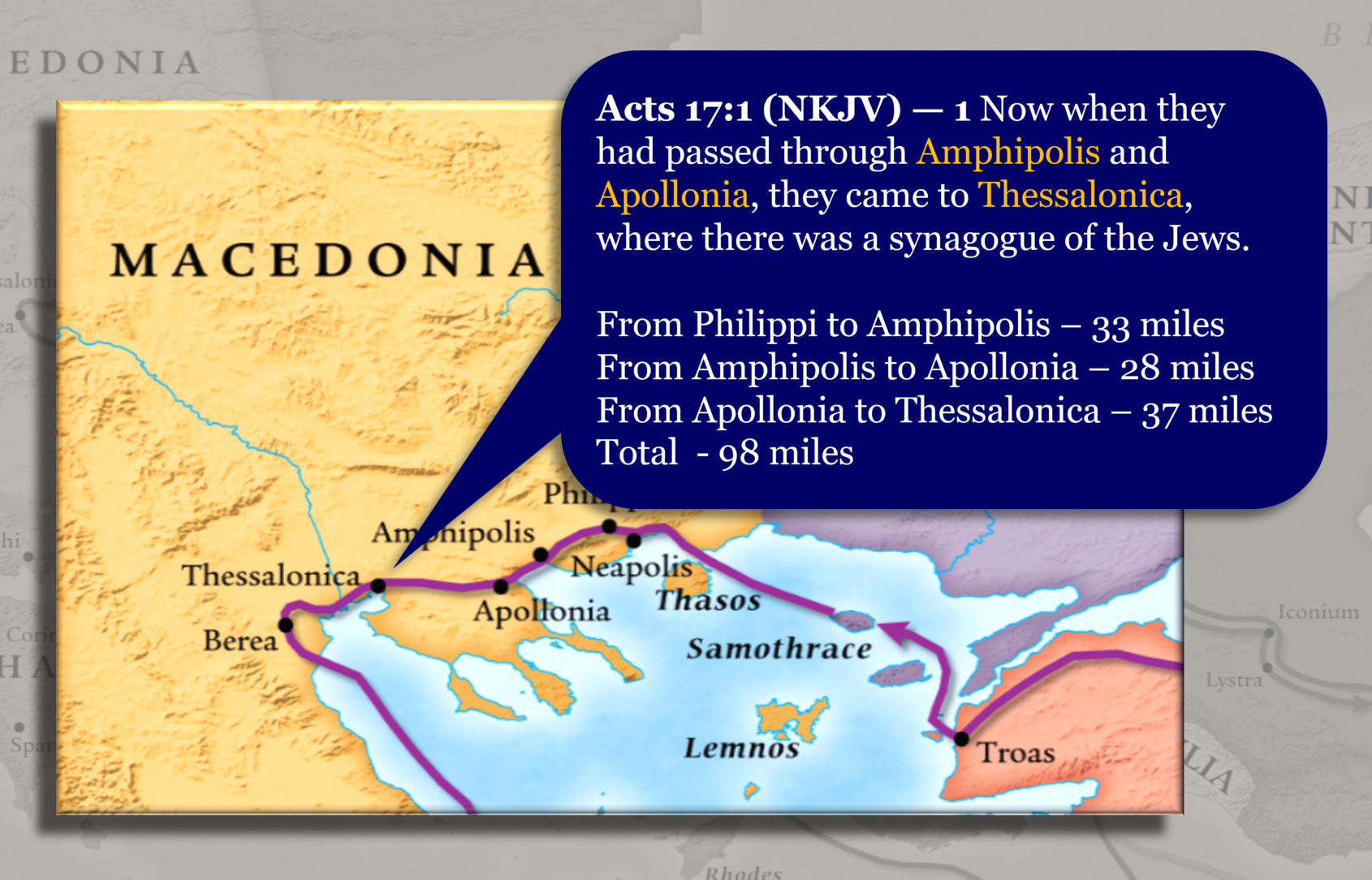
Missional Living – (Acts 17:5-15)

The Five A’s in Acts 17:5–15

  • Author: Luke continues his orderly account of the gospel’s movement from Jerusalem toward Rome (Luke 1:1–4; Acts 1:8). He repeatedly shows that persecution may relocate Christ’s witnesses (Acts 8:1-3), but it cannot restrain Christ’s Word (Acts 8:4).
  • Audience: The Acts of the Apostles or Acts is addressed to a particular Theophilus (Acts 1:1). Nevertheless, the comprehensive character of the narrative and its sustained attention to the church’s message, mission, suffering, leadership, and expansion suggest that Luke anticipated a wider Christian readership. In the passage that we are considering, the beloved physician shows believers how the apostolic mission advanced and how different audiences responded to the same message.
  • Atmosphere: Paul and Silas leave Thessalonica at night facing clear and present danger from envious religious adversaries, a mob manipulated and mobilized to attack them, and city leaders wanting to quell any uprising that might bring them unwanted attention (Acts 17:10). Berea initially offers a more receptive environment (Acts 17:11-12), but the peace is soon shattered by Thessalonian opponents who travel from Thessalonica to Berea to start trouble (Acts 17:13).
  • Architecture: Luke deliberately contrasts two synagogue responses. In Thessalonica, jealous leaders reject the message and recruit a mob (Acts 17:5). In Berea, hearers receive the message and investigate the Scriptures (Acts 17:11). The repeated word immediately (εὐθέως | eutheōs) in verses 10 and 14 gives the narrative a striding pace and urgency.
  • Aim: Luke shows that the Word advances through faithful preaching, thoughtful examination, courageous believers, and a team of workers who continue even when a leading missionary must leave.

Acts 17:5-15

5 But the Jews who were not persuaded, becoming envious, took some of the evil men from the marketplace, and gathering a mob, set all the city in an uproar and attacked the house of Jason, and sought to bring them out to the people. 6 But when they did not find them, they dragged Jason and some brethren to the rulers of the city, crying out, “These who have turned the world upside down have come here too. 7 Jason has harbored them, and these are all acting contrary to the decrees of Caesar, saying there is another king—Jesus.” 8 And they troubled the crowd and the rulers of the city when they heard these things. 9 So when they had taken security from Jason and the rest, they let them go.

10 Then the brethren immediately sent Paul and Silas away by night to Berea. When they arrived, they went into the synagogue of the Jews. 11 These were more fair-minded than those in Thessalonica, in that they received the word with all readiness, and searched the Scriptures daily to find out whether these things were so. 12 Therefore many of them believed, and also not a few of the Greeks, prominent women as well as men. 13 But when the Jews from Thessalonica learned that the word of God was preached by Paul at Berea, they came there also and stirred up the crowds. 14 Then immediately the brethren sent Paul away, to go to the sea; but both Silas and Timothy remained there. 15 So those who conducted Paul brought him to Athens; and receiving a command for Silas and Timothy to come to him with all speed, they departed.

Acts 17:5-9 The Continuing Ministry of Jesus Through Paul

This passage shows that the opposition to Paul and Silas was more than a spontaneous disagreement over doctrine. But the Jews who were not persuaded, becoming envious (Acts 17:5) responded to the success of the gospel by recruiting some of the evil men from the marketplace, gathering a mob, and setting the city in an uproar. Unable to find Paul and Silas, they dragged Jason and other believers before the rulers of the city and accused the missionaries of turning the world upside down and acting contrary to Caesar by proclaiming another king—Jesus (Acts 17:6–7). Their envy moved from inward resentment to public opposition, organized agitation, accusations before civil authorities, and ultimately an attempt to suppress the messengers and their message.

This response was not new. The ministry of Jesus had already revealed the pattern, and Jesus had warned His disciples that they should expect to experience it themselves. What Paul encounters in Thessalonica follows a path already visible in the Gospels and earlier in Acts.

Pattern of Opposition Seen First in Jesus’ Ministry Seen in Acts
1. The success of God’s work provokes envy. The problem is not merely disagreement with the message. The growing influence of the messenger threatens the position and influence of established religious leaders. Pilate recognized this motive: For he knew that they had handed Him over because of envy (Matthew 27:18; cf. Mark 15:10). The leaders themselves worried, If we let Him alone like this, everyone will believe in Him (John 11:48). The same motive appears explicitly when the gospel attracts large audiences. But when the Jews saw the multitudes, they were filled with envy (Acts 13:45). At Thessalonica, the Jews who were not persuaded, becoming envious organized opposition to Paul and Silas (Acts 17:5).
2. Envy produces contradiction. When opponents cannot simply ignore the message, they begin publicly challenging the messenger and attempting to undermine what is being taught. Jesus repeatedly faced opponents who challenged Him, not because they sincerely wanted instruction, but because they wanted to discredit Him. Then the Pharisees went and plotted how they might entangle Him in His talk (Matthew 22:15; cf. Matthew 12:14). At Pisidian Antioch the progression is explicit: contradicting and blaspheming, they opposed the things spoken by Paul (Acts 13:45). The disagreement becomes active resistance to the proclamation of the gospel.
3. Contradiction escalates into blasphemy and slander. When the work of God cannot easily be denied, opponents may attempt to redefine it as something evil. After Jesus delivered a demon-possessed man, His opponents claimed, This fellow does not cast out demons except by Beelzebub, the ruler of the demons (Matthew 12:24). They also said, You are a Samaritan and have a demon (John 8:48), and He has a demon and is mad. Why do you listen to Him? (John 10:20). Luke says that Paul’s opponents were contradicting and blaspheming (Acts 13:45). The pattern seen against Jesus now appears against those proclaiming Him.
4. Religious opposition recruits others and becomes organized. Private hostility eventually seeks allies, crowds, and political power capable of silencing the messenger. The religious leaders did not act alone. But the chief priests and elders persuaded the multitudes that they should ask for Barabbas and destroy Jesus (Matthew 27:20). Religious hostility was transformed into organized public pressure against Christ. At Thessalonica the envious opponents took some of the evil men from the marketplace, and gathering a mob, set all the city in an uproar (Acts 17:5). They then brought Jason and other believers before the civil authorities and framed the gospel politically: These are all acting contrary to the decrees of Caesar, saying there is another king—Jesus (Acts 17:7).
5. Jesus predicted that His servants would experience the same treatment. Opposition to the messengers of Christ is therefore not surprising; it is part of the pattern Jesus told His followers to expect. Jesus said, A disciple is not above his teacher, nor a servant above his master (Matthew 10:24). He later warned, If they persecuted Me, they will also persecute you (John 15:20), and specifically predicted religious persecution: They will put you out of the synagogues (John 16:2). Paul’s experiences in Pisidian Antioch and Thessalonica demonstrate the fulfillment of Jesus’ warning. As Paul carries the message of Christ into new cities, opposition to Christ becomes opposition to Christ’s messenger (Acts 13:45, 50; 17:5–9).
6. The pattern extends from Jesus to the apostles and then to Paul. Luke shows continuity between the ministry of Christ and the mission carried forward by His witnesses. Gospel fruit is repeatedly followed by hostility from those threatened by its success. Jesus’ ministry established the pattern: powerful works and growing crowds were followed by envy, contradiction, accusations, organized opposition, and eventually the involvement of civil authority (Matthew 12:14, 24; 27:18–20). Before Paul experienced this opposition, the Jerusalem apostles experienced it. After believers were increasingly added to the Lord (Acts 5:14), the high priest and his associates were filled with indignation (Acts 5:17; Greek ζήλου | zēlou). The same pattern later appears with Paul in Acts 13:45 and Acts 17:5.

Acts 17 contains a final irony. Paul’s opponents accuse the missionaries: These who have turned the world upside down have come here too (Acts 17:6), yet Luke has just told the reader who actually caused the public disorder: Paul’s opponents gathering a mob, set all the city in an uproar (Acts 17:5). The missionaries preached peace through Christ; their opponents organized the riot.

The experience of Paul and Silas therefore bears the marks of the ministry of their Master. Jesus proclaimed the kingdom, drew people to Himself, provoked the envy of threatened leaders, was contradicted and slandered, and finally faced organized religious and political opposition. He warned His disciples that the servant should expect the treatment received by his master. In Thessalonica, that prediction was being fulfilled. The gospel was advancing, people were believing, and those who carried the message of Jesus were beginning to experience the opposition that had first been directed against Jesus Himself.

When opposition, inspired by envy, begins gathering and organizing adversaries to stop a faithful ministry, there is reason to believe that you are on track. The enemies of Jesus are endeavoring to hinder the work of His servant. Why? Because Jesus, working through His people, is waging war successfully against wickedness. The gospel frees slaves, restores dignity, brings the forgiven into the family of God, and sends the redeemed into the mission of God. For this purpose the Son of God was manifested, that He might destroy the works of the devil (1 John 3:8). When that work advances, resistance should not surprise us. Jesus said, If they persecuted Me, they will also persecute you (John 15:20).

Acts 17:10: A New Family Protects the Mission

The people persuaded in Thessalonica (Acts 17:4) had done more than accept Paul’s conclusion that Jesus is the Christ. Luke now calls them the brethren (οἱ ἀδελφοί | hoi adelphoi). This family language indicates that some of the people in Thessalonica have been born again and that a new Christian community has come into existence. Former strangers in the Macedonian city of Thessalonica have become brothers and sisters in Christ. Why? Because they have been brought into the family of God through faith in Christ (John 1:12–13; Galatians 3:26). They have been baptized into the body of Christ through the Spirit of Christ (1 Corinthians 12:13). [Were they also water baptized? Water baptism is not explicitly mentioned in the Thessalonian account, so we should not claim more than Luke records. Nevertheless, baptism normally followed faith in the apostolic mission (Acts 2:41; 8:12; 16:33). It is therefore reasonable to recognize baptism as part of the larger apostolic pattern and assume that it took place. At the same time we acknowledge that Acts 17 does not specifically report it.] In the new family relationship there are new family responsibilities. Luke shows the Thessalonians embracing those new responsibilities.

The brethren do not merely enjoy their new fellowship. They act to protect those through whom they received the gospel. Luke says that they immediately (εὐθέως | eutheōs) sent Paul and Silas away by night. The Greek verb translated sent away is (ἐξέπεμψαν | exepempsan), while by night translates (διὰ νυκτός | dia nyktos). The darkness provided cover for the missionaries’ departure. The immediately (εὐθέως | eutheōs) says that there was urgency and indicates that the danger had not ended with Jason’s posting of a bond and release. But the part that we must see is that the new believers are already accepting personal responsibility for the missionaries; in this way they have also taken personal responsibility for the mission.

Paul and Silas are sent to Berea, a city lying southwest of Thessalonica and away from the Via Egnatia. Their movement toward Berea appears to have been forced by persecution. But the forced detour becomes a missionary opportunity. Hostile people force scattering and departure, but God leverages their leaving for His own glory, the good of the scattered, and the places where they will go (Genesis 50:20; Romans 8:28).

Upon arriving, Paul and Silas enter the synagogue of the Jews (τὴν συναγωγὴν τῶν Ἰουδαίων | tēn synagōgēn tōn Ioudaiōn). Notice that Paul will not stop. He has been beaten in Philippi, opposed in Thessalonica, and hurried out of that town at night. Yet, when he reaches the next city, he goes straight into the synagogue.  He is driven by the grace of God, his great affection for Christ, and the indwelling Spirit to press on in ways that are causing him to lose his life. But instead of quitting, he returns to the work and stays with the commands and conventions of Jesus.

  1. Command – When persecution prevents continued ministry in one place, proceed to another. Jesus said, When they persecute you in this city, flee to another (Matthew 10:23; see also Luke 9:5–6). Flight is not necessarily faithlessness. Sometimes leaving one location is how the witness continues.
  2. Command – Make disciples among all nations. The Great Commission required Christ’s followers to go, make disciples, baptize them, and teach them to observe Christ’s commands (Matthew 28:18–20). Paul cannot allow mistreatment to cancel the commission.
  3. Convention – Begin with those prepared by the Law and the Prophets. Paul’s synagogue-first pattern appears throughout Acts (Acts 13:5, 14–16; 14:1; 17:1–3; 18:4; 19:8). It corresponds with the gospel being for the Jew first and also for the Greek (Romans 1:16; see Acts 13:46). The Jewish people possessed the Scriptures, the covenants, and the promises concerning the Messiah (Romans 3:1–2; 9:4–5). The Law served as a tutor leading people toward Christ (Galatians 3:24), while the Prophets bore witness to the righteousness revealed through faith in Him (Romans 3:21–22).

The synagogue was therefore not merely a familiar meeting place. It was a strategic point of contact with people already acquainted with the vocabulary, promises, and expectations necessary for discussing the Messiah.

When the harvest is plentiful and the laborers are few, the synagogue is the first and best place to go and find people ready to receive redemption and a part in the ministry of reconciliation. Paul has the strength and strategy of Christ in his going to the world with the gospel.

Acts 17:11: Receptive Hearts and Examining Minds

Luke says that the Bereans were more fair-minded (εὐγενέστεροι | eugenesteroi) than those in Thessalonica. The comparative adjective comes from (εὐγενής | eugenēs) and means “noble,” “well-born,” or, in this context, “noble-minded.” Luke is not describing their ancestry or social status. He says their nobility, when compared to the Thessalonians, is a matter of how they responded to the Word. The comparison should not be broadened into a condemnation of everyone in Thessalonica. Some Thessalonians believed and joined Paul and Silas (Acts 17:4). Luke is especially contrasting the Berean synagogue hearers with the jealous and hostile Thessalonian leaders of verses Acts 17:5 and Acts 17:13. Let us take a moment to look more closely at Berean nobility; it had two parts:

  1. Attitude: They received the Word with readiness. They received (ἐδέξαντο | edexanto) the message with all readiness (μετὰ πάσης προθυμίας | meta pasēs prothymias).The noun (προθυμία | prothymia) communicates eagerness, willingness, or readiness of mind. They did not begin with a determination to reject Paul. They were willing to hear the argument fairly. Their hearts were open, but their minds were not switched off.
  2. Action: They examined the Scriptures daily. Luke describes them as examining (ἀνακρίνοντες | anakrinontes) the Scriptures. The participle comes from (ἀνακρίνω | anakrinō), a word associated with careful investigation, questioning, discernment, or judicial examination. Bereans were just accepting what Paul said and they were not casually glancing at a verse before rubber stamping the statements of the apostle. They were investigating Paul’s claims daily (τὸ καθ᾽ ἡμέραν | to kath’ hēmeran).

Their investigation had a specific purpose: to determine whether these things were so (εἰ ἔχοι ταῦτα οὕτως | ei echoi tauta houtōs). In context, these things reaches back to Paul’s claims in Acts 17:2–3: (1) the Messiah had to suffer, (2) rise from the dead, and (3) be identified as Jesus of Nazareth. The Bereans compared Paul’s explanation with the Law, the Prophets, and the Psalms. They did not reject Paul because his teaching was unfamiliar, nor did they accept it merely because he spoke confidently. They allowed the Scriptures to judge the message.

This resembles good science in its commitment to disciplined examination. In science claims are not accepted merely because of the reputation of the person making them. Evidence is examined, conclusions are tested, and reported results must be of the sort that can be independently verified. They were using the revelation they already recognized as authoritative to evaluate Paul’s interpretation. Their example brings together two qualities that are too often separated:

  • Readiness without examination can become gullibility.
  • Examination without readiness can become hardened skepticism.
  • Readiness joined with examination becomes noble discernment.

This is consistent with Paul’s later command: “Test all things; hold fast what is good” (1 Thessalonians 5:21). Ironically, that instruction was written to believers in Thessalonica. The Berean response has become a beacon to everyone that is wanting to consider the hope of the gospel and be thorough in review of the facts.

Acts 17:12: Examination Leads to Faith

Verse 12 begins with an important connection: Therefore many of them believed. Luke uses the inferential conjunction (οὖν | oun), meaning “therefore,” “then,” or “consequently.” Their faith was not disconnected from their examination. They received the Word, searched the Scriptures, discovered that Paul’s claims were consistent with God’s prior revelation, and consequently believed (ἐπίστευσαν | episteusan).

Investigation does not mechanically produces regeneration. Faith remains the result of God’s gracious work through His Word and Spirit (John 3:5–8; Romans 10:17). But this is a message to everyone who wants to know if Christianity can be questioned. It says emphatically that Christianity does not require people to suppress honest questions or ignore evidence. Paul’s preaching could withstand scrutiny because it was rooted in events that had occurred and Scriptures that had already been given.

The Christian faith is not a house of cards that collapses when touched by a sincere question. It is a house founded upon rock (Matthew 7:24–25). Its doors are open to those willing to come and see the truth contained therein (John 1:46). The gospel does not fear investigation; it calls people to investigate with intellectual honesty, moral humility, and a willingness to obey the truth they discover (John 7:17).

Luke also emphasizes the breadth of the response. Many Jews believed, along with prominent Greek women and men. The word translated prominent is the Greek adjective (εὐσχήμων | euschēmōn). In verse 12 it appears in the plural genitive form (εὐσχημόνων | euschēmonōn). The word can describe people who are honorable, respected, influential, or of high social standing. As in Thessalonica, the gospel is reaching Jews and Greeks, women and men, and people with influence in the city (Acts 17:4). Notice the contrast:

  • In Thessalonica, influential opponents use their position to stir up disorder.
  • In Berea, influential hearers submit their conclusions to Scripture and believe.

Status does not determine response. The disposition of the heart toward truth does.

Acts 17:13: Opposition Travels Too

When the Thessalonian detractors learn that the word of God (ὁ λόγος τοῦ θεοῦ | ho logos tou theou) had been proclaimed in Berea by Paul, they head there to stop his work. Notice the description of the message. Luke does not call it Paul’s philosophy, religious opinion, or personal interpretation. It is the Word of God. Paul is the preacher, but God is the source of the message. Luke uses the verb (κατηγγέλη | katēngelē), meaning “was proclaimed” or “was announced.” The verb is passive. The Word of God was being proclaimed by Paul (ὑπὸ τοῦ Παύλου | hypo tou Paulou). Paul is the human agent through whom the divine message is being made known.

The opponents travel to Berea and begin stirring up and troubling the crowds. Luke uses two vivid participles:

  • The participle stirring up (σαλεύοντες | saleuontes), from (σαλεύω | saleuō), means shaking, agitating, or causing instability.
  • The participle troubling (ταράσσοντες | tarassontes), from (ταράσσω | tarassō), means disturbing, unsettling, confusing, or throwing into disorder.

Do not miss the irony. In Thessalonica they accuse Paul and Silas of turning the world upside down. However, they are the ones coming in and causing tumults both in Thessalonica and now in Berea. And realizing they cannot defeat Paul’s argument from Scripture, they attempt to destabilize the audience. In Thessalonica they recruited wicked men from the marketplace and created a mob (Acts 17:5). In Berea they again agitate the crowds. Their strategy is not careful rebuttal but manufactured disorder.

Their persistence reflects the character and activity of Satan. I want to state this part with special care. Luke is not condemning the Jewish people as an ethnic group. Paul, Silas, Timothy, and many Berean believers were themselves Jews. The issue is not ethnicity but spiritual allegiance. Anyone who adopts the devil’s methods of deception, destruction, and murderous opposition begins to resemble the devil morally.

Jesus told hostile leaders that they were imitating the devil, who was a murderer from the beginning and a liar and the father of it (John 8:44). He described the devil as one who snatches away the Word before it can produce fruit (Matthew 13:19), while the tares are sown by the enemy, who is the devil (Matthew 13:38–39). The thief comes to steal, and to kill, and to destroy (John 10:10). Paul would later say explicitly, Satan hindered us (1 Thessalonians 2:18).

The pattern began in Eden. The devil entered a place made good by God, contradicted God’s Word, and sought to destroy innocent beings made in God’s image (Genesis 3:1–5). That same pattern continues whenever people:

  • enter a place where God’s Word is bearing fruit,
  • contradict or distort what God has said,
  • agitate people against God’s messengers,
  • and attempt to prevent reconciliation of rebels to God and one another through faith in Christ.

The gospel seeks restoration between God and humanity and reconciliation among people (2 Corinthians 5:18–20; Ephesians 2:14–18). Satan opposes that work by promoting blindness, confusion, accusation, and division (2 Corinthians 4:4; Revelation 12:9–10). His human agents do not rest merely because the gospel workers have relocated. When they hear that the Word is flourishing elsewhere, they follow in order to stop the advance of the kingdom.

The Thessalonian opponents travel roughly fifty miles to stop the gospel. Paul travels wherever necessary to preach the gospel. That contrast should make some supposed Jesus followers uncomfortable.

Acts 17:14: Remove Paul, and the Mission Continues

The opposition focuses particularly on Paul. Verse 13 says that the Word had been proclaimed in Berea by Paul, and verse 14 says that the brethren immediately sent Paul away. The brethren acted decisively to remove Paul from immediate danger.

The opponents appear to assume that removing the principal preacher will disable the ministry. Their strategy misunderstands the architecture of Christ’s church. The ministry is not built around one indispensable personality. Paul is prominent, but he is part of a missionary team, and the gospel is the power of God, not the power of Paul (Romans 1:16; 1 Corinthians 3:5–7). Silas and Timothy remained there. Luke uses (ὑπέμειναν | hypemeinan), from (ὑπομένω | hypomenō), meaning to remain, stay behind, endure, or continue in a place.

Silas and Timothy did not remain in Berea to twiddle their thumbs, stare sadly toward the sea, and wonder when the world’s most interesting man might return. Luke does not specify their exact activities, so we should avoid inventing a detailed itinerary. Nevertheless, their previous work and later assignments make the likely purpose clear. They remained to strengthen, instruct, and stabilize the new believers.

This was consistent with Paul’s established pattern. He and Barnabas returned to young churches, strengthening the souls of the disciples, and appointed elders (Acts 14:21–23). Paul later sent Timothy to Thessalonica to establish you and encourage you concerning your faith (1 Thessalonians 3:1–3). Silas was himself a prophet and respected leader who strengthened believers through exhortation (Acts 15:22, 32). Paul’s departure therefore demonstrates successful discipleship.

A ministry that collapses whenever its principal leader leaves has gathered an audience but has not advanced their abilities of enough for the mission. Paul could leave because others had been equipped to continue.

There is also an understated detail in verse 14: the brethren (οἱ ἀδελφοί | hoi adelphoi) again act to protect Paul. The gospel has produced more people who will now assume personal risk and inconvenience for the sake of its messenger. Conversion is creating not merely listeners, but participants in the mission.

Acts 17:15: The Body Conducts and Coordinates the Mission

Those escorting Paul brought him all the way to Athens. Luke describes them with the phrase (οἱ καθιστάνοντες τὸν Παῦλον | hoi kathistanontes ton Paulon), literally “those conducting Paul” or “those escorting Paul.” The participle (καθιστάνοντες | kathistanontes) comes from (καθιστάνω | kathistanō), a form related to (καθίστημι | kathistēmi). In this context, it carries the idea of conducting, accompanying, or bringing someone safely to a destination. Luke does not explicitly identify every escort as a recent Berean convert, but the context strongly suggests that members or associates of the new Christian community were involved.

This was no casual trip to the edge of town. Athens lay a considerable distance from Berea. Whether the entire journey was by sea or included an overland portion is not stated. Luke’s concern is not the transportation schedule but the devotion shown by those who conducted Paul safely to his destination.

They went out of their way to ensure through personal escort the welfare of their brother and apostle. How are we caring for our spiritual leadership and people who are called to promote the gospel?

Athens was a renowned center of religion, philosophy, art, and public discussion. Yet Paul did not arrive there as an impressive philosopher accompanied by an academic delegation. He arrived as a persecuted missionary escorted by ordinary believers. God was bringing His witness to one of the great intellectual centers of the ancient world through the loving service of the body of Christ.

Before the escorts departed, they received a command for Silas and Timothy to come to him with all speed. The word translated command is (ἐντολήν | entolēn), and with all speed translates (ὡς τάχιστα | hōs tachista). The expression means “as quickly as possible” or “with all possible speed.”

Paul valued his coworkers and did not view himself as a self-sufficient spiritual celebrity. His urgency shows both the demands of the mission and his dependence upon the team Christ had assembled. The escorts then departed, presumably carrying Paul’s instructions back to Berea. Thus, the believers serve as more than bodyguards. They become part of the mission’s communication network. The work advances because some preach, some teach, some remain, some travel, some protect, and some carry instructions.

Opposition separated Paul from Silas and Timothy temporarily, but it did not destroy their coordination. The enemy could disrupt the team’s location, but he could not dissolve their fellowship or terminate their work.

Practical Application of the Passage

Text Missional Principle What We Do
Acts 17:5–7 Expect resistance when Christ’s mission advances. Opposition does not automatically prove faithfulness, but resistance should not surprise faithful believers. Refuse to be intimidated out of obedience.
Acts 17:6–9 Accept personal cost for the sake of the mission. Jason and the other believers suffered because they identified themselves with Christ’s servants and their work. Put something at risk for the mission.
Acts 17:10 Protect the messenger without abandoning the mission. The brethren sent Paul and Silas away, but the missionaries immediately continued their work in Berea. Protect the people. Preserve the mission.
Acts 17:10–12 Make Scripture central to mission. The Bereans received Paul’s message and examined it against the Scriptures. Open the Bible with someone.
Acts 17:11–12 Receive truth eagerly and examine it carefully. The Bereans combined readiness to hear with disciplined biblical discernment. Receive the Word. Search the Word.
Acts 17:13–15 Keep going when opposition follows you. Opposition followed Paul from Thessalonica to Berea, but it did not stop the mission. Do not let opposition stop your obedience.
Acts 17:14–15 Mission is team ministry. Paul, Silas, Timothy, Jason, and unnamed believers from Thessalonica nd Berea played different roles in advancing the same mission. Find your place and move the mission forward.

Find your place and move the mission forward.

Old Testament Material That Illuminates the Passage

1. Ezra 7:10: The Berean Pattern Before Berea

Ezra prepared his heart to seek the Law of the LORD, and to do it, and to teach statutes and ordinances in Israel.

This verse brings together the essential elements seen in Berea:

  1. a heart prepared to receive,
  2. a determination to search,
  3. submission to what is discovered,
  4. and readiness to communicate it to others.

The Bereans were not searching merely to win an argument. Their examination was connected to believing and obeying.

2. Isaiah 8:20: Revelation Tests Religious Claims

To the law and to the testimony! If they do not speak according to this word, it is because there is no light in them.

Isaiah establishes the principle that new religious claims must be tested by God’s existing revelation. The Bereans did not evaluate Paul according to novelty, popularity, or eloquence. They asked whether his teaching agreed with what God had already spoken.

3. Deuteronomy 13:1–5: Even Impressive Claims Must Be Tested

Moses warned Israel that even signs and wonders did not excuse them from testing a teacher’s message according to prior revelation. A spectacular ministry was not sufficient evidence of faithfulness. This explains why examining an apostle was not disrespectful. The Bereans were obeying a principle already embedded in the Law. Paul’s authority did not require unquestioning credulity.

4. Deuteronomy 18:15–22: The Coming Prophet and the Testing of Speech

This passage promises a prophet like Moses whom God’s people must hear, while also providing standards for evaluating prophetic claims. It therefore supports both parts of the Berean response: readiness to hear God’s promised messenger and care in determining whether a message truly comes from God. It may also have formed part of Paul’s argument that Jesus was the promised prophet and Messiah (Acts 3:22–26).

5. Proverbs 18:13, 17: Hear Fully and Examine Carefully

He who answers a matter before he hears it, it is folly and shame to him (Proverbs 18:13).

The first one to plead his cause seems right, until his neighbor comes and examines him (Proverbs 18:17).

These proverbs describe the intellectual fairness lacking among the Thessalonian opponents and present among the Bereans. The Bereans heard Paul’s case and then examined it. They were neither prematurely dismissive nor carelessly accepting.

6. Psalm 1:1–3 and Joshua 1:8: Daily Attention to Scripture

The Bereans examined the Scriptures daily (τὸ καθ᾽ ἡμέραν | to kath’ hēmeran). Psalm 1 describes the blessed person meditating in God’s law day and night, while Joshua 1:8-9 commands continual meditation upon the Book of the Law.

Daily examination was therefore more than academic curiosity. It reflected the Old Testament portrait of the faithful person whose life is continually shaped by God’s Word.

7. The Messianic Texts They May Have Examined

Because these things (ταῦτα | tauta) refers back to Paul’s claims in Acts 17:2–3, the Bereans were likely examining passages related to the Messiah’s suffering, resurrection, reign, and identity. Luke does not list the exact scrolls they opened, but the following passages were central to apostolic preaching:

  • Genesis 3:15: The promised offspring is wounded yet defeats the serpent.
  • 2 Samuel 7:12–16: The promised Davidic king receives an enduring throne.
  • Psalm 2: God establishes His Anointed King despite the nations’ opposition.
  • Psalm 16:8–11: God’s Holy One will not be abandoned to the grave. Peter and Paul both apply this passage to Jesus’ resurrection (Acts 2:25–32; 13:35–37).
  • Psalm 22: The righteous sufferer is mocked, afflicted, vindicated, and ultimately praised among the nations.
  • Psalm 110:1: David’s Lord is exalted to God’s right hand.
  • Isaiah 52:13–53:12: The Servant suffers for the sins of others, is cut off, and afterward sees the fruit of His sacrificial work.
  • Daniel 7:13–14: The Son of Man receives everlasting dominion.
  • Zechariah 12:10: God’s people look upon the one who was pierced and mourn.

Paul’s message was not that Jesus surprisingly became the Messiah after an unfortunate crucifixion. His argument was that the Scriptures had always anticipated a Messiah who would suffer, be vindicated, rise, and reign.

8. Genesis 3:1–15: The Pattern Behind the Opposition

Genesis 3 supplies the theological background for verse 13. The serpent:

  1. enters what God has made good,
  2. questions and contradicts God’s Word,
  3. deceives human beings,
  4. attacks those made in God’s image,
  5. and opposes God’s purposes.

The Thessalonian agitators reenact this pattern when they enter Berea, disturb people who are receiving God’s Word, and attempt to prevent its life-giving results. Yet Genesis 3:15 also promises the serpent’s defeat. The opposition may wound God’s servants, but it cannot overturn God’s redemptive purpose.

The controlling truth of Acts 17:10–15 is therefore this:

The messengers may be driven from city to city, but the Word keeps arriving and birthing new believers before the opposition can stop it.

Missional Living – Pressing On (Acts 17:1-4)

17:1 Now when they had passed through Amphipolis and Apollonia, they came to Thessalonica, where there was a synagogue of the Jews. 2 Then Paul, as his custom was, went in to them, and for three Sabbaths reasoned with them from the Scriptures, 3 explaining and demonstrating that the Christ had to suffer and rise again from the dead, and saying, “This Jesus whom I preach to you is the Christ.” 4 And some of them were persuaded; and a great multitude of the devout Greeks, and not a few of the leading women, joined Paul and Silas.

Pressing On (Acts 17:1)

Although Paul and Silas had been shamefully treated in Philippi, their ministry there had been remarkably fruitful. The gospel was preached to a gathering of Gentile women (Acts 16:13); Lydia and her household believed and were baptized (Acts 16:14–15); a demonically oppressed girl was delivered (Acts 16:16–18); prisoners heard prayers and praises offered to God (Acts 16:25); and the Philippian jailer and his household were brought to faith in Christ and baptized (Acts 16:30–34). Before leaving Philippi, Paul and Silas returned to Lydia’s home, encouraged the newly formed fellowship of believers, and departed (Acts 16:40). The Now of Acts 17:1 introduces the next stage of Paul’s second missionary journey.

From Philippi, Paul and Silas pressed onward through Amphipolis and Apollonia until they reached Thessalonica (Acts 17:1). The journey covered approximately one hundred miles along the Via Egnatia. Traveling westward from Philippi along the Via Egnatia, they passed approximately 33 miles through Amphipolis. They may have lodged there, but Luke records no extended ministry. They were traveling through. They continued approximately 28 miles to Apollonia and then another 37 miles to Thessalonica. Altogether, they traveled nearly 100 miles on foot before beginning their next recorded season of ministry.

Their perseverance becomes even more striking when we remember what they had just endured. They had been stripped, severely beaten, confined in the inner prison, and fastened in stocks (Acts 16:22–24). Paul later reminded the Thessalonians that he and Silas had “suffered before and were spitefully treated at Philippi” (1 Thessalonians 2:2). Yet they did not retire from their mission. Although they were still recovering from persecution and may have borne its visible marks, they entered another city and began proclaiming Christ again.

Figure 1 – From Philippi to Thessalonica

We possess advantages Paul did not have: automobiles, airplanes, telephones, livestreams, social media, printed Bibles, electronic libraries, and instant communication. We can carry the gospel farther in hours than Paul could travel in days or weeks. Yet greater convenience is not necessarily accompanied by greater commitment.

Paul did not remember the journey principally as an impressive feat of physical endurance. He remembered that, after suffering in one city, God gave them boldness to preach in the next (1 Thessalonians 2:2). They pressed on!

Their wounds did not silence their witness. Their mistreatment did not diminish their mission. Their disappointment did not determine their direction.

How do we compare? Paul and his companions traveled nearly 100 miles on foot, perhaps while still bearing the wounds of Philippi, to tell strangers that Jesus is the Christ. We often find it burdensome to go next door, to cross the street, to drive across town, to alter an evening’s schedule, or to endure an uncomfortable conversation to speak about Jesus.

The question raised by this journey is not merely, “How far would we walk?” It is:

What inconvenience, discomfort, rejection, or sacrifice are we willing to endure so that someone else may hear that Jesus is the Christ?

Paul’s 100-mile trek makes me see the relative weakness of my own Christianity; it is often the case that it serves only when service is convenient. These missionaries did not wait until they were completely rested, emotionally restored, socially appreciated, and physically comfortable. They went because Christ was worthy, the gospel was true, and Thessalonica needed to hear it.

They had been beaten, but they kept walking. They had been rejected, but they kept their resolve to carry the message of reconciliation where it was needed. They had suffered for Christ in Philippi, and they were still willing to speak for Christ in Thessalonica.

A Strategic Starting Point (Acts 17:2)

Why did they stop in Thessalonica? That is, why did Paul and Silas not stop to preach Christ in Amphipolis or Apollonia? Luke supplies a strategically important detail and deciding factor:

where there was a synagogue of the Jews. (Acts 17:1)

Paul was not wandering aimlessly hoping to meet people with whom he could have dialogue about religious stuff. He was moving purposefully toward population centers in which he had common ground for conversation about the Christ. The synagogue provided people who also knew the Scriptures and would have copies (Luke 4:16-21; Acts 15:21), who also anticipated the Messiah, and who also could understand an argument drawn from Moses and the Prophets. Paul, therefore, was being strategic when he entered the synagogue, and for three Sabbaths reasoned with them from the Scriptures (Acts 17:2). His ultimate goal was to reach everyone with the offer of reconciliation. But the laborers were few (Matthew 9:37-38; Luke 10:2). Paul’s custom of going to the synagogue was two-pronged in purpose. First, it was part of his hope to reach his brethren (Romans 1:16; 9:1-3; Acts 13:46). Second, it was his strategy for getting help in bringing the gospel to the nations (Acts 18:1-4, 24-28). Synagogues gathered God-fearers and Jews already grounded in the Law and the Prophets; the attendees were, again,  the most prepared candidates to receive Christ and immediately assist in carrying the gospel to the surrounding Gentile world.

Explaining and Demonstrating (Acts 17:3)

How did the apostle go about reaching the people in the synagogue with the gospel? In Acts 17:3, Luke uses two vivid, complementary Greek verbs—dianoigō (διανοίγω – explaining) and paratithēmi (παρατίθημι – demonstrating)—to describe how Paul methodically engaged the synagogue in Thessalonica from the Scriptures.

  • Explaining: dianoigō (διανοίγω) – The verb dianoigō (διανοίγω) literally means “to open thoroughly” or “to open completely” (dia, “through,” + oignymi, “to open”). In classical and biblical usage, it describes unbarring what was closed or bringing clarity to what was hidden. Luke uses dianoigō three times in Luke 24 to establish the post-resurrection pattern of scriptural illumination:
    • Luke 24:31: In this case the opening of eyes is not literal but figurative. After His crucifixion and resurrection, two of Jesus’ followers were joined by Him as they walked to Emmaus.  Although they were walking and talking with Someone they had been in close company with for years, they did not realize it was Jesus in their company. During time together in the house they broke bread together; then their eyes were opened (diēnoichthēsan) and they recognized Him. When it says that their eyes were opened it does not mean they had been walking with their eyes closed for seven miles. Their eyes had been restrained (Luke 24:16). It means that they were finally given the ability to perceive who the Stranger in the midst really was (Matthew 11:27; John 12:39-40).
    • Luke 24:32: It is more than an epiphany. Looking back they realized that something was happening as He explained the fact that the Christ had to suffer. Scriptures that they had formerly not seen as clearly stating the necessity of the Christ suffering as he redeemed His people were made plain. The disciples on the Emmaus road asked, “Did not our heart burn within us while He talked with us on the road, and while He opened (diēnoigen) the Scriptures to us?”
    • Luke 24:45: “And He opened (diēnoixen) their understanding, that they might comprehend the Scriptures.”
In Acts 17:3, Paul follows the exact rabbinic and Christological method of Jesus in Luke 24: he “opened” the Hebrew Scriptures by unfolding texts that had previously seemed veiled or obscure, revealing how the Messianic prophecies directly required suffering and resurrection. The veil of their meaning was taken away.
  • Demonstrating: Paratithēmi (παρατίθημι) – The verb paratithēmi combines para (“beside”) and tithēmi (“to place” or “to set”). It literally means “to place side by side” or “to set before.” In this context, paratithēmi carries the sense of adducing evidence or setting proofs side-by-side. Paul placed the Old Testament prophecies of the suffering Servant and Messiah (e.g., Isaiah 53, Psalm 16, Psalm 22) alongside the historical facts of Jesus’ life, death, and resurrection.

By placing the prophecy next to the historical fulfillment, the conclusion was inescapable: “This Jesus whom I preach to you is the Christ” (Acts 17:3). Paul was not the only one capable of doing this. On Pentecost, Peter had done the same thing (Acts 2:14–36). Using passages from Joel and the Psalms (Joel 2:28–32; Psalm 16:8–11; Psalm 110:1), the big fisherman explained the recent crucifixion and resurrection of Jesus and the strange occurrence of people speaking in other languages as evidence that Jesus of Nazareth is both Lord and Christ (Acts 2:4–11, 22–24, 31–36).

After years under the teaching of Peter and the other apostles, this skill is also seen in members of the Jerusalem church (Acts 2:42; 5:42; 6:7). Philip was able to show the Ethiopian eunuch that the passage he was reading from Isaiah was a prophecy concerning Jesus of Nazareth (Isaiah 53:7–8; Acts 8:26–35). Philip was not an outlier. When persecution broke out, the church was scattered (Acts 8:1–3). The people who had been discipled in Jerusalem went everywhere preaching the word (Acts 8:4; 11:19–21). What word? They preached Christ and explained the connection between the Scriptures and the life, death, and resurrection of Jesus (Acts 8:5, 12, 35). Being separated from the apostles did not render the church members incapable of advancing the cause of Christ. After being mentored by the apostles, they were able to speak about Christ effectively and to give a reason for the hope that was in them (1 Peter 3:15).

This raises an important question for modern Jesus followers: Can we do this? Are we developing the skill needed to explain and demonstrate from the Scriptures that Jesus is the Christ? Are the people whom we are discipling being taught to do this? The apostles taught the believers in Jerusalem this skill through their doctrine and public witness (Acts 2:42; 4:33; 5:42). When persecution broke out and the church was scattered, they went everywhere preaching the word (Acts 8:1, 4). This is how the early church spread.

The Outcome – Persuaded People Join the Mission (Acts 17:4)

So, what came out of all that explaining, demonstrating, and reasoning? Luke says that Paul’s reasoning from the Scriptures produced results. The beloved physician says that some of the Jews were persuaded. Luke presents their persuasion as the result of sustained reasoning from the Scriptures. Paul explained the prophetic testimony, placed it alongside the historical facts concerning Jesus, and called his hearers to consider the conclusion. They were convinced by the evidence Paul presented from the Scriptures. The prophecies concerning the suffering and resurrection of the Messiah corresponded with the historical facts concerning Jesus of Nazareth (Acts 17:2–3). Their faith was reasonable because it rested upon revelation and evidence.

But persuasion was not the end of their response. Those who were persuaded joined Paul and Silas. The word translated joined indicates that they associated themselves with the missionaries and became part of the new community being formed around Jesus. They did more than agree with Paul’s interpretation. They publicly aligned themselves with Paul, Silas, and the gospel they preached. In Thessalonica, where opposition would soon become violent, this identification required courage (Acts 17:5–9; 1 Thessalonians 2:14). Genuine faith produces a change in allegiance and association.

The response extended beyond the Jewish members of the synagogue. A great multitude of the devout Greeks believed. These were Gentiles who had turned away from pagan religion to worship the God of Israel and had become associated with the synagogue, although they had not necessarily become full Jewish proselytes. Paul’s message showed them that they did not have to become Jews before coming to God. Through faith in Jesus Christ, believing Jews and Gentiles were brought into the same redeemed community (Acts 10:34–35, 43; 15:7–11; Galatians 3:26–29).

Luke also reports that not a few of the leading women joined Paul and Silas. His expression means that a significant number of prominent and influential women believed. Women had already played an important role in the Macedonian mission. In Philippi, Lydia believed the gospel, opened her home to Paul’s company, and helped provide a place from which the new church could grow (Acts 16:14–15, 40). Leading women would also respond to the gospel in Berea (Acts 17:12). Luke refuses to treat these women as incidental or invisible. Their conversion mattered both to the church and to the cities in which they lived.

Acts 17:4 presents a diverse beginning for the Thessalonian church: some Jews, a great multitude of God-fearing Greeks, and a significant number of leading women. The gospel crossed ethnic, cultural, and social boundaries. These people had different backgrounds, but they were brought together by one conviction: Jesus is the Christ. Their shared faith created a new fellowship and gave them a new allegiance. This verse also shows the relationship between explanation, persuasion, and identification. Paul explained and demonstrated the truth from the Scriptures; the hearers were persuaded; and those who were persuaded joined themselves to the people advancing the gospel. Healthy evangelism seeks more than momentary agreement. It calls people to believe in Jesus, identify with His people, and participate in His mission (Matthew 28:19–20; Acts 2:41–42).

In His grip by His grace,
Roderick L. Barnes, Sr.

Questions for Discussion

  1. What does Paul and Silas’s decision to continue toward Thessalonica reveal about their understanding of calling, suffering, and perseverance?
  2. How does the fruitful ministry in Philippi help us see that hardship is not necessarily evidence that a ministry has failed (Acts 16:13–40)?
  3. Paul and Silas traveled approximately one hundred miles after being beaten and imprisoned. What physical, emotional, or spiritual wounds are most likely to cause us to withdraw from serving Christ?
  4. Why did Paul begin his ministry in the synagogue? What does his choice reveal about intentional and strategic evangelism?
  5. Paul “reasoned,” “explained,” and “demonstrated” from the Scriptures that Jesus is the Christ (Acts 17:2–3). What does each of these activities contribute to an effective presentation of the gospel?
  6. How well prepared are we to show someone from Scripture that the Christ had to suffer, die, and rise from the dead?
  7. Paul’s message was not merely that a Messiah would come. His conclusion was, “This Jesus whom I preach to you is the Christ.” Why must faithful evangelism bring the conversation specifically to Jesus?

Questions for Prayer

  1. Where have disappointment, mistreatment, or exhaustion caused me to lose momentum in serving Christ?
  2. What wounds do I need to bring honestly before God so that they do not become reasons for disobedience?
  3. Am I asking God only to remove difficulties, or am I also asking Him for strength to remain faithful through them?
  4. Do I know the Scriptures well enough to explain clearly why Jesus is the Christ? In what area do I need greater preparation?

Closing Prayer

Lord, give us the courage to press on when obedience is costly. Heal the wounds that tempt us to retreat, and keep hardship from turning into bitterness or fear. Ground us deeply in Your Word so that we can reason clearly, explain faithfully, and demonstrate that Jesus is the Christ. Lead us to people who are ready to hear, and work through the gospel to persuade them. Make us faithful in going, speaking, praying, giving, and supporting others until the work You have entrusted to us is complete. In Jesus’ name, amen.