Missional Living – Marriage and Ministry Advice (Acts 18:18-28)
18 So Paul still remained a good while. Then he took leave of the brethren and sailed for Syria, and Priscilla and Aquila were with him. He had his hair cut off at Cenchrea, for he had taken a vow. 19 And he came to Ephesus, and left them there; but he himself entered the synagogue and reasoned with the Jews. 20 When they asked him to stay a longer time with them, he did not consent, 21 but took leave of them, saying, “I must by all means keep this coming feast in Jerusalem; but I will return again to you, God willing.” And he sailed from Ephesus.
22 And when he had landed at Caesarea, and gone up and greeted the church, he went down to Antioch. 23 After he had spent some time there, he departed and went over the region of Galatia and Phrygia in order, strengthening all the disciples.
24 Now a certain Jew named Apollos, born at Alexandria, an eloquent man and mighty in the Scriptures, came to Ephesus. 25 This man had been instructed in the way of the Lord; and being fervent in spirit, he spoke and taught accurately the things of the Lord, though he knew only the baptism of John. 26 So he began to speak boldly in the synagogue. When Aquila and Priscilla heard him, they took him aside and explained to him the way of God more accurately. 27 And when he desired to cross to Achaia, the brethren wrote, exhorting the disciples to receive him; and when he arrived, he greatly helped those who had believed through grace; 28 for he vigorously refuted the Jews publicly, showing from the Scriptures that Jesus is the Christ.
Headed Home (Acts 18:18-21) —
- Priscilla is listed before Aquila in Acts 18:18. If we use the Nestle Aland United Bible Society (NU) text, she is also listed first in Acts 18:26. The Textus Receptus, a sixteenth-century printed Greek text based primarily on a relatively limited group of later Byzantine manuscripts, has Aquila listed first. Luke says, in effect, the wife and husband accompanied Paul. Later in Acts 18:26, if we use NU as a basis for translation (NIV, NASB, NLT, CSB, HCSB, ESV, NRSVue, LEB, NIrV), he says that the wife and husband heard the preaching of Apollos and then took him aside to explain the way of God more accurately. NKJV and KJV read “Aquila and Priscilla.”
- The term brethren in Acts 18:18, as a way of referring to the people being left behind, indicates that some of the people in Corinth have become Christ followers; they are now regarded as family in Christ.
- In the text it says that Paul sailed for Syria. It took me a while to realize that Syria is the region that includes Antioch, Damascus, and Caesarea. By saying that Paul sailed for Syria, Luke is saying that the apostle is homebound.
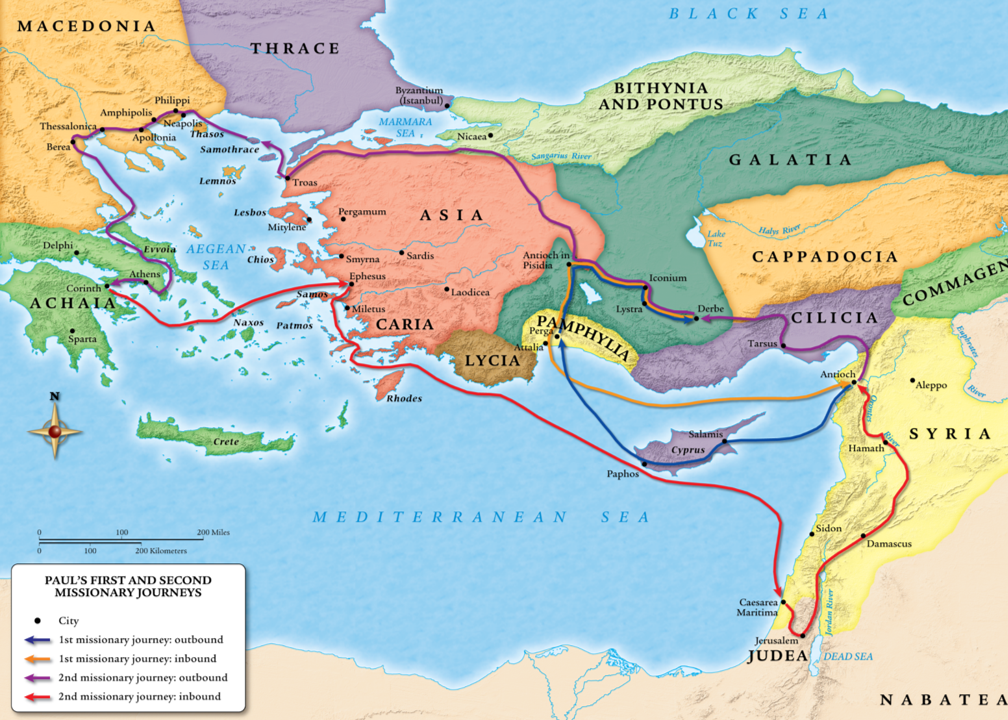
Figure 1: Paul is sailing for Syria because he is homebound. Although he was stop in Judea to attend the feast in Jerusalem, he is returning to his sending church in Antioch. That church is in Syria.
- Cenchrea (or Cenchreae) was Corinth’s eastern seaport on the Saronic Gulf, in the Roman province of Achaia. Luke’s reference to Paul’s haircut functions as a parenthetical explanation: before sailing, Paul had his hair cut because he had taken a vow (Acts 18:18). The association between a vow and uncut hair recalls the Nazirite regulations of Numbers 6:1–21. However, the prescribed completion of the Nazirite vow involved offerings and shaving at the sanctuary (Numbers 6:13–20, especially verse 18). Paul’s cutting of his hair occurred at Cenchrea. While we should exercise caution in identifying the precise nature of his vow, in the context of the ministry in Corinth and in proximity to the earlier promises of the Lord, we may infer. Infer what? The Lord had promised Paul His presence and protection in Corinth (Acts 18:9–10); we may infer that Paul’s vow expressed gratitude for that assurance or a special dedication to the work entrusted to him. Its connection with his departure makes such a reading possible and even likely.
This was probably not a formal Nazirite vow, which could not properly be undertaken outside the Holy Land, but a private vow, the fulfilment of which was an act of thanksgiving—possibly for the divine promise of verse 10, which had been confirmed by his preservation from harm throughout his Corinthian ministry. (Bruce, 1988, p. 355)
- Paul is en route to Jerusalem; he is determined to keep the coming feast. On his way he stops in the city of Ephesus and goes into the synagogue. Paul’s stated principle was that the gospel is “for the Jew first and also for the Greek” (Romans 1:16). His missionary practice reflected that priority: upon entering a city, he ordinarily began by proclaiming Christ in the synagogue (Acts 13:5, 14–16, 46; 14:1; 17:1–2, 10, 17; 18:4). We see this pattern again in Acts 18:19, when he enters the synagogue at Ephesus and reasons with the Jews. But more than a principle is at work; there is a guiding Presence. The Holy Spirit directs Paul’s missionary work (Acts 16:6–10). The apostle is spiritual or Spirit-led. Christ lives in him (Romans 8:14; Galatians 2:20). Paul’s practice of going to the Jews first reflects the priority expressed in Jesus’ own ministry: “the lost sheep of the house of Israel” (Matthew 10:5–6; 15:24). He continues to press on that priority as He lives through Paul.
- The Apostle Paul Has Left the Building – The Jews of the synagogue asked Paul to stay; but he would not consent (Acts 18:20). He had to make it to the coming feast. The feast is unspecified; Paul could have been trying to get back to Jerusalem for Passover. Because the words “I must be all means keep this coming feast in Jerusalem” are absent from the NU text, the identity of the feast should not carry interpretive weight. What matters is that the apostle to the Gentiles has left Ephesus after only reaching out to the Jews. In the absence of this great man of God, how is the ministry going to work?
Return to Worship in Jerusalem, Report in Antioch, and then Back to Work (Acts 18:22-23) — Luke and the Gospel writers commonly describe travelers as going up to Jerusalem (Luke 2:42; 19:28; Acts 11:2; 15:2) and down from Jerusalem to other places (Luke 10:30; Acts 8:5; 15:30). This convention helps explain Luke’s compressed account in Acts 18:22: after landing at Caesarea, Paul went up and greeted the church, indicating a visit to the fellowship in Jerusalem. He then left Jerusalem and is described as having gone down to Antioch. At last, the apostle is back where he began his second missionary journey (Acts 15:35–41).
There was much to share about what had taken place. We can imagine that, in the midst of much teaching, he related the high points of the journey:
| Location | Scripture | Paul’s Account |
|---|---|---|
| Antioch in Syria | Acts 15:36–41 | I proposed revisiting the churches. After Barnabas and I disagreed over taking John Mark, I chose Silas and departed. We traveled through Syria and Cilicia, strengthening the churches. |
| Derbe and Lystra | Acts 16:1–5 | I recruited Timothy to accompany us. As we traveled, we delivered the Jerusalem council’s decisions and strengthened the churches. |
| Troas | Acts 16:6–10 | The Holy Spirit prevented us from preaching in Asia and entering Bithynia. At Troas, I received a vision of a Macedonian man asking for help. We concluded that God had called us to preach in Macedonia. |
| Samothrace and Neapolis | Acts 16:11–12 | We sailed from Troas through Samothrace to Neapolis, then traveled inland to Philippi. |
| Philippi | Acts 16:13–40 | We proclaimed the message, and Lydia believed and welcomed us into her home. I commanded a spirit of divination to leave an enslaved girl. Silas and I were beaten and imprisoned, but God opened the prison doors. The jailer and his household believed. After learning that we were Roman citizens, the magistrates came and asked us to leave. |
| Amphipolis and Apollonia | Acts 17:1 | We passed through these cities on our way to Thessalonica. |
| Thessalonica | Acts 17:1–9 | I reasoned from the Scriptures in the synagogue on three Sabbaths, explaining that the Christ had to suffer and rise from the dead. Some Jews and many Greeks believed, but our opponents attacked Jason’s house. The believers sent us away by night. |
| Berea | Acts 17:10–14 | We entered the synagogue, where our hearers received the message eagerly and examined the Scriptures daily. Many believed. When opponents came from Thessalonica and stirred up trouble, the believers sent me away, while Silas and Timothy remained. |
| Athens | Acts 17:15–34 | Distressed by the city’s idolatry, I reasoned in the synagogue and marketplace. I also addressed the Areopagus, proclaiming the Creator, calling for repentance, and declaring the resurrection. Some mocked, others wanted to hear more, and some believed. |
| Corinth | Acts 18:1–17 | I worked with Aquila and Priscilla and reasoned in the synagogue. After opposition, I taught next door in the house of Justus. Crispus and many Corinthians believed. The Lord encouraged me to keep speaking, and I remained eighteen months teaching God’s word. When my opponents brought me before Gallio, he dismissed their accusation. |
| Cenchrea | Acts 18:18 | I had my hair cut because of a vow. Accompanied by Priscilla and Aquila, I sailed toward Syria. |
| Ephesus | Acts 18:19–21 | I entered the synagogue and reasoned with the Jews. Although they asked me to stay longer, I declined, promising to return if God willed. I departed, leaving Priscilla and Aquila there. |
| Caesarea | Acts 18:22 | I landed at Caesarea and continued inland. |
| Jerusalem | Acts 18:22 | I went up and greeted the church. |
| Antioch in Syria | Acts 18:22 | I went down to Antioch, returning to the church from which I had departed on this journey. |
Paul is an apostle (ἀπόστολος, apostolos) — one sent. He has been called to go. And so, after returning to Antioch and spending time with his sending church, he departs again. Where does he go? Through the regions of Galatia and Phrygia, strengthening (ἐπιστηρίζων, epistērizōn) all the disciples (Acts 18:23), including those in churches established during his first missionary journey.
Paul goes back to the people that have heard and believed, to churches that were previously planted, and to saints he has not seen in a while. His ministry is more than decisions and baptisms. He is engaged in the larger and longsuffering work of leading people to faith, helping them hold on to their commitment, and promoting growth. He is actually headed toward Ephesus (Acts 19:1); he said that he would return them them if God was willing (Acts 18:21). A more direct route to the Ephesians would have been to sail from Antioch to Ephesus. But the man of God is not finished with the work that was begun on his first missionary journey.
He returned to his former fields and further ministered to the churches there. A journey to Ephesus by sea would have been much easier. The foot journey from Antioch to Ephesus was well in excess of 1,000 miles. Paul set a notable example of the importance of continued nurture of new converts. (Polhill, 1992, 395-396)
When I examine my life in the light of this passage a question is raised: Is there anyone that the Lord used me to bring to Him that I should now visit to strengthen?
Apollos Message – Excellent but Incomplete (Acts 18:24-25) — Luke now returns to Ephesus to describe what happened after Paul’s departure. Priscilla and Aquila had remained there, and in the synagogue they heard a dynamic speaker—Apollos. An Alexandrian-born Jew, he was eloquent (λόγιος, logios) and mighty in the Scriptures (δυνατὸς ἐν ταῖς γραφαῖς, dynatos en tais graphais). When Apollos began to expound the scriptures there, the couple heard him and were greatly impressed by the learning and skill which he devoted to the defense of what he knew about the gospel gospel.
For all gospel preachers, calling people to repentance is a major part of the presentation (Jews – Acts 2:38; 319; 5:31; Gentiles – 11:18; 17:30; Everyone – 20:21; Luke 24:47). But it is not enough to appeal for change. There must be the good news of forgiveness and favor through faith in Christ, the better baptism of the Holy Spirit for those that receive Jesus, and the mission of living for Jesus.
Marriage and Ministry Advice (Acts 18:26-28) — However, as they listened, they became aware of some gaps in his knowledge: he knew only the baptism of John. To be sure, Apollos was accurate in what he preached; but he was also incomplete. So they took their brother aside to help him. Out of public view they set forth “the way of God” to him more accurately. The investment of the apostle Paul was beginning to show a return; their time with Paul had culminated in their ability to teach others. This is the aim of discipleship. And we should appreciate and imitate their approach to dealing with deficiency. Bruce says it well:
But Priscilla and Aquila’s procedure was admirable: how much better it is to give such private help to a teacher whose understanding of his subject is deficient than to correct or denounce him publicly! (Bruce, 1988, p. 360)
They may have been left with a commission. Luke does not say whether or not Paul enjoined them to continue his work. Whether the apostle did or not, the mission of helping with evangelism and discipleship was theirs. Why? Because they are people surrendered to Jesus (Matthew 28:18-20); with or without Paul they have a calling to do what they can to make disciples. And together, the bride and groom cast a vision for every marriage comprised of Jesus followers. In them the goal of God for creating the first couple is clearly seen. Priscilla and Aquila collaborate as Christ followers for the glory of God, for the good of His people, and specifically in the cause of Christ. Their marriage matters because it becomes a means for making the message known. Here is what they are saying to us:
Our marriage is more than a sacred symbol of Christ and His Church. We work. See us working together to win the lost and fan the flame of our fellow Jesus follower. In our union we endeavor to encourage evangelism and humbly offer correction when someone’s ministry could be improved.
And then what must we say about Apollos? Look at what the passage says:
- Eloquent or Learned: LOGIOS (λόγιος) — The Greek adjective logios can describe an accomplished speaker or a learned, educated person. In Acts 18:24, Luke presents Apollos as someone gifted in communication and intellectual engagement. This is the only occurrence of logios in the Greek New Testament.
- Mighty or Capable: DYNATOS (δυνατός) — The phrase dynatos ōn en tais graphais (δυνατὸς ὢν ἐν ταῖς γραφαῖς) means “being mighty in the Scriptures.” Apollos was not merely polished in speech; he was capable of understanding, reasoning from, and defending the Scriptures. In Acts 18:28 he powerfully demonstrated from the Scriptures that Jesus is the Christ.
- Teachable Teacher: HUMILITY — Acts 18:25–26 says Apollos taught accurately concerning Jesus but knew only the baptism of John. His instruction was therefore incomplete. Priscilla and Aquila took him aside and explained the way of God more accurately. The narrative portrays him as receptive to further instruction, despite his considerable abilities. The passage does not explicitly detail everything he knew or did not know about the Holy Spirit, so we should avoid overstating that point.
Apollos stands apart from what we normally see in great speakers; this great teacher is still teachable. Apollos had the eloquence to communicate effectively, the scriptural competence to argue convincingly, and the humility to be taught more accurately. His gifts did not make him unteachable; his teachability made his gifts increasingly useful in ministry. Eloquence can make a message compelling. Biblical competence gives it substance. Humility keeps the messenger growing in truth.
Questions for Consideration and Action Items
References
Bruce, F. F. (1988). The Book of the Acts (p. 355). Wm. B. Eerdmans Publishing Co.
Polhill, J. B. (1992). Acts (Vol. 26, pp. 395–396). Broadman & Holman Publishers.