Go Back (Luke 17:11-19)

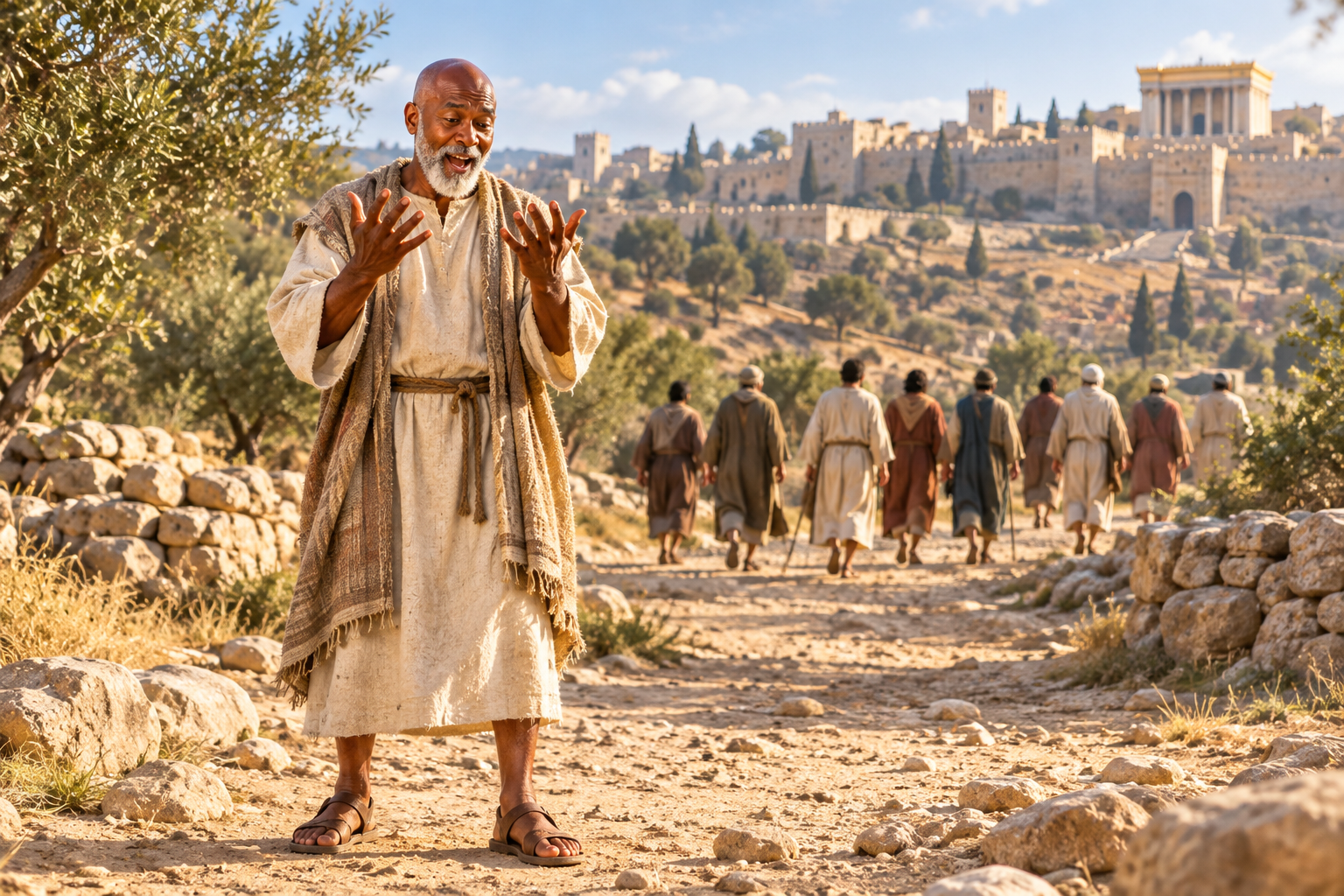
The realization that he had been healed moved the foreigner (Luke 17:15). He interrupted his journey to show himself to the priest in order to show himself grateful to the One who would serve as our great High Priest (Hebrews 4:14–16; 5:5–10). At some point en route, this Samaritan recognized that his body had been healed. What did he notice? Luke does not tell us. But we can consider possibilities while acknowledging what the passage leaves unsaid:

  • Fullness — We do not know how long he had suffered or what damage his condition had caused. Hansen’s disease, one condition associated with the modern term leprosy, can damage nerves, impair vision, and lead to injuries and tissue loss. Luke does not establish this particular diagnosis or describe missing fingers, toes, or eyesight. Nevertheless, we may wonder: Did the man notice a change in his skin? Did movement become easier? Was something visibly restored? Whatever the evidence, he recognized that he had been healed.
  • Feeling — Hansen’s disease can also cause a loss of sensation. Perhaps this man noticed that his hands could feel again. That possibility is an illustration, not a detail supplied by Luke. The certainty is that Jesus had changed his condition, and he knew it.

Whatever it was that he saw—ἰδών (idōn), “having seen” or “when he saw”—he recognized that he had been healed. His healing was not an isolated event. The others had been cleansed as well. Yet Jesus’ questions reveal that only this foreigner returned to give glory to God (Luke 17:17–18). Someone might defend the nine by pointing to Jesus’ command: “Go, show yourselves to the priests” (Luke 17:14). But the Lord’s response makes clear that obedience to that instruction did not make gratitude unnecessary. The Samaritan recognized that the One who had helped him deserved his worship and thanksgiving.

When did you realize that the Lord had answered your prayer? What has changed since Christ began His work in you? Where have you seen His forgiveness, His provision, or His power breaking sin’s hold? And what should it look like when you recognize His handiwork in your own life?

The questions and commentary of Jesus reveal the heart of the Father. Jesus said that whoever has seen Him has seen the Father (John 14:9). In the assessment of the Son, we see the Father’s desire for worshipers who worship in spirit and truth (John 4:23–24). We are reminded of David, who danced before the Lord with all his might and refused to let concern for his royal dignity silence his rejoicing (2 Samuel 6:14, 20–22).

What, then, should we do when we recognize the Lord’s mercy?

  • Go Back (Luke 17:15) — Turn your attention from the gift to the One who graciously gave it. Make time to draw near to Jesus and acknowledge His help.
  • Glorify Openly (Luke 17:15) — Let your words make God’s goodness known to those around you. Be ready to testify about what He has done in your life. Your testimony can encourage others to seek Him. Those who come to God must believe that He exists and that He rewards those who diligently seek Him (Hebrews 11:6).
  • Get Low (Luke 17:16) — Humble yourself before Jesus, remembering that His mercy—not your merit—has helped you. Let your posture and your choices express your dependence on Him.
  • Give Thanks (Luke 17:16) — Name what He has done and personally thank Him for it. Do not let His kindness become so familiar that it goes unacknowledged.

In His grip by His grace,
Roderick L. Barnes, Sr.

The Word of the King and Demons (Matthew 8:16-17)

The Word of the King

The Word of the King and Demons

Passage: Matthew 8:16-17; Mark 1:32-39

16 When evening had come, they brought to Him many who were demon-possessed. And He cast out the spirits with a word, and healed all who were sick, 17 that it might be fulfilled which was spoken by Isaiah the prophet, saying: “He Himself took our infirmities And bore our sicknesses.”

Matthew 8:16 — The people have come to have hope for the seriously sick. By “seriously” I mean those whose maladies went deeper than physical disease. Worse than a body that is broken is a temple that has been taken over and is being tyrannized by an unclean spirit. People in this condition are held hostage in their own tent; in fact, the body no-longer belongs to them but is possessed and controlled by a demon. The demon-possessed are not living but existing; their physical, social, and spiritual lives have been been altered. What does that entail? Well, it varies. But when a person is demon possessed there are some things that are mentioned in the Scriptures:

    • Exceptional Strength and Durability (Mark 5:1-5) – A side effect of demonic possession can be strength and ruggedness exceeding that of human beings. The demon-possessed man mentioned by Mark had often been bound with shackles and chains (Mark 5:3). However, the man pulled them apart and broke the shackles in pieces (Mark 5:4).
    • Unusual Insights Based On Monitoring and Sharing (Acts 16:16-17) – Paul and his companions were followed by a demon-possessed girl who had insights into the mission and message of the team (Acts 16:16-17). Spirits are familiar with Jesus and certain saints; Christians that do damage to demonic realms become notorious among the principalities that are against the Lord (Acts 19:15). Fortune telling is actually the outworking of an evil spirit telling a person things that they have learned or observed as they travel to and fro throughout the earth seeking someone to devour (Job 1:6-7; 1 Peter 5:8); they monitor people (especially saints) looking for opportunities to do damage.
    • Deranged Thinking (Mark 5:5) – Under the influence of an evil spirit the man mentioned above was observed crying out and cutting himself with stones (Mark 5:5). This type of self-harm was the outworking of an unclean spirit that was not supposed to be there.
    • Loss of Faculties (Matthew 9:32-33) – At times the manifestation of a demonic presence was a loss of a basic ability. One man loss the power of speech. When the demon was removed the man was no longer mute.
    • Contentious and Combative toward Community (Matthew 8:28) – An unclean spirit works through the possessed persons and influences saints to disrupt community, create division, and create confusion (James 3:13-16).

Notice that the casting out of demons is distinguished from healing all who were sick (Matthew 8:16). It is wrong to say that what are called demons in the narrative should be regarded in modern times as mere medical issues. General sicknesses and demonic activity are separate in manifestation and treatment.

Failure to recognize the difference between general disease and demonic possession when trying to help can lead to further harm. Why? The difference is significant: (1) demons are sentient beings determined to deceive people and defy the will of God (John 10:10) and (2) diseases are defects in the body, the effects of pathogens, or other problems for which the explanation (if not the cause) is natural. Dealing with demons using modern medicine is like trying to handle a hostage situation with cough drops.

Matthew 8:17 — To what end does Jesus do this? That is, why is He healing people and casting out demons? Matthew, more than any other gospel writer, explicitly mentions that an event or action taken by Jesus was in fulfillment of a prophecy. He does this between 20 to 25 times. In this case, the actions of the Man from Nazareth are to be seen as the realization of something spoken over 700 years prior by Isaiah the prophet.

Let us notice three things about what is taking place.

    1. The Simplicity (Matthew 8:16) – Matthew would have his reader know that Jesus did not struggle to free people from demon-possession. In contrast with the exorcisms performed by the priests, there was no complicated ritual. He says that He cast out the spirits with a word (Matthew 8:16). The unusual authority of Jesus is hereby put on display; the spirits, says Matthew, are entirely subject to Him. If we are to regard the narrative as being both simple and accurate, Jesus did not use many words to exorcise the unclean spirits; he used a [single] word (λόγῳ – noun, dative, singular, masculine). Maybe He said, “Out!” And that, when the King is speaking, is all that is needed.
    2. The Silencing (Luke 4:40-41) – The evil spirits recognize Jesus. But Jesus will not allow them to speak. Why? Insofar as they speak the truth about His identity they gain credibility that will be used for evil thereafter. Jesus will not allow the demons to give people the false impression that He (1) associates with them, (2) accepts their testimony, or (3) approves of their activities. This practice of distancing Himself from spirits of disobedience will be taken up by the apostle Paul (Acts 16:16-18).
    3. The Significance (Isaiah 53:4) – In the physical and spiritual realm Jesus is delivering. People are being delivered from disease and demon-possession. To what end? The work is not merely a wonder. It is a sign. Recall the words of the angel to Jesus’ earthly father: You shall call His name Yeshua for He shall yoshia His people from their sins (Matthew 1:21). The passage in Isaiah also makes repeated mention of the healing ministry of the servant of God (Isaiah 53:4-6, 10-12); in that chapter it is a healing from the consequences of transgressions and indwelling sin (Isaiah 53:5,8,11-12).

Jesus delivered from diseases and, with a word, from demons to demonstrate that He was delivering from the destructive outworking of disobedience.

Failing to believe in the significance and sufficiency of His work leaves me still working to accomplish what I can’t do. Believing this word leads to me receiving the medicine that is the Son of Man and His work to make me healthy. There is a balm in Gilead (Jeremiah 8:22); let us apply it.

Questions for Discussion

    1. Have I seen activity in my life or around me that suggests that demons are at work causing problems?
    2. Am I still trying to treat the symptoms and sickness of of sin with something other that the medicine provided by God (John 8:36)?
    3. When I look at Matthew 4:1-11 and Matthew 8:16-17, what does it say about dealing with demons (1 John 4:4)?