On Thanksgiving (Luke 17:11-19; Daniel 6:1-10)
Preface
In this section I will thank Compass Church and the people who encouraged me to write. Thank you! I will also state the purpose of penning this work and how it is organized. Finally, I will point to resources for people who would like to get more out of the book or who would like to make suggestions.
For my grandmother, Ozella Marshall. You introduced me to Jesus and held out hope that one day I would serve Him. And you gave encouragement in the most important of all spiritual disciplines – prayer. Praying as I go, Grandma.
Part 1 – The One Who Came Back to Give Thanks
Introduction (Luke 17:11-19)
11 Now it happened as He went to Jerusalem that He passed through the midst of Samaria and Galilee. 12 Then as He entered a certain village, there met Him ten men who were lepers, who stood afar off. 13 And they lifted up their voices and said, “Jesus, Master, have mercy on us!” 14 So when He saw them, He said to them, “Go, show yourselves to the priests.” And so it was that as they went, they were cleansed. 15 And one of them, when he saw that he was healed, returned, and with a loud voice glorified God, 16 and fell down on his face at His feet, giving Him thanks. And he was a Samaritan. 17 So Jesus answered and said, “Were there not ten cleansed? But where are the nine? 18 Were there not any found who returned to give glory to God except this foreigner?” 19 And He said to him, “Arise, go your way. Your faith has made you well.”
Praying On Point (Luke 17:11-13)
11 Now it happened as He went to Jerusalem that He passed through the midst of Samaria and Galilee. 12 Then as He entered a certain village, there met Him ten men who were lepers, who stood afar off. 13 And they lifted up their voices and said, “Jesus, Master, have mercy on us!”
Luke 17:11 – Jesus and His disciples are en route from Capernaum to Jerusalem; their Rabbi has firmly decided to go up to The Holy City to be the Passover Lamb (Luke 9:21-22, 28-31; 9:51; ) that takes away the sin of the world (John 1:29, 36). (For those who would like to see a picture of a likely route, see Figure 1: Possible route for final trip of Jesus to Jerusalem in the Maps section.) Instead of going around the region of Samaria, as Jews normally did, Jesus is passing through the midst of the regions of Samaria and Galilee. He is quite unlike His people in this regard (John 4:9); people that Jews will normally avoid and treat with contempt are intentionally engaged and loved by Jesus (John 4:31-42).
Luke 17:12 – Going through the mentioned regions takes him through the towns of Gentiles (Isaiah 9:1; Matthew 4:15) and people with Jewish and non-Jewish ancestry (Samaritans). This is why He entered a certain village (Luke 17:12); it is on the way to the City of David. Outside this certain village, whether it was a Galilean village or Samaritan village is not what matters, were ten men (GK) who were lepers (GK). They were not in the village but could be met as Jesus entered; Galilean Jews that held to the law of Moses would not have allowed the men to be in community (Leviticus 13:46; Numbers 5:2).
Luke 17:13 – Luke’s account of how they reached out to Jesus indicates that there was distance between the lepers and Jesus (Luke 17:12–13). This accords with what is known of what the Law required (Leviticus 13:45–46; Numbers 5:1–4) and other mentions of lepers in the Old Testament.
| Passage | What it shows |
|---|---|
| Leviticus 13:45–46 | The law required a person with leprosy to call out “Unclean! Unclean!” and live outside the camp while the condition persisted. This passage gives both the warning and the separation requirements. |
| Numbers 5:1–4 | The Lord commanded Israel to put people with leprosy and others who were ceremonially unclean outside the camp, where He dwelt among His people. Israel carried out the command. |
| Numbers 12:14–15 | Miriam was shut outside the camp for seven days. The people waited for her to be received back before continuing their journey. |
| 2 Kings 7:3 | Four men with leprosy sat at the entrance to Samaria’s gate during the siege. Their location illustrates life at the edge of the community. |
| 2 Kings 15:5 | King Azariah lived in a separate house after being struck with leprosy. His son Jotham took charge of the royal household and governed the people. |
| 2 Chronicles 26:21 | The parallel account calls the king Uzziah and adds that he was cut off from the house of the Lord. His separation affected both public life and worship. |
| Psalm 38:11 | The psalmist describes friends and relatives keeping their distance because of his affliction. The verse illustrates the social isolation that could accompany illness. |
“Lepers were compelled by law to keep their distance… and these did. But they came as near as they dared and shouted an appeal for help. They did not ask specifically for healing, but simply for mercy.” (Morris, 1988, p. 275) Three things stand out in the calling out of the lepers. First, they call Him by name. His fame has spread and people know about the teacher and healer called Jesus (Ἰησοῦ, Iēsou, the form used in direct address). His name means the Lord saves, and Matthew connects it to His mission to save His people from their sins (Matthew 1:21). Thus, they were calling out for mercy to the One who saves.1 Second, consider the title placed alongside his name: Master (ἐπιστάτα, epistata, the vocative of ἐπιστάτης, epistatēs). This is a distinctive of Luke’s gospel.2 Five times the disciples use this term when addressing Jesus (Luke 5:5; 8:24, 45; 9:33, 49). The ten lepers also use this term. When used in address it indicates that the person speaking regards Jesus as having authority. (In parallel scenes, Mark uses διδάσκαλε, didaskale, in Mark 4:38 and 9:38, and ῥαββί, rhabbi, in Mark 9:5.) Luke records a ruler and several religious leaders addressing Jesus as Teacher (διδάσκαλε, didaskale; Luke 7:40; 10:25; 11:45; 18:18; 19:39; 20:21, 28, 39); there is no example of a ruler in Luke’s gospel calling Jesus Master; and those that call him Teacher do so as a professional courtesy and as insincere show of respect before attacking Him. Luke is telling us that the lepers are similar to the disciples of Jesus in the way they refer and regard Him; both confess His authority.
Third, among those things that stand out in the pleading of the lepers, is their request — mercy (ἐλέησον, eleēson, “have mercy,” from ἐλεέω, eleeō). In Luke’s gospel there are three requests for mercy. I have put them in a table for you:
| Passage | Who Asks and What They Ask For |
|---|---|
| Luke 16:24 | The rich man cries, “Father Abraham, have mercy on me.” He asks for relief from his torment and uses the same verb as the ten men in Luke 17:13, ἐλέησον (eleēson). |
| Luke 18:13–14 | The tax collector stands afar off and prays, “God, be merciful to me a sinner!” He uses ἱλάσθητί (hilasthēti). Jesus says he goes home justified.3 |
| Luke 18:38–43 | The blind man near Jericho twice asks Jesus, the Son of David, to have mercy on him. He uses ἐλέησον (eleēson). When Jesus restores his sight, he follows Him, glorifying God. |
In each of these cases the one requesting mercy sees the truth about himself. The rich man has a realization of his need for help (Luke 16:24), the tax collector a recognition of his tremendous debt and spiritual poverty (Luke 18:13-14), and the blind man near Jericho has clear vision about his own brokenness and only hope for being fixed (Luke 18:38-43). Each is broken and knows it. This type of brokenness is a prerequisite to being healed, to being helped, and to getting an answer from God (Psalm 34:18; Psalm 51:17; Isaiah 57:15).
Our prayers reveal how we see ourselves. The Pharisee believed he was righteous, so he asked for nothing (Luke 18:9–12). The tax collector saw the glaring truth about his own sin, so he pleaded for mercy (Luke 18:13). The ten lepers watched as a disease they could do nothing to stop ravaged their bodies. They knew how desperately they needed help, and they believed Jesus had the authority to heal them. So they prayed on point. “Jesus, Master, have mercy on us!” (Luke 17:13).
To pray on point, we must face two truths. First, we must see and accept our own need (Matthew 5:3). When we fail to see our need, we ask for the wrong thing or nothing at all. Second, we must believe that Jesus has the authority to help us (Matthew 28:18). When we fail to recognize His authority, we look elsewhere for help. When we see our need and trust His authority, we ask for the right thing from the right Person.
Create the Context for Divine Intervention (Luke 17:14-16)
14 So when He saw them, He said to them, “Go, show yourselves to the priests.” And so it was that as they went, they were cleansed. 15 And one of them, when he saw that he was healed, returned, and with a loud voice glorified God, 16 and fell down on his face at His feet, giving Him thanks. And he was a Samaritan.
Luke 17:14 – Jesus does not touch the men. He does not say “be cleansed.” And the leprosy does not leave immediately (Luke 5:13). He gave them directions from the law about what to do when someone has been cured of leprosy (VR). In response to His command there may have been a moment of hesitation and confusion. “What, Master? Show ourselves to the priest? Uh, why would we do that?” Whatever their initial response, ultimately they obeyed. That is, they heeded the one they called Master. And something happened in their going; their prayer was answered as they went (GK). “Jesus was putting their faith to the test by asking these men to act as though they had been cured. And as they obeyed so it happened: as they went they were cleansed “(Morris, 1988, p. 275). This is not an isolated incident. There are other times in Scripture were a problem is addressed with a peculiar prescription.
| Event (Reference) | Problem, Peculiar Prescription, and Obedience | Delayed Outcome |
|---|---|---|
| The Wedding at Cana (John 2:1–11) | Problem: The wedding feast ran out of wine. Peculiar Prescription: Jesus told the servants to fill six stone waterpots with water, then draw some out and take it to the master of the feast. Obedience: They filled the pots to the brim and took what they drew to the master. |
The servants filled the pots, drew from them, and carried what they drew to the master of the feast. When he tasted it, the water had become wine. |
| Naaman (2 Kings 5:9–14) | Problem: Naaman had leprosy. Peculiar Prescription: Elisha told him to wash seven times in the Jordan. Naaman expected Elisha to come out and heal him in person. Obedience: After listening to his servants, Naaman went down and dipped seven times in the Jordan. |
Naaman’s flesh was restored after he went down to the Jordan and dipped seven times, as Elisha had instructed. |
| The Man Born Blind (John 9:1–7) | Problem: The man had been blind from birth. Peculiar Prescription: Jesus put clay on his eyes and told him to wash in the pool of Siloam. Obedience: He went to the pool and washed. |
The man still had to go to Siloam and wash. After he washed as Jesus instructed, he came back seeing. |
| Simon Peter and the Catch of Fish (Luke 5:1–7) | Problem: Simon and his companions had fished all night and caught nothing. Peculiar Prescription: Jesus told Simon to go out into deep water and let down the nets for a catch. Obedience: Simon told Jesus about the fruitless night, then let down the nets at His word. |
After Simon and his companions let down the nets at Jesus’ word, they caught so many fish that they needed help from the other boat. |
| The Widow of Zarephath (1 Kings 17:8–16) | Problem: The widow had only enough flour and oil for one last meal for herself and her son. Peculiar Prescription: Elijah told her to make him a small cake first, then prepare food for herself and her son. Obedience: She went and did as Elijah said. |
After she used her scarce provisions as Elijah directed, she and her household ate for many days. The flour and oil held out, just as the Lord had promised. |
Naaman and the man born blind are the closest parallels to Luke 17:14. In each account, obedience was the context for the desired outcome. Naaman dipped, the blind man washed, and the ten went to show themselves to the priests. Luke makes the timing explicit in the words as they went, they were cleansed. In each case presented in the table above, help arrived in the context of obedience. Naaman would not have been healed had he not obeyed. The wedding would have been without wine if the servants had not been willing to obey Jesus. And the lepers are healed as they went.
At times the peculiar prescriptions of God are required for receiving His mercy. In obedience to the commands of Christ I create the context to end my crisis and receive my cure. In my mind I have been waiting on God. In reality it may be that God is waiting on me. Divine intervention is sometimes only found on the other side of radical obedience.
Have we missed a blessing because we have yet to obey a peculiar prescription from the Lord? What has He already told us to do that we’re waiting to do until we see how things turn out?
Luke 17:15 – As they went, the cleansing took place. At some point on the way to the priests, one of the ten realized that he had received what he had hoped for. Luke describes his response in two parts. First, the man returned (ὑπέστρεψεν, hypestrepsen). The verb is an aorist indicative. Luke presents the return as a whole event. Second, Luke tells us what the man was doing as he returned. He was glorifying God (δοξάζων τὸν θεόν, doxazōn ton theon).
The NKJV uses the simple past glorified God. But look at how it translates the same expression in two other healing accounts. The paralyzed man goes home glorifying God (Luke 5:25). The blind man near Jericho receives his sight and follows Jesus, glorifying God (Luke 18:35–43, especially vv. 42–43). Luke uses δοξάζων (doxazōn), a present active participle, in all three passages. I would render verse 15 this way:
¹⁵ And one of them, when he saw that he was healed, returned, glorifying God with a loud voice as he went back.
If you want to learn Greek, don’t come to me. But I think rendering the phrase consistently helps us hear the scene. The man sees that he has been healed, turns around, and raises his voice in praise on the way back to Jesus. Notice his response to the work of God in his life – worship.
Luke 17:16 – Upon meeting Jesus the healed man bows down. That is, he falls down on his face at the feet of Jesus. He is prostrate in praise before Heaven’s Prince. While he is in this position the man made right is giving thanks. His face is down but going up from him is thanksgiving. There is one more thing that Luke would have us to know about this man: And he was a Samaritan.
And he was a Samaritan (και αὐτος ἠν Σαμαρειτης [kai autos ēn Samareitēs]). This touch colours the whole incident. The one man who felt grateful enough to come back and thank Jesus for the blessing was a despised Samaritan. The αὐτος [autos] has point here. (Robertson, 1933)
The one who came back to give thanks was of a despised people with a corrupted belief system. Jesus, tell us what to think about this? Help us, Lord, see the point being made and the relevance to our lives before you.
Receive Salvation by Grace through Faith in Christ (Luke 17:17-19)
17 So Jesus answered and said, “Were there not ten cleansed? But where are the nine? 18 Were there not any found who returned to give glory to God except this foreigner?” 19 And He said to him, “Arise, go your way. Your faith has made you well.”
Acts 17:17-18 – The conjunction of verse 17 introduces Jesus’ answer and assessment of what Luke presents. We should imagine that the twelve are with Him as all of this is taking place. They would likely have been present at the scene when the lepers who stood afar off begged for mercy. And they would have heard the Master tell the lepers to go and show themselves to the priest. Now they are with Jesus as this Samaritan approaches with a loud voice glorifying God. I imagine the Samaritan saying something like this:
“Give thanks to the Lord, for His mercy endures forever! And his kindness is to those who are near and to those who are lightly esteemed, stricken, and rejected. Praises to God!”[EN – Someone will go away from this book and say that I have added to Scripture. May there also be someone to say that I prefaced this by saying “I imagine the Samaritan saying something like this.”]
The answer of Jesus is to the disciples with him. He is teaching them something through his three questions.
- Question 1 – Were there not ten cleansed? We are made to see in the question of Jesus that He was not unaware of the number that requested his help. What may have appeared to be just a group was a gathering of ten individuals. In a group of people making their requests known to God, there is an accounting by God of each one. What may appear to be a crowd is seen by God in its details.
- Question 2 – But where are the nine? Through this question the expectations of God on his people are revealed. Jesus, friend, is the image of the invisible God and when we have seen Him we have seen the Father. Through his question the Son of God reveals that the returning group is missing people. The nine who did not return are missed.
- Question 3 – Were there not any found who returned to give glory to God except this foreigner? It is implied that of the ten, the nine called by His name were supposed to be first in praise, lead the way in worship, and be greater in giving God glory. Instead a foreigner is demonstrating the greatest gratitude and has accomplished the ask of giving God glory.
Through his questions Jesus is saying that, contrary to the Jews seeing themselves as somehow superior in their devotion to God, Jesus reveals them as failing to meet the basic expectation of giving thanks and glory to God.
Acts 17:19 – While the NKJV has Jesus telling the Samaritan that his faith has made him well (GK), it does not seem to be the best translation… to me. I think “Your faith has saved you” is a stronger reading for two reasons. First, it is more logical in the narrative. Luke has already told us that all ten were cleansed (Luke 17:14) and that the Samaritan saw that he was healed (v. 15). By the time Jesus speaks in verse 19, Jesus, the Samaritan, and the reader know that the man has been healed. To say that his faith had made him physically well says nothing new to the man or the reader. To tell the healed man that his faith has made him physically well implies that the outworking of the man’s faith in Jesus (or His word) was remediation of the problems in his body: “Your faith has delivered you from the disease that was destroying you.” That is not the point of the gospel and Jesus has not come to save people from sickness; He came to save from sin (Matthew 1:21).
Second, to read the underlying Greek as “Your faith has saved you” is more consistent. Luke 7:50 is especially important here. Jesus says the same words to the woman whose sins He has just declared forgiven: , “Your faith has saved you” (ἡ πίστις σου σέσωκέν σε, hē pistis sou sesōken se). In Luke 17, the Samaritan has already seen the changes in his own body body (Luke 17:15). Jesus’ words disclose a spiritual reality that the leper would not have known on his own.
Luke has already told us that all ten lepers were cleansed and that the Samaritan saw that he was healed (Luke 17:14–15). A physical-only reading makes Jesus’ final words pleonastic. It has Him merely repeat what Luke has established and the Samaritan already knows. Jesus’ words, “Your faith has made you well” (Luke 17:19), are best heard as assurance of salvation. Through what he experienced and what Jesus declared, the Samaritan learned firsthand what Jesus told another Samaritan, “Salvation is of the Jews” (John 4:22). The Jewish Messiah had saved him. The same truth holds for us. We are saved by grace through faith in Jesus Christ (Ephesians 2:8–9).
Conclusion
| Takeaway | Action Items |
|---|---|
| Pray on point (Luke 17:11–13) | Recognize your need and trust Jesus’ authority to help. Name one need you have been trying to handle on your own and ask Jesus for mercy. |
| Obey as you go and return to give thanks (Luke 17:14–18) | Take one step of obedience Jesus has already made clear in Scripture, even while you wait for an answer. Name a mercy you have received, thank Jesus for it, and tell someone what He did. |
| Receive salvation by grace through faith in Christ (Luke 17:19; Ephesians 2:8–9) | Bring your sin to Jesus and trust Him to save you. Give Him thanks for the salvation He gives by grace. |
References
Arndt, W., Danker, F. W., Bauer, W., & Gingrich, F. W. (2000). In A Greek-English lexicon of the New Testament and other early Christian literature (3rd ed.). University of Chicago Press.
Martin, J. A. (1985). Luke. In J. F. Walvoord & R. B. Zuck (Eds.), The Bible Knowledge Commentary: An Exposition of the Scriptures (Vol. 2). Victor Books.
Morris, L. (1988). Luke: an introduction and commentary (Vol. 3). InterVarsity Press.
Robertson, A. T. (1933). Word Pictures in the New Testament (Lk 17:16). Broadman Press.
Endnotes
- And whoever calls on the name of the Lord shall be saved (Joel 2:32; Acts 2:21; Romans 10:13). Because God cannot lie there is now the expectation that they will be saved. ↩
- This term is used in secular writings. Where? Aristaeus the tutor of Dionysus is called Master. Olympus the tutor of Zeus is called Master. Pherecydes the teacher of Pythagoras is called Master. They are all called ἐπιστάτης. (Arndt, 2000, p. 381) ↩
- Let us compare ἐλέησον (Luke 16:24) to ἱλάσθητί (Luke 18:13). Both are translated mercy. The verb ἐλεέω becomes in ἐλέησον Luke 16:24. It has the connotation of showing compassion by moving to help someone in desperate need; it is to render relief to someone that is suffering or to provide what is needed for someone dealing with physical or financial setback. The verb ἱλάσκομαι is also translated mercy. It carries the idea of a changed attitude toward someone who is at fault; anger or wrath is removed and replaced with a disposition of being favorably inclined. The tax collector asked for a change of disposition toward himself in light of what he deserved. Be propitiated toward me, a person that has rebelled against you. ↩
Part 2 – Steadfast and Immovable in Giving Thanks
Introduction (Daniel 6:1-10)
1 It pleased Darius to set over the kingdom one hundred and twenty satraps, to be over the whole kingdom; 2 and over these, three governors, of whom Daniel was one, that the satraps might give account to them, so that the king would suffer no loss. 3 Then this Daniel distinguished himself above the governors and satraps, because an excellent spirit was in him; and the king gave thought to setting him over the whole realm. 4 So the governors and satraps sought to find some charge against Daniel concerning the kingdom; but they could find no charge or fault, because he was faithful; nor was there any error or fault found in him. 5 Then these men said, “We shall not find any charge against this Daniel unless we find it against him concerning the law of his God.”
6 So these governors and satraps thronged before the king, and said thus to him: “King Darius, live forever! 7 All the governors of the kingdom, the administrators and satraps, the counselors and advisors, have consulted together to establish a royal statute and to make a firm decree, that whoever petitions any god or man for thirty days, except you, O king, shall be cast into the den of lions. 8 Now, O king, establish the decree and sign the writing, so that it cannot be changed, according to the law of the Medes and Persians, which does not alter.” 9 Therefore King Darius signed the written decree.
10 Now when Daniel knew that the writing was signed, he went home. And in his upper room, with his windows open toward Jerusalem, he knelt down on his knees three times that day, and prayed and gave thanks before his God, as was his custom since early days.
Faithful in the Work (Daniel 6:1–5)
1 It pleased Darius to set over the kingdom one hundred and twenty satraps, to be over the whole kingdom; 2 and over these, three governors, of whom Daniel was one, that the satraps might give account to them, so that the king would suffer no loss. 3 Then this Daniel distinguished himself above the governors and satraps, because an excellent spirit was in him; and the king gave thought to setting him over the whole realm. 4 So the governors and satraps sought to find some charge against Daniel concerning the kingdom; but they could find no charge or fault, because he was faithful; nor was there any error or fault found in him. 5 Then these men said, “We shall not find any charge against this Daniel unless we find it against him concerning the law of his God.”
Daniel 6:1–2 — Darius’ Administration. By the time we reach chapter 6, Nebuchadnezzar is gone. Belshazzar had failed to heed what God had taught Nebuchadnezzar about pride (Daniel 4:34–37; 5:18–24, 30–31). Darius the Mede received the kingdom at sixty-two and appointed 120 satraps and three governors. Daniel was one of the three. The satraps were to report to the governors so that the king would suffer no loss.
Daniel 6:3 — Daniel Is Distinguished. Daniel had served under foreign rulers since his youth (Daniel 1:3–6). In old age he was still distinguishing himself above the governors and satraps. Why was he doing such good work at a time when we might expect him to be feeding pigeons in the park and putting together puzzles? The text tells us that an excellent spirit was in him (Daniel 5:12; 6:3). The quality of his inner life showed up in the quality of his work. Darius was considering putting him over the whole realm.
Question (1) — When my youthful vigor has evaporated, will the quality of what remains inside distinguish me for good or bad?
Question (2) — How does one cultivate an excellent spirit?
Daniel 6:4 — Professionally and Personally. His coworkers began looking for a charge against him concerning the kingdom. Daniel’s work could bear scrutiny. They found neither corruption nor negligence because he was faithful. When they turned their attention to his devotion, they found that it was as dependable as his work.
Leading a life of loving God is the best protection against haters in the hunt for a way to harm you and against wicked people who want a weapon against you.
Daniel 6:5 — The Character of Daniel’s Commitment to God. Even Daniel’s enemies knew where his allegiance lay. They expected his obedience to the law of his God to be so consistent that they could use it to predict what he would do. They set out to make faithfulness itself the offense (Miller, 1994, p. 184).
Daniel’s commitment to God was not concealed.
Daniel’s commitment to God was not contrived.
Daniel’s commitment to God was consistent.
Daniel’s commitment to God was not comfortable.
Daniel’s commitment to God was not convenient.
Faithfulness Under Pressure (Daniel 6:6–9)
6 So these governors and satraps thronged before the king, and said thus to him: “King Darius, live forever! 7 All the governors of the kingdom, the administrators and satraps, the counselors and advisors, have consulted together to establish a royal statute and to make a firm decree, that whoever petitions any god or man for thirty days, except you, O king, shall be cast into the den of lions. 8 Now, O king, establish the decree and sign the writing, so that it cannot be changed, according to the law of the Medes and Persians, which does not alter.” 9 Therefore King Darius signed the written decree.
Daniel 6:6–9 — A Decree Designed to Trap Daniel. The officials presented their proposal as the agreement of all the governors and administrators. Daniel was one of the governors, and the narrative gives no indication that he consented. For thirty days no one could petition any god or man except Darius. The penalty was the lions’ den. Darius signed the decree under a rule that bound even the king. Only later did he see what the officials had done and labor to rescue Daniel (Daniel 6:12–14; Miller, 1994, p. 184).
The decree gave Daniel a choice he had already settled in his daily practice. What the officials thought would make him abandon prayer exposed how deeply prayer had become part of his life.
Praying and Giving Thanks (Daniel 6:10–11)
10 Now when Daniel knew that the writing was signed, he went home. And in his upper room, with his windows open toward Jerusalem, he knelt down on his knees three times that day, and prayed and gave thanks before his God, as was his custom since early days.
Daniel 6:10 — Daniel’s Unwavering Commitment. When Daniel knew the writing had been signed, he went home and prayed and gave thanks before his God. Notice five things about his praying.
- The Place of His Praying — Daniel used his home for prayer. We often hear complaints about prayer being taken out of the schools. But who took it out of the home?
- The Posture of His Praying — He knelt. His body expressed the surrender and reverence of his heart (Psalm 95:6; Luke 22:41; Acts 9:40; Ephesians 3:14).
- The Perseverance of His Praying — He prayed three times that day, as he had from his early days (Daniel 6:10; Luke 5:16).
- The Purpose of His Praying — Daniel brought his needs to God and thanked Him. The decree was still in force, and Daniel already had reason to give thanks (Daniel 6:10–11).
- The Particular Direction of His Praying — Daniel faced Jerusalem. Solomon had prayed that when God’s people were in captivity and turned toward their land, city, and temple, God would hear them (1 Kings 8:44–50; Miller, 1994, p. 184).
The direction was a decision designed to promote devotion.
Daniel’s decision raises a question about civil authority. Scripture calls believers to be subject to governing authorities (Romans 13:1–2). When authorities require disobedience to God, the apostles give the governing principle in Acts 5:29. Daniel obeyed God through the same quiet practice he had kept for years.
Daniel 6:11 — Caught Calling on God. The officials found Daniel praying and making supplication. His devotion did not depend on the political climate, the disposition of the opposition, or the laws of the land.
Looking Ahead (Daniel 6:12–28)
Darius realized too late that the officials had used his decree against Daniel. When he sent Daniel to the den, even the king could describe him as a man who served his God continually (Daniel 6:14–16). God sent His angel and shut the lions’ mouths. Daniel was lifted out without injury because he believed in his God (Daniel 6:21–23; Hebrews 11:33). The king who had claimed every petition for himself now proclaimed that Daniel’s God is the living God whose kingdom will endure (Daniel 6:25–27; Pentecost, 1985, pp. 1348–1349).
The evil intent of Daniel’s enemies was employed in God’s efforts to evangelize the lost (Genesis 50:20). Persecutors participated and played a key part in proving that (1) the God of Daniel is the living God (Daniel 6:26), (2) God cares for His people (Daniel 6:27), and (3) unwavering commitment was the basis for collaborating with God to change the world.
What is our unwavering commitment to? Let it be just Jesus. Daniel’s example calls us to follow Him openly, to pray consistently, and to give thanks while the outcome is still in His hands.
Conclusion
| Takeaway | Action Items |
|---|---|
| Be faithful in the work entrusted to you (Daniel 6:1–5) | Review one responsibility at work or at home. Correct what needs correcting and follow through on what you promised. |
| Recognize when pressure tests your allegiance (Daniel 6:6–9) | Name a situation where going along could cost you an act of obedience. Decide now how you can respond respectfully and remain faithful to God. |
| Build a habit of prayer before trouble comes (Daniel 6:10) | Choose regular times to pray this week. Put them on your calendar and keep them, starting today. |
| Give thanks while the trouble is still before you (Daniel 6:10) | Bring one unresolved concern to God today. In that same prayer, name one way He has already cared for you and thank Him for it. |
Endnotes
References
Miller, S. R. (1994). Daniel (Vol. 18). Broadman & Holman Publishers.
Pentecost, J. D. (1985). Daniel. In J. F. Walvoord & R. B. Zuck (Eds.), The Bible knowledge commentary: An exposition of the Scriptures (Vol. 1). Victor Books.
Part 3 – Final Title
Introduction
Section 1 ()
Section 2 ()
Section 3 ()
Conclusion
Endnotes
References
Glossary
The New Testament passage is in Greek. Daniel 6 falls within the Biblical Aramaic portion of Daniel (Daniel 2:4b–7:28). Hebrew forms are included where they help identify shared names.
Greek Words in Luke 17:11–19
- λεπροί (leproi) — “Leprous.” This describes the ten men in Luke 17:12. The biblical category of leprosy covered a range of skin conditions.
- πόρρωθεν (porrōthen) — “From a distance” or “afar off.” The ten men stood at a distance when they called to Jesus (Luke 17:12–13).
- Ἰησοῦ (Iēsou) — “Jesus.” Here the men use the form of His name used in direct address (Luke 17:13). The name is related to Hebrew יֵשׁוּעַ (Yēšūaʿ). Matthew 1:21 connects His name with His mission to save His people.
- ἐπιστάτα (epistata) — “Master.” This is the form of ἐπιστάτης (epistatēs) used in direct address. The ten appeal to Jesus as someone with authority to help (Luke 17:13).
- ἐλέησον (eleēson) — “Have mercy.” An aorist active imperative of ἐλεέω (eleeō). The men ask Jesus to show compassion by acting on their behalf (Luke 17:13).
- ἱερεῦσιν (hiereusin) — “To the priests.” Jesus sends the men to show themselves to the priests, who had a role in examining skin conditions and confirming ceremonial cleanness (Luke 17:14; Leviticus 13–14).
- ἐκαθαρίσθησαν (ekatharisthēsan) — “They were cleansed.” An aorist passive indicative of καθαρίζω (katharizō). All ten received cleansing as they went (Luke 17:14, 17).
- ἰάθη (iathē) — “He was healed.” An aorist passive indicative of ἰάομαι (iaomai). The Samaritan saw that his healing had already taken place (Luke 17:15).
- ὑπέστρεψεν (hypestrepsen) — “He returned.” An aorist active indicative of ὑποστρέφω (hypostrephō). One of the ten turned back to Jesus (Luke 17:15).
- δοξάζων (doxazōn) — “Glorifying.” A present active participle of δοξάζω (doxazō). The man was giving glory to God as he returned (Luke 17:15).
- εὐχαριστῶν (eucharistōn) — “Giving thanks.” A present active participle of εὐχαριστέω (eucharisteō). The Samaritan thanked Jesus at His feet (Luke 17:16).
- Σαμαρίτης (Samaritēs) — “Samaritan.” A member of the Samaritan community, whose worship was associated with Mount Gerizim (Luke 17:16; John 4:9, 20).
- ἀλλογενής (allogenēs) — “Foreigner.” Jesus uses the word for the Samaritan who came back to give glory to God (Luke 17:18).
- πίστις (pistis) — “Faith” or “trust.” Jesus identifies the man’s faith in His final declaration (Luke 17:19).
- σέσωκέν (sesōken) — “Has saved” or “has made well.” A perfect active indicative of σῴζω (sōzō). The verb can describe rescue, healing, or salvation. This commentary reads Jesus’ declaration (Luke 17:19) in light of the same wording in Luke 7:50.
Greek Grammar in Luke 17:11–19
- Aorist — Presents an action as a whole. In the indicative it commonly refers to a past event. For example, ὑπέστρεψεν (hypestrepsen), “he returned,” presents the Samaritan’s return as one event (Luke 17:15).
- Perfect — Commonly presents a completed action with a resulting state or effect in view. For example, σέσωκέν (sesōken) in Luke 17:19 presents the saving action with its result in view as Jesus speaks.
- Imperfect — Presents a past action or state as ongoing, unfolding, or repeated, depending on context. For example, διήρχετο (diērcheto), “He was passing through,” gives the setting for the encounter (Luke 17:11).
- Participle — A verbal form that can describe someone or something or explain the circumstances of a main action. It takes forms such as present and aorist. In Luke 17:15, the aorist participle ἰδών (idōn), “when he saw,” gives the occasion for the man’s return. The present participle δοξάζων (doxazōn), “glorifying,” describes what he was doing as he returned.
Biblical Aramaic in Daniel 6
- אֲחַשְׁדַּרְפְּנַיָּא (ʾaḥashdarpenayyā) — “Satraps.” Provincial officials under the king. Darius appointed 120 and placed three governors over them (Daniel 6:1–2).
- סָרְכִין (sārekhīn) — “Governors” or “administrators.” These three officials received reports from the satraps. Daniel was one of them (Daniel 6:2).
- מִתְנַצַּח (mitnaṣṣaḥ) — “Distinguishing himself.” Together with הֲוָא (hawāʾ), the participle portrays Daniel as standing out among the officials (Daniel 6:3).
- רוּחַ יַתִּירָא (rūaḥ yattīrā) — “An excellent spirit.” The narrative gives this as the reason Daniel distinguished himself (Daniel 6:3).
- עִלָּא (ʿillā) — “Ground for a charge.” Daniel’s opponents searched for a basis to accuse him (Daniel 6:4–5).
- דָּת (dāt) — “Law.” In Daniel 6:5 it refers to the law of Daniel’s God. In Daniel 6:8 it refers to the law of the Medes and Persians.
- קְיָם (qeyām) — “Statute.” The officials sought to establish a royal statute restricting petitions for thirty days (Daniel 6:7).
- כְּתָבָא (ketāvā) — “The writing” or “the written decree.” Daniel knew it had been signed when he went home to pray (Daniel 6:9–10).
- בָּרֵךְ (bārēkh) — “Kneeling.” The word describes Daniel’s posture in his upper room (Daniel 6:10).
- מְצַלֵּא (meṣallēʾ) — “Praying.” A participle in the description of Daniel’s regular practice (Daniel 6:10).
- מוֹדֵא (mōdēʾ) — “Giving thanks.” The participle describes what Daniel did before God alongside praying, even after the decree had been signed (Daniel 6:10).
- מִתְחַנַּן (mitḥannan) — “Making supplication” or “pleading for favor.” This describes Daniel asking God for help when the officials found him (Daniel 6:11).
- אֱלָהֵהּ (ʾelāhēh) — “His God.” Daniel kept bringing his prayers and thanksgiving before the God to whom he was devoted (Daniel 6:10–11).
- דָּנִיֵּאל (Dāniyyēl) — “Daniel,” a name meaning “God is my judge.” The name appears in both the Hebrew and Aramaic portions of the book (Daniel 1:6; 6:2).
Places and Regions
- Jerusalem — The city of the temple in Judah. Greek Ἰερουσαλήμ (Ierousalēm), Hebrew יְרוּשָׁלַיִם (Yerūšālayim), and Aramaic יְרוּשְׁלֶם (Yerūšəlem). Jesus was traveling toward it, and Daniel prayed facing it from exile (Luke 17:11; Daniel 6:10; 1 Kings 8:44–49).
- Samaria — In Luke 17:11, the region between Galilee and Judea associated with the Samaritans. The name also refers elsewhere to the former capital of the northern kingdom of Israel (1 Kings 16:24).
- Galilee — The northern region of the land of Israel associated with much of Jesus’ early ministry. Luke mentions it alongside Samaria on the journey to Jerusalem (Luke 4:14–16; 17:11).
- Capernaum — A town on the northwestern shore of the Sea of Galilee and a center of Jesus’ ministry. The post discusses it as part of the broader journey (Luke 4:31; 17:11).
- Jericho — A city in the Jordan Valley near the northern end of the Dead Sea. Luke’s account of the blind man near Jericho supplies another example of calling for mercy and glorifying God (Luke 18:35–43).
- The unnamed village — The settlement Jesus was entering when the ten men met Him. Luke gives its setting along the journey and leaves its name unspecified (Luke 17:11–12).
- Babylon — An ancient city on the Euphrates in present-day Iraq and the capital of the empire that took Judeans into exile. It provides the setting for Daniel’s years of service under successive rulers (Daniel 1:1–7; 5:30–31).
- Media and Persia — Ancient regions of the Iranian plateau associated with the Medes and Persians. Daniel 6:8 names their law in explaining why the officials insisted the decree could stand.
For further study, see the Greek text of Luke 17, the Aramaic interlinear for Daniel 6:10, and William D. Mounce’s guide to Greek participles.
Maps
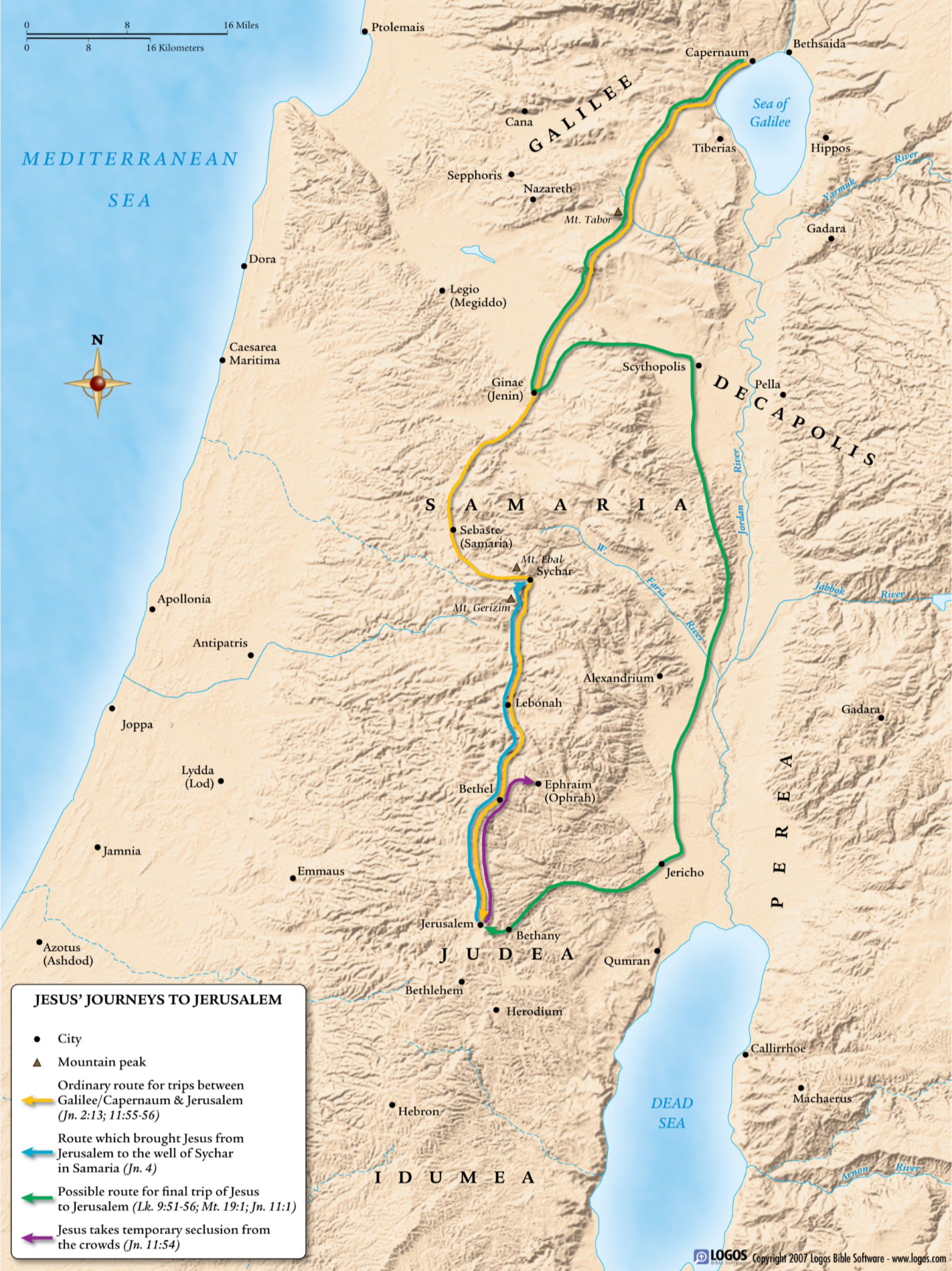
Figure 1: Possible route for final trip of Jesus to Jerusalem (Luke 9:51-56; Matthew 19:1; John 11:1)